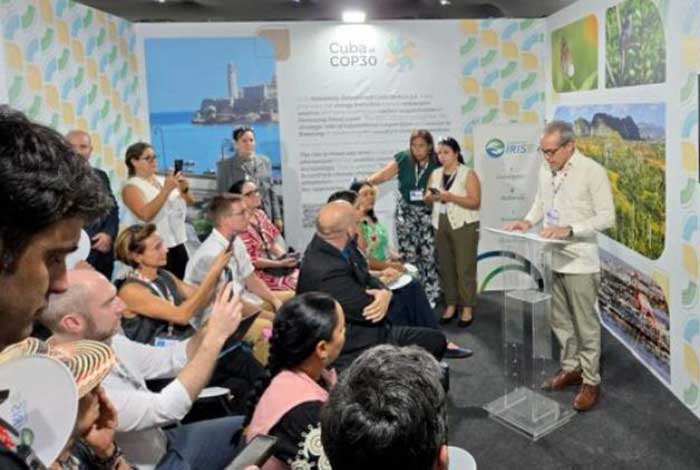
Cuba is determined to defend the voice of the Global South nations at COP30 and demonstrate how science, social resilience, and unity underpin its environmental policy in a global scenario currently marked by inequalities.
This was stated by the Minister of Science, Technology, and Environment, Armando Rodríguez, during an extensive interview, speaking as one who brings decades of scientific struggle on his shoulders. He acknowledges the Brazilian hosts and immediately focuses on what he believes is the true core of the climate dispute: inequality.
The Cuban delegation is in Belém with "the voice of the countries of the Global South, of the small island states, and of the developing nations," emphasized the minister, who considers that climate change is not just an ecological challenge but "becomes an economic and social challenge for countries like ours."
From this perspective, Havana presents the scientific foundations of its environmental policy. Its representative described how hazard, vulnerability, and risk studies, developed down to the municipal scale, shape strategic public decisions in the face of rising sea levels, extreme hurricanes, and biodiversity protection.
With the update of its Nationally Determined Contribution, NDC 3.0, the island has an ambitious program to install two thousand megawatts (MW) of solar photovoltaic energy, with 200 MW of storage capacity by 2026. It also undertakes commitments such as mangrove reforestation programs, the sustained increase of forest cover, and transformations in energy, agriculture, and transport.
In the interview, Rodríguez did not avoid the topic. The United States embargo against Cuba "is the greatest difficulty facing Cuban environmental policy because it limits access to technology, funds, and trade."
Faced with this reality, the largest of the Antilles sustains its science with its own resources: 50 universities, more than 200 research centers, and a scientific ecosystem that it considers a "conquest of the Revolution."
The minister emotionally recalled the so-called Earth Summit in Rio de Janeiro (1992), when the speech by the historical leader of the Cuban Revolution, Fidel Castro, shook the forum: "For us, that speech is the philosophical stone of Cuban environmental policy."
He quotes it from memory: "Let hunger be eliminated, not mankind." That persistence, he argues, is part of the country's daily life. "Continuity for us is everyday life," he specified.
At the 30th United Nations Climate Change Conference (COP30) in Belém, where the jungle breathes both concern and hope simultaneously, Cuba once again presents itself as a small nation that tries to speak on behalf of many, betting on science and unity to face a planetary challenge. (CubaSí)