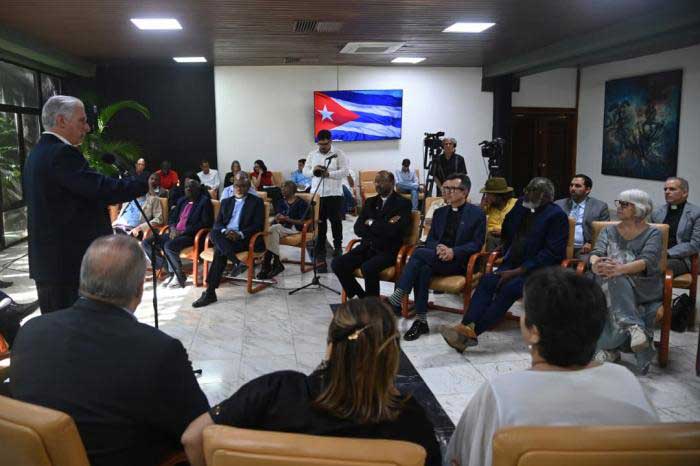
 The Cuban President denounced that a war economy imposed by the empire could not prevent the achievement of many advances.
"Thank you so much for being with us; thank you so much for joining us; thank you so much for the message of peace and profound faith with which you accompany us." These were the words of the President of the Republic of Cuba, Miguel Díaz-Canel Bermúdez, to representatives of international ecumenical organizations, who are on a pastoral visit to Cuba in the context of the Holy Week celebrations.
Sincerity, fraternity, and a human touch characterized the dialogue held by the President at Havana’s Convention Center with representatives of 600 million Christians from some 120 nations. These representatives, from the island, are carrying a message of peace and solidarity and have had the opportunity to exchange ideas with various faith communities, participate in Palm Sunday activities, and speak with Cuban pastors and religious leaders from several denominations that are part of the Cuban Council of Churches (CIC, in Spanish).
Invited by the CIC and the Reformed Presbyterian Church, religious leaders from around the world —who have personally witnessed the difficult times Cubans are experiencing— heard President Díaz-Canel speak on Monday about the efforts of a nation that refuses to be defeated. It was an afternoon of intense emotion, also attended by the Prime Minister of the Republic, Manuel Marrero Cruz, and the Secretary of Organization of the Central Committee of the Communist Party of Cuba, Roberto Morales Ojeda —both members of the Political Bureau.
The president expressed to his "dear sisters and brothers," to his "dear friends," that it was a pleasure to welcome them to Cuba at such a difficult time. "We highly appreciate and attach great significance to your visit, which reaffirms that Cuba is not alone," the Head of State affirmed during the exchange, which was also attended by the head of the Office of Attention to Religious Affairs of the Central Committee of the Party, Caridad Diego Bello; and Yuniasky Crespo Baquero, head of the Ideological Department of the Central Committee; among other leaders.
The First Secretary of the Central Committee of the Communist Party of Cuba added that the visit speaks to historic relations, and highlighted the fact that the religious leaders arrived on the island with an itinerary that included Palm Sunday, during Holy Week. Díaz-Canel Bermúdez spoke of a meeting with "enormous symbolic weight," and that this served as a prelude to sharing ideas about the Caribbean nation.
The president recounted historical passages and episodes related to a truth to which the Head of State referred: "What we are experiencing," he said in relation to these difficult times, "is the cumulative effect of 67 years of blockade."
He remarked at one point in his speech that "we have not been able to achieve what we have wanted." He was referring to many unresolved issues, to "many dreams we have not been able to realize," and then he spoke about creativity as a form of resistance, which, he reasoned, has made possible a body of work of enormous social significance.
The Cuban President denounced that a war economy imposed by the empire could not prevent the achievement of many advances "that today are hampered, diminished by the blockade" intensified at this time.
"In everything they do," he emphasized, "there is a collective punishment of the Cuban people." He reflected during the meeting that one should ask oneself the reason for such an attitude that affects millions of human beings. The reason the dignitary has found —and explained to his interlocutors— is "the example of Cuba, which in 67 years has not been able to break or humiliate us."
The dignitary also spoke of opportunities amidst crises, of priorities that continue to drive the country despite adversity, highlighting the importance of ensuring that "in everything we are proposing, there must always be a focus on social issues."
Toward the end of his remarks, Díaz-Canel commented: "The concept we have shared and defended is that we will not surrender; and what we ask of you, those who are visiting us, is that, with the awareness and sensitivity you have shown toward Cuba and our people, you explain the harshness of this situation."
The Head of State described the blockade as "a violation of the human rights of Cubans," as the act of "depriving a people who are generous, hardworking, and compassionate of the most necessities for living in peace."
At this point, he exemplified that "due to shortages of supplies, we have more than one hundred thousand people waiting for surgeries; and, of those one hundred thousand people, there are more than eleven thousand children. And can anyone doubt that Cuba can perform these operations? Haven’t we demonstrated a healthcare system capable of performing these operations? Why are they depriving us of doing them? How can they then brazenly claim that everything they do is for the betterment of the Cuban people? What can be expected from people who lie like that?"
Díaz-Canel Bermúdez told the ecumenical religious leaders: "We ask that you demonstrate this reality; that you tell this story, and we ask the leaders of our churches to continue developing the community initiatives with which you have always supported us, and to also become involved in this entire movement that we are conceiving at the community level, because you have a great deal of experience in community work, popular education, and all these things that are so important at this time."
VOICES CARRYING PEACE AND SOLIDARITY
With feelings of gratitude for being received by the country's leadership, all the religious friends began their remarks. Jerry Pillay, General Secretary of the World Council of Churches, said he knew that Cubans "are living through difficult times." He commented:
"I come with high-ranking religious leaders. They are General Secretaries of well-established churches throughout the world, representing millions worldwide." He then made explicit the reason for the visit: "We are here to celebrate the beginning of Holy Week with you."
At another point, he emphasized, "We are joining you in solidarity," and he also stated, "We will join the voices of people of faith in saying that what is being done to you is wrong."
"Our presence, and the presence of such a high-level delegation," the ecumenical leader asserted, "shows that we are here to offer our support and to tell the people of Cuba that they are not alone."
Anthony Poggo, General Secretary of the Anglican World Communion, added his sentiments: "As the scriptures say, when one suffers, we all suffer, and that is why we stand with you."
More than one message emerged during the meeting: Cuba "can count on our prayers and our support," emphasized Reynaldo Ferreira Leao Neto, General Secretary of the World Methodist Council. Other voices joined in to remind everyone that war is not the way, that violence is not the way, and that depriving a people of their food and their hopes is also not the way.
Joel Ortega Dopico, President of the Cuban Council of Churches, expressed his emotion, saying that the presence of these friends was a source of "healthy pride for the Cuban ecumenical movement," and the culmination of many years of work. For this reason, he offered heartfelt thanks.
"People talk about the collapse of Cuba, he reflected, "but it is this world that is truly collapsing". Dopico affirmed that this visit marks the beginning of a new phase in which the global ecumenical movement and the Cuban ecumenical movement will work more closely together.
He emphasized: "We must do everything to prevent war and ensure that peace prevails. I urge you to raise your voices with the utmost urgency." On behalf of everyone," he stressed, "I believe we are very grateful for your presence." And he did not fail to mention that the high religious leaders "have left their churches, their organizations, to be here with us on Palm Sunday, on such a significant day, because we know that it is the day when the Lord, riding on a donkey, defied the empire, and defied all the powers of that world as unjust as this one of today. That is why you make me proud to be a Christian, to be a follower of the carpenter's son."
The afternoon session ended with a prayer in which religious leaders prayed for Cuba, for the resilience and hope of an entire people, and also for its leaders at this moment fraught with so many challenges and decisions. (Granma)