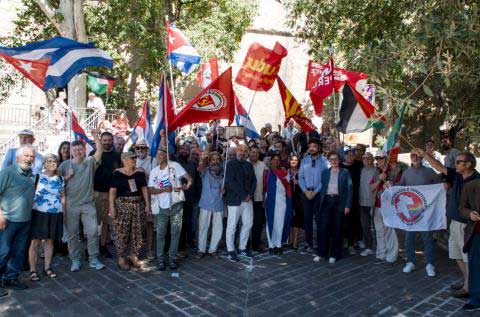
Strengthening relations with Cuba, breaking attempts at isolation, and countering the U.S. blockade are the objectives of "Ruta a Cuba: Estar donde importa" (Route to Cuba: Being Where It Matters), an Italian caravan that will travel to the island on September 23.
According to information announced today at a press conference at the headquarters of the Italian National Press Federation (FNSI) in Rome, the initiative is promoted by the organizations ARCI, CGIL, Anaic, Nexus, ANPI, ARCS, AOI and the Peace and Disarmament Network, in collaboration with the Democratic Party, the Five Star Movement and the Greens and Left Alliance.
Members of the caravan participated in the meeting, where Cuba's ambassador to Italy, Jorge Luis Cepero, referred to the importance of the initiative, the impact of the unilateral coercive measures applied by the U.S. Government against the island, and the resilience capacity of the Cuban people.
The large delegation that will visit the Caribbean nation until September 30 is made up of representatives of associations, unions, parliamentarians, local leaders and journalists.
Among their demands, they urge the Italian Government and the leadership of the European Union to use the diplomatic and political instruments at their disposal to foster dialogue and help eliminate the obstacles that prevent the Cuban population from accessing essential goods and humanitarian assistance.
Another objective is to make visible to those authorities the situation in Cuba caused by the energy siege that makes it impossible for fuel to reach the island.
According to the president of the National Association of Italy-Cuba Friendship, Marco Papacci, the mission denounces the unilateral economic, commercial and financial blockade imposed by the United States on Cuba, in violation of international law, which has been in force for more than sixty years and has progressively tightened.
Likewise, it rejects Washington's recent coercive measures, which exacerbate an already critical situation, hindering the acquisition of supplies, access to markets and international financial systems, as well as the transportation of essential goods and humanitarian aid, he said.
"It is unacceptable that access to food, medicine, fuel, energy and humanitarian aid becomes a tool of political pressure," the organizers of the caravan said.
"The Cuban people must be able to decide their own future with full autonomy and respect for their right to self-determination," Papacci stressed.
The delegation will deliver to Cuban institutions medicines, school supplies and solar panels that were made possible thanks to the solidarity of thousands of people and the Energy for Life campaign, which has already financed numerous solar panel installations in public health, cultural and educational centers in Havana and in eastern Cuba, benefiting more than 800,000 people, he explained.
The ANAIC leader stressed that bringing medicines and energy to Cuba means opening concrete channels of solidarity and cooperation, and contributing to breaking the blockade and the isolation it generates, providing essential goods and services where they are needed.
The mission includes meetings with officials from United Nations agencies and programs in Cuba, representatives of the National Assembly of People's Power (parliament) and the island's government, as well as exchanges with civil society, social and union organizations and cultural institutions.
They will visit hospitals, schools and companies to learn firsthand about the impact of the tightening of the blockade on the population and the functioning of public services.
Meetings are also planned with the Central Organization of Cuban Workers, the Federation of Cuban Women and the Committees for the Defense of the Revolution, as well as with cultural organizations, including the UNEAC and the Hermanos Saiz Association. (CubaSí)