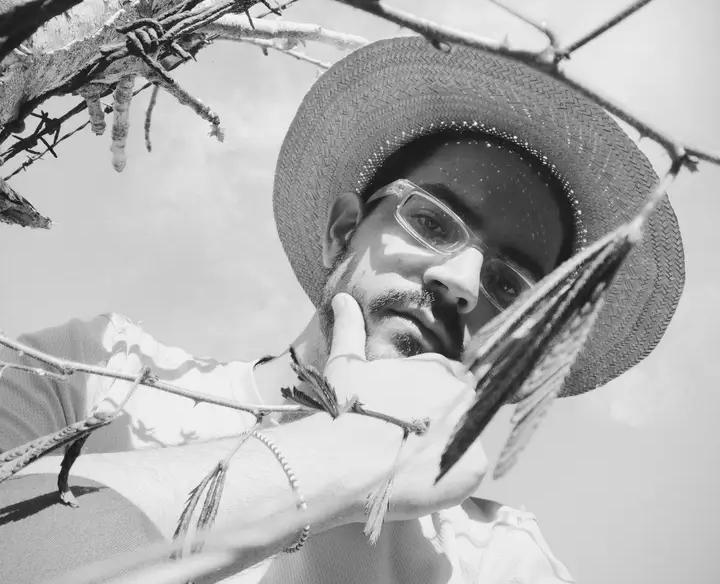
"I had a lot of fun writing the stories in this book. It's a kind of experiment, like when we go to a restaurant and don't know what dish to choose; I wanted the reader not to know which one to choose after finishing the book," Roberto González Rodríguez, from Sancti Spíritus, told 26. He won the recent edition of the Portus Patris Literary Prize, the oldest of its kind, organized by the Hermanos Saíz Association (AHS in Spanish) in the country, with his work "Buffet delirante."
Las Tunas, Cuba.- For Roberto, empathy with the reader is of great importance. "If they don't feel identified, my work as a writer has not worked as it should. The story that gives the award-winning book its name, for example, is about a person whose body is possessed by beings from another planet, who show him the happiest parts of his life while eating each part of his body. In other words, on the one hand, he glimpses passages from his life where he was happy, and at the same time, on the other, they devour his hand, his leg...
“It's like a game of pain and joy, but always trying to show how the character decides to sacrifice his body to be happy, to find that happiness that he had at some point in his life, and didn't know how to take advantage of. In addition, in a certain way, the reader participates, which is very important to me, in being able to decide what fate they prefer for the character.”
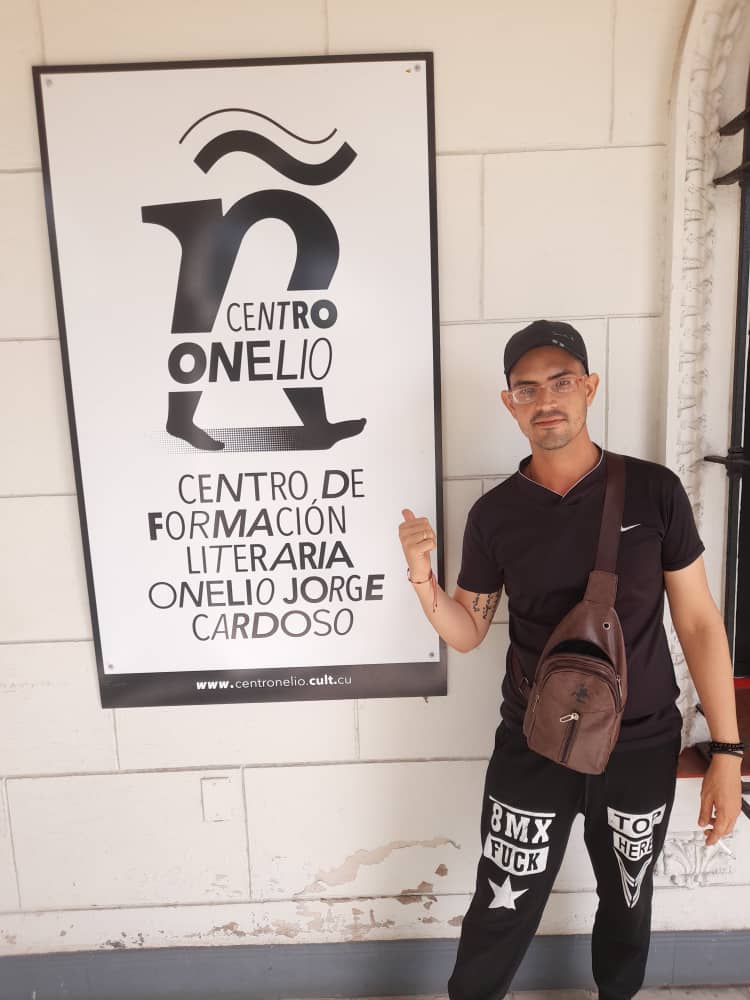
Roberto is grateful for having attended the Onelio Jorge Cardoso Literary Training Center for the consolidation of knowledge about literature. "Taking the narrative techniques course was a unique experience, as it provides tools for using literary techniques and resources; it's always appreciated. What's more, all that knowledge is now latent in my work in a way. In the notebook Buffet delirante, I use the Chinese box, I play with shifts in reality, changes in narrator... but I also use the traditional story, where the reader starts, nothing seems to happen, and when they finish, they say, ‘Well, I need to take some time and think about what really happened here.’"
“I think that magic, that game that only the linear story allows, because when you start playing with the reader, you make a change of narrator, a shift, or you present them with a Chinese box, they know you're playing with them a little. I think that's something we writers can't lose, even if we play with techniques,” he said.
 This is not the first time that this writer from Sancti Spíritus has participated in Portus Patris. In fact, he was a finalist about five years ago. "Every award is an indication, a way of telling you that your work is worthwhile, that you are on the right track and should continue writing. It's like a pat on the back that tells you your work is valuable. Most artists are solitary creatures, and when it comes to creating, we need solitude. That sometimes shocks us and prevents us from having a social life, but the story hammers away at your head, and you have to forget everything else and start writing. Above all, I believe in the magic of literature. When I win an award, I feel it is a reward for the sacrifice, for the time spent in solitude, for having to rewrite a story ten or thirteen times, but it is always worth it, because it is what you love to do."
Roberto confesses to being passionate about magical realism. "I consider myself its faithful student. When the character takes hold of you, you have to drop everything and start writing. You enjoy the creative process where the irrational is present. You want the reader to wonder what happened or didn't happen when they read the story. I like to play with that, and magical realism gives you that opportunity.
In that sense, my teacher par excellence is Gabriel García Márquez and his masterpiece, One Hundred Years of Solitude, but also Carpentier's The Kingdom of This World. I love many works; I am a faithful devourer, and I even follow the new boom in magical realism, represented mainly by Latin American women such as Mónica Ojeda, Samantha Schweblin, and Elaine Vilar Madruga.
"I try to give all my stories a touch of magical realism. There is nothing more beautiful than playing with the magic of the marvelous real to show the reader that there may be things beyond, even if they don't believe it. Why can't Mackandal turn into an animal? Why can't yellow flowers fall on Macondo? I also try to play with the darkest part of the human mind, like a buffet of delusions. I feed off that part of the brain that we tend to hide, the lycanthropic part that all human beings carry within us and that eventually comes to the surface. That's what I did in Buffet delirante."
When asked if he only writes prose, the son of the land of Yayabo replied: "I feel very comfortable with narrative. I have experimented with poetry, but it is really a genre I respect. While a narrator has the possibility of playing with fifteen, twenty, or thirty pages to create a story, sometimes, in a poem of four or five verses, you have to summarize that story. Narrative is my safe zone. I'm still holding back on poetry until I'm ready to bring it out into the open."
For him, with unpublished novels and other projects on the agenda, "literature is an escape route, a way to shout to the world but in silence, to feel free and give others those universes that are in my head. A means of communication, a way of saying I'm here and leaving a mark. I believe in the transcendence of literature, that it will always be there as one of the strongest references for human beings."
A native of Cabaiguán, he confesses to being proud of his peasant roots.
According to him, his two passions are accounting and literature. “I am a university professor, and the part I like most about accounting is being able to teach the new generations everything I know,” he said. He also reaffirms the importance of self-improvement for those who inspire with words. “Narrative is an art that is constantly studied; it's like a doctor who has to prepare every day,” he said. Not surprisingly, this attitude, combined with his talent, has earned him accolades such as the Bustos Domecq Award.
He thanks all those who have lit the way for him, such as the writer Elaine Vilar Madruga, who has been his teacher; the AHS for opening the doors to his professional development, the family that supports him at the “Escrucijada” Writing Laboratory, and the jury of “Portus Patris,” this time made up of writers Sergio Cevedo, María de Jesús Chávez, and Maikel Paneque, “for trusting and betting on this buffet of stories full of delusions.”
The winner of the “Pedro Verdecie” collateral prize, too, awarded to him by the José Martí Provincial Library in Las Tunas, concluded: “Hopefully, readers will soon be able to savor these stories as if they were dishes...” Hopefully, we add.