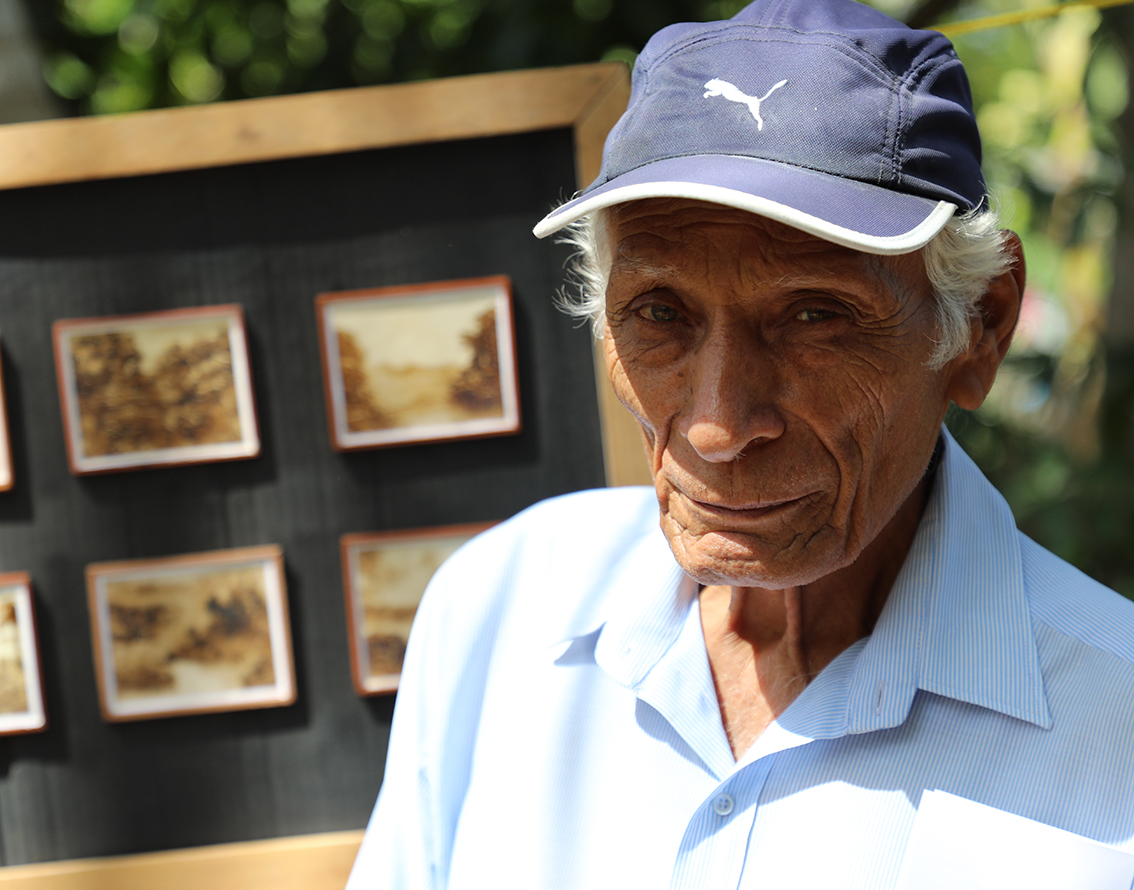
- Many wonderful people inspire us through all forms of artistic expression and even, anonymously, contribute in some way to the final result. Here we present one of those inspiring individuals; let his interview serve as a way of saying thank you on Cuban Culture Day, and always.
“I am not a painter for the elite, I am a painter for the people,” says the man with white hair and green-yellow eyes who has found his raison d'être in the landscape. José Ángel Naranjo, with more than 50 years of artistic life, talks to 26 in the Los Tamarindos courtyard of the Huellas Cultural Center, as if his life were passing before him in brushstrokes, anecdotes, emotions...
He says that Manzanillo cradled his first dialogues with nature, encouraged by his aunt Consuelo Pérez Fonseca, a primary school teacher who has since passed away. “My roots are in Campechuela, that's where it all began. Then we moved, and I finished my education in Elia, Colombia. There were five of us siblings; I was the third. We studied when the Revolution came, before that it was impossible; my father, who worked at the sugar mill, couldn't afford to pay for our education,” he says.
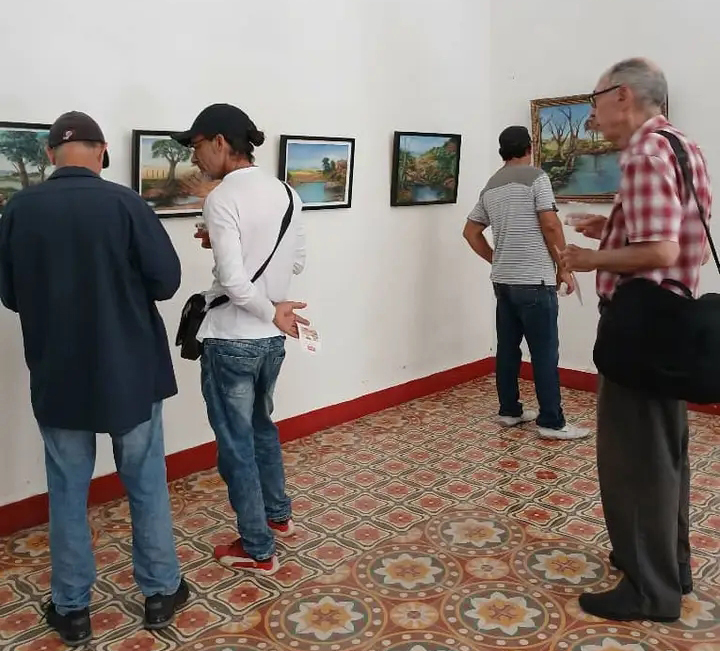 He confesses to being absorbed by the works in museums, dreaming of one day creating something similar. Portraits especially caught his attention, but inside something kept telling him over and over again: “Landscape, landscape, landscape!” How could he refuse? “I've loved the countryside since I was a child. I used to fish and hunt with friends. I was happy.”
Naranjo first studied technical drawing, linked to the specialties of mechanics, architecture, and topography, but the voice remained irreverent: “Landscape, landscape, landscape!” Then, Camagüey, with its distinctive cultural effervescence, would spread its wings to his dreams. "I went to work in the City of Tinajones and, at that time, I enrolled in a night course taught at the School of Art there. When I finished this period, I continued to teach myself.
"I sought out every book I could find that talked about painting. In Agramonte, I also created a group to bring together some creators, and I did the same in Elia and Las Tunas. On June 23, 2002, Perspectiva was born, which fills me with joy, as it is still active today. Furthermore, from the beginning, we set out to reach out to communities, and we have continued to do so, even reaching other provinces."
He has not only been an acclaimed artist but also a fervent cultural promoter, someone who realized from a very young age the importance of supporting the work of others. “I like to put my knowledge at the service of others; I was not so lucky myself.”
Naranjo has also taken care to study the field he works in. "When I was 8 years old, my aunt gave me some paintbrushes and said something that has stayed with me forever: ‘The problem is not knowing the colors and mixing them, but applying them in the right place.’ That's why I've always tried to learn about art, to better express what I feel, to bring my soul to light, and for the public to notice it.
 “I had to learn, for example, about the bark of trees, their foliage, how light enters and exits through their branches... When observing the work of a visual artist, I tried to immerse myself in how they created the work... There wasn't a day that I didn't go to the Tomasa Varona cultural center; they even thought I worked there...”
Naranjo has come a long way since he and other dreamers held exhibitions in the windows of some stores in Elia. However, he has continued to be an encouraging force for many artists who see him as a kind of leader. “I haven't cared about their age, religion, or political position, only their love for art, and that's why we've reached such intricate places.” El Escambray, Havana, Santiago de Cuba... so many places where his efforts have borne fruit.
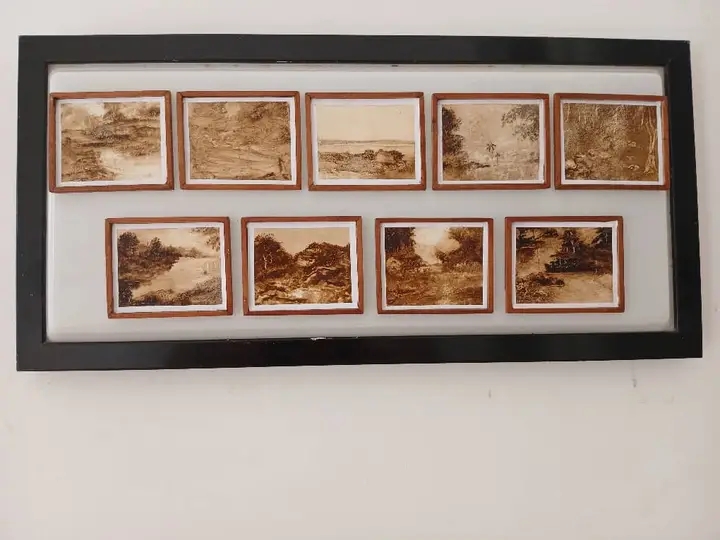
“I am proud of all those who have accompanied me on these journeys, either in person or through their work. The greatest achievement is for their art to be known,” he says. And he does not fail to mention the permanent miniature art gallery he created in Campechuela, his native land, one of the greatest fruits of Perspectiva.
He is especially happy to have promoted small-format creation from the Balcón de Oriente. "Before us, it was very rare to find exhibitions of this type in galleries or anywhere else. Although there was a time when miniatures were made even in the spheres of wristwatches or earrings, they were made as gifts, not for exhibition. That is why we were concerned with creating a movement aimed at this, which is led by Manuel Izquierdo in the west, Wenceslao García in the center, and me in the east."
Naranjo, in his attempt to raise awareness and encourage this art form, has traveled throughout much of the country, giving lectures and workshops, supporting new talent... “In Cuba, miniaturism is indigenous, as even our aborigines cultivated it without knowing it, and before the arrival of the Europeans; that must be defended,” he emphasizes.
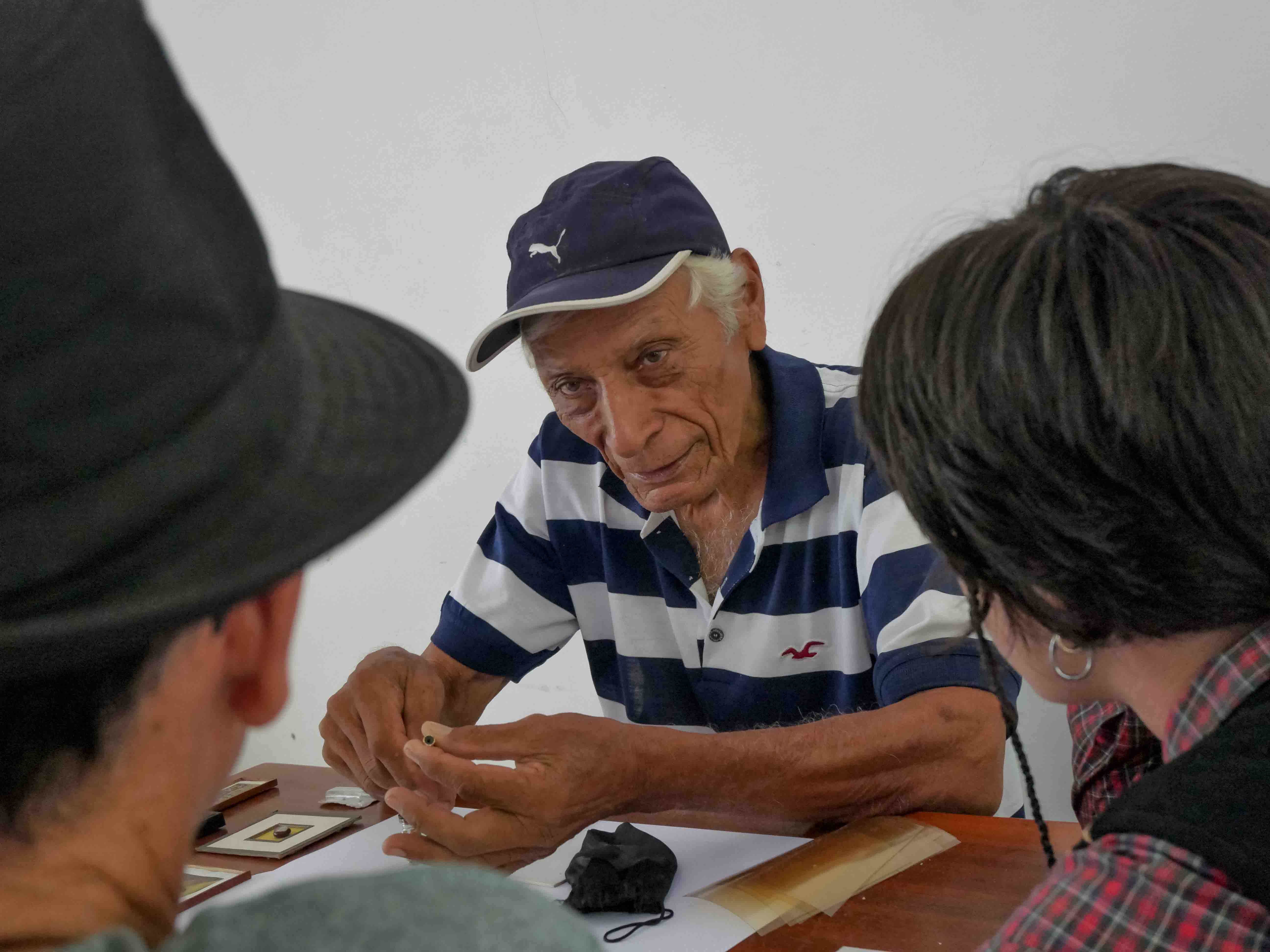
He has also grown in the face of material shortages. "For some time now, everything has become scarce: oil paints, watercolors, canvas... We had to find solutions. Art cannot die. We began to experiment. At one of the meetings, we agreed to do a study on brushes, studying more than 30 bristles from different animals, even rats. In this way, we discovered that dog hair works well for this purpose, as do long rooster feathers, especially at the end, which become very thin. We also studied pigments: banana sap, bija, güira, and others. Asphalt has been particularly well received, and it has been sensational, as it produces extraordinary shades and is very popular."
He claims to have too many awards to his name: the Pedro Verdecie Prize, several awards from the José Martí Cultural Society (SCJM), and other accolades. However, like any good artist, what truly makes him happy is the affection and admiration of the public. After almost a hundred solo exhibitions and exchanges with other creators throughout our archipelago, he says, “My greatest reward is the people.”
With the love of his wife, four daughters, grandchildren, and great-grandchildren, he feels like a happy man, but not completely fulfilled. "I still have a lot to do. The years I have left are for art, for our culture," says the octogenarian who presides over Miniature Art in the Eastern Region and has dedicated more than half a century to the usefulness of virtue. May his work endure forever, like the orange blossoms that adorn each orange tree with their pure white color. May it be so.