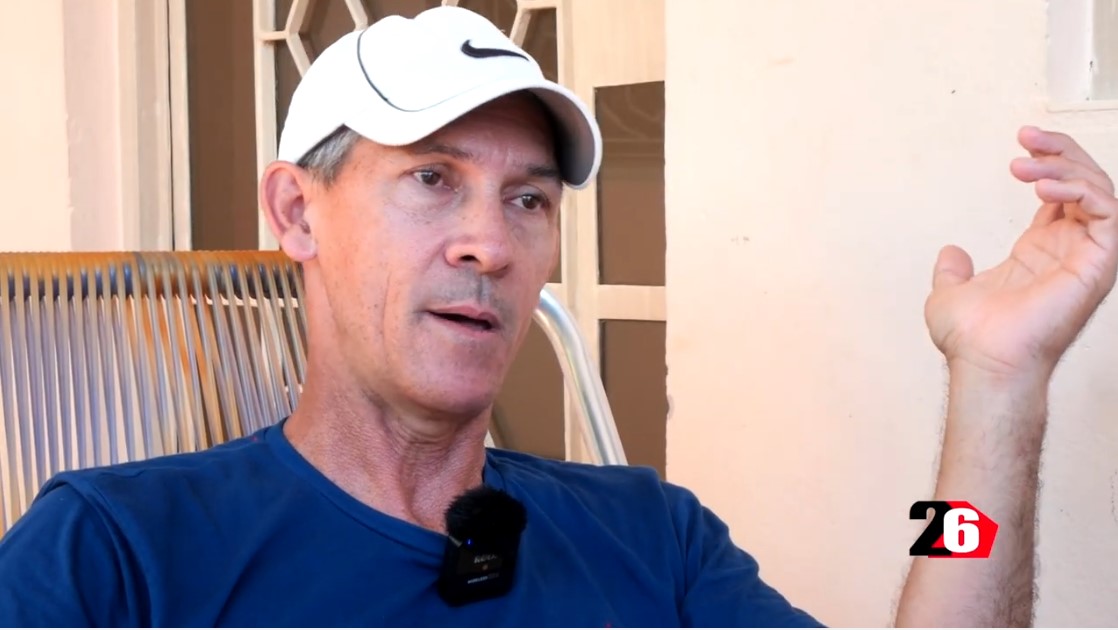
Ángel Alberto Álvarez Carralero could have soared, transcended, reached the pinnacle of creation elsewhere, but he chose to stay there, amidst the salt air and the spirit of his hometown.
Las Tunas, Cuba.– Perhaps it seemed like a small choice to some, but I learned from talking with him that, sometimes, true greatness lies in defending what is simple, strong, and everyday. He married in Puerto Padre, built a beautiful family, crowned by Angélica and Alicia, and has done so without abandoning the art he champions, the irrepressible passion he feels for his roots. He has embraced, with the strength of his excellent work, the colossal challenges of a creator determined to put food on the table for his family, from that misunderstood and voracious position, with limited resources and perspectives not always open to the "knowledge of the educated."
“I graduated from the Academy of Fine Arts in Las Tunas and the Higher Institute of Design (ISDI in Spanish) in Havana, and I've said many times that I'm a local patriot."
“I feel grateful because life has given me many opportunities and allowed me to grow from here, contrary to the usual dynamic of development that encourages you to move to other places if you want to get ahead."
“Now, being in a small town forces you not to specialize because you’ll starve; you have to do many things. And that’s also good, because it forces you to be constantly learning, searching, growing.”
Ángel Alberto, like any good resident of Puerto Padre, is aware that many label him as having “an excessive love for his homeland.” He smiles as he tells me, “I prefer to channel those excesses into creating my work, and life has allowed me to do that.”
“Now, being in a small town forces you not to specialize because you’ll starve; you have to do many things. And that’s also good, because it forces you to be constantly learning, searching, growing.” He closes his eyes and, settled in a rocking chair on the terrace, surrounded by the hustle and bustle of work, he walks down Avenida Libertad for me as if we were standing right in front of it. He knows every detail, calls it "the catwalk of Puerto Padre's art scene," and smiles.
"This is a port city, and even though our port isn't a major shipping hub today, it used to be. It was an important link along the entire northern coast of the country. Going to Gibara, for example, was just a matter of having a snack or playing. In fact, the warehouses were small because there was no need to store large items; they were frequently brought in from Miami or other nearby places."
Therefore, the people of Puerto Padre grew up with that vision, far removed from provincialism, and that is also reflected in who we are: a people of the world, proud of the men we have had."
"This is a port city, and even though our port isn't for long voyages, it once was. It was an important link along the entire northern coast of the country. Going to Gibara, for example, was just a way to have a snack or play. In fact, the warehouses were small because there was no need to store large things; they were often brought in from Miami or other nearby places.
"Therefore, the people of Puerto Padre grew up with that vision, far removed from provincialism, and that is also reflected in who we are: a people of the world, proud of the men we have had." “There’s an anecdote that’s often told around here as a joke. When someone from a municipality in Las Tunas goes to Havana and is asked where they’re from, they say Las Tunas; but if they were born here, they say ‘Puerto Padre,’ completely naturally, without mentioning any other affiliation.”
We discussed the splendor of those lands during the Republican era. He told me about the 42 publications that emerged from them, about the distinction of having one of the first radio stations in Cuba, and said, “The concert band here is about 20 years older than the one in Camagüey, for example.”
He continued. “The coat of arms of Puerto Padre dates from 1936 (Art Deco in Spanish), devoid of unnecessary ornamentation. Pure meaning. In it, the bundle of rods represents not the city, but its neighborhoods; that’s why it’s inclusive. And on the banner of the coat of arms, it says: All for the Fatherland (in Latin).
“Here, people love their homeland, but with a universal vision.” “You can’t be a patriot on a grand scale if you aren’t a patriot on a local level.” This idea of the particular, felt as a space of genesis, yet with aspirations of universality, also resonates in Ángel Alberto’s work. For example, the bust of Mella, located near the university where he became an assistant professor. He approached the project as a challenge because “when the established artist says it can’t be done, the novice says it can,” and he, then a novice in such matters, wasn’t the first choice to take on the challenge in record time.
But he accepted the blessed desire to create the image of Julio Antonio Mella in the purest style of the Blue Town of Los Molinos. “We sculpted Mella’s bust from a photograph taken by Tina Modotti. I chose her gaze, that of a woman in love, and we removed the hat, but we tried to see through her eyes.” Let us remember that he was a man with a sternocleidomastoid muscle that stood out as heroic, with brow ridges almost reaching Olympus. He gazed at the sun with a defiant, not feisty, attitude; bare-chested, forehead open.
“The photographic likeness isn't what I want; the artistic one, yes; and that includes the psychological, the contextual, because it's the future, the one that elevates you. It's all the likenesses in one: the emotion. People remember you because of the emotion.”
Ángel Alberto weaves together ideas, converses in reflection, and attends to the passing truck driver, the friend who asks a question, his little girl playing, all at once, without losing the power of his words. Puerto Padre seems to be a recurring theme not only in his work but also in his way of acting, his view of life. In his opinion, the city doesn't need to look to the future to develop; what's urgent lies in the past. And he returns to the subject.
“The Máximo Gómez promenade, for example, had more than 66 cisterns. It harvested rainwater in a very small urban centre. From the excavation, before the houses were even built, the stone for construction, the cocó (a type of volcanic rock), and the space for a cistern were created to harvest water. That water was drawn using windmills.”
He has many dreams intertwined with its streets, its people, and its well-being. It's a pleasure to listen to him, and yes, it also makes you think about the essence of his message. Every town, city, and port in Cuba should now look within itself, rediscover the driving forces that have sustained it, and the knowledge that sets it apart from every possible angle.
Perhaps, in this way, with the magic that love and the most brutal introspection provide, we will find ways to move forward.