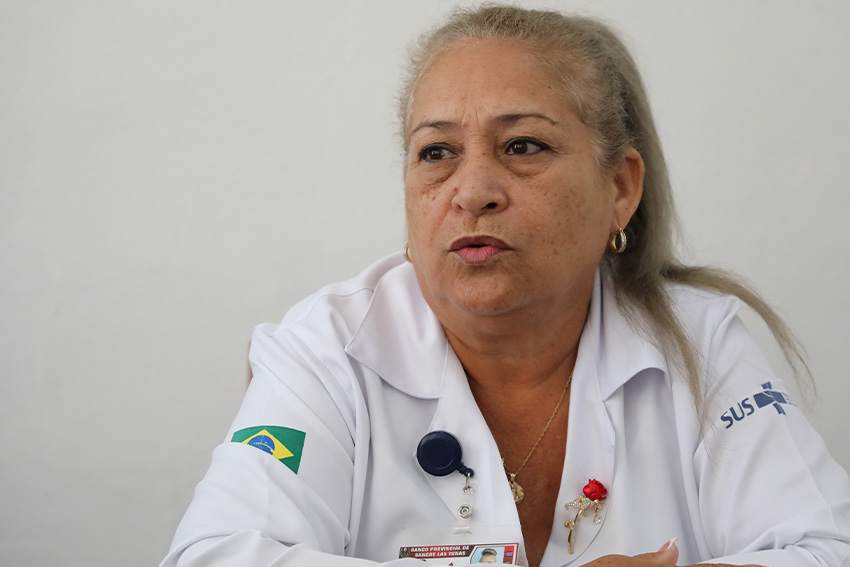
Pakistan marked her life with a halo of pain that she still carries in her heart, no matter how many years pass. She remembers the icy air in her lungs the first time she stepped off the plane, aware that this would be her most difficult international mission and that on the other side, all the destruction of Kashmir awaited her. It was the beginning of October 2005.
The city of Balakot welcomed part of the Henry Reeve Brigade. A 7.6 magnitude earthquake caused enormous material losses and thousands of deaths and injuries. When Dr. Nersa Vega Rivas stepped onto the snow, she was struck by the full sadness of those lands, amidst the smell of decomposing corpses and the pleas in a strange language.
“It was too much to take in. We spent days cut off from our families. We lived in tents, and every day there were incredibly strong aftershocks that were terrifying. What sad days… there was snow everywhere, corpses, desolation, and awful smells. The six months I spent there aged me…
“I was deeply affected by the loss of a school with around 500 girls. The building completely collapsed; only the weathervane above the cross on the roof remained. That left a deep mark on me; I’ve never been able to get it out of my head—the discovery of the small bodies they pulled from that frozen mass grave."
Pakistan finished shaping my character.” I remember working sick, exhausted, without water because the riverbeds had been diverted, in the midst of extreme conditions, but the brigade's strength impacted those people; rarely is the power of solidarity seen so clearly.”
THE ONLY WAY…
She tells me that since she was little, she loved playing doctor and nurse. She would write imaginary prescriptions and medicate the line of dolls waiting to be “sick.”
It wasn't too surprising that she was accepted into the old Faculty of Medical Sciences, Zoilo Marinello. She chose the specialty of Comprehensive General Medicine, now Family Medicine, without much effort; she was clear that her vocation was to make an impact on communities.
Her social service in the rural area of Hermanos Mayo, in the town of Barranca, confronted her with the great challenges of her career, and Nersa gradually assumed a commitment that would later serve her well in leading large groups and institutions.
The November 7th Polyclinic in Calixto, Majibacoa, foresaw the beginning of her gift for leading processes. She was very young when she took the helm of a Basic Work Group (GBT in Spanish) and discovered that her voice was strong and that she would use it to defend the principles she believed in, and that sincerity has remained undiminished…
“Later, in the municipality of Las Tunas, I joined the Guillermo Tejas polyclinic as a specialist, and that's how I came to the Casa Piedra maternity home, which became an essential learning experience. It brought me great challenges: the challenge of a new life and the challenge of overseeing every detail of the process.
“I was fortunate to work with women for the first time. Each one is a world unto herself, with considerable differences and similarities, shaped by her stories, her living conditions, her partners, and her decisions. I learned to listen, to value, and also to say things at the necessary moment, no matter how difficult they might be. Those are my keys to leadership.”
In her unwavering simplicity, Nersa always speaks in the third person because she believes that change is achieved collectively. She doesn't like to mention her achievements, but she left a positive mark that shaped her future paths.
WHEN SOLIDARITY BECOMES REAL
“I first arrived in Venezuela on a special mission following a landslide caused by excessive rainfall that swept away entire towns. We were part of the Comprehensive Health Program; I was there for two years, and then I joined the family doctor program known as Barrio Adentro II.”
“I was in Venezuela when the earthquake struck Pakistan. From there, I joined the Henry Reeve Brigade and was a director at the field hospital we set up in Balakot, the most devastated city. We performed numerous surgeries during that period, with a multidisciplinary team of valuable professionals. We also managed to expand the rehabilitation program from those countries to our country. It was an unparalleled experience.”
“Then I returned to Venezuela, and another immense challenge awaited me: to be part of Mission Miracle, as director of the ophthalmological center in the state of Aragua.” Restoring sight is a beautiful experience, but it requires a lot of study. As a general practitioner, I had to learn about ophthalmology and how to diagnose cataracts and other eye injuries. Anyone who knows me knows I'm very involved in my work, and many times I stayed up until the early hours training in that specialty.”
Nersa says the expressions of gratitude from the people they treated were genuine and gratifying. “A large number were blind and unaware of their health condition. When we intervened, it was like bringing light back to them in a world of darkness. They wept with gratitude. That was a moment of true loyalty.
“We returned to our homeland in 2010, and I served as director of the Diabetes Center, yet another challenge… We accomplished many things; we had a wonderful program, and we consolidated the comprehensive care program for diabetic patients and their families. The center met its performance indicators.”
“We had a very good program, and we consolidated the comprehensive care program for diabetic patients and their families. The center met its targets.” “We had one day a week to give them lectures on how to behave, how to dress, eat, take care of themselves, and take their medications. A lot of health promotion was done, and it had a real impact on the patients.
By decision of the Municipal Health Directorate, in 2017, Nersa assumed the position of Deputy Director of Medical Assistance, and as usual, she worked tirelessly with all the municipalities, in all areas of health. Two years later, she arrived at the Provincial Blood Bank, and other commitments and passions grew within her.
“I fell in love with the work here immediately. I started as a doctor and ended up as director. Today, I can tell you that this institution has an excellent team, and the programs are carried out with a complete sense of ownership.” “It’s cost me countless sleepless nights.
When I see a Facebook post from people wanting or buying blood, I get really annoyed because sometimes they don’t even know what they need, and here we are, ensuring this vital fluid is available no matter what. It goes without saying that we ourselves have stepped up when a significant donation of our blood type is needed; we lead by example.
“It’s a beautiful, altruistic task, one that requires inspiring people to embrace it because there’s no pay. This is an act of the heart, voluntary, and at the same time necessary to save lives. Blood is priceless, and it can’t be.” We love this program, we defend it, we fight for it, that's why it hurts so much when resources are scarce, and there aren't good snacks and donors aren't attended to.”
“Dealing with thousands of difficulties, we have achieved one hundred percent of donations every month and, most importantly, that our donors feel somewhat cared for, that our workers love what they do, that they respect the situations they go through, and I like to think that collectively we have managed a total improvement of the center.”
She speaks vehemently about her daily routines, about the void left by the shortage of reagents. But it also gives more strength to what they can do, to the will to want to help. “You can save 3 to 5 patients with one blood donation because not everyone needs the same components.
To date, we maintain a blood supply for 100% of medical emergencies. When it's not available at the Blood Bank, we look for it in other municipalities, whether in Puerto Padre, Amancio, or Jobabo, where we have blood banks to maintain medical care.”
FIRST A WOMAN, THEN A LEADER…
She affirms that being a leader is very complex, that sometimes she spends day and night awake when there is a serious case, looking for alternatives so that neither blood nor its components run out. Previously, in other situations, it was also like that.
In addition to her responsibilities, she is a member of the Provincial Electoral Council as the godmother of the municipality of Jesús Menéndez. Her involvement also ensures that in the annual reports, that territory has been highlighted in all electoral activities. She does this voluntarily.
“Each of these responsibilities takes away quality time with your family, with the people you love; it’s a very high price to pay, make no mistake. Without the support of your family, you can’t achieve anything because your home should be a home, a source of strength, so you can contribute to society. First and foremost, you’re a woman; you take care of your loved ones in your most intimate circle. That commitment is natural.
“Life has now called me to rest; I’ve turned 60, and I’m proud to have been able to serve the people. My greatest gratitude goes to my family, who have always been my strength in all my endeavors. They never abandon me or leave me; they’re always giving me advice, helping me, just like my colleagues and friends.” “I feel like my hands are full.”
…
Nersa is preparing to hand over her responsibilities as a director to a colleague and friend, although she has no plans to leave the Provincial Blood Bank or the routines that have defined the last few decades of her life.
Her conversation is a blend of anecdotes from which she has drawn the lessons that now guide her. Her voice is as firm as her character. The white coat shelters a woman leader who, through her sensitivity and without intending to, has left her mark on Las Tunas.