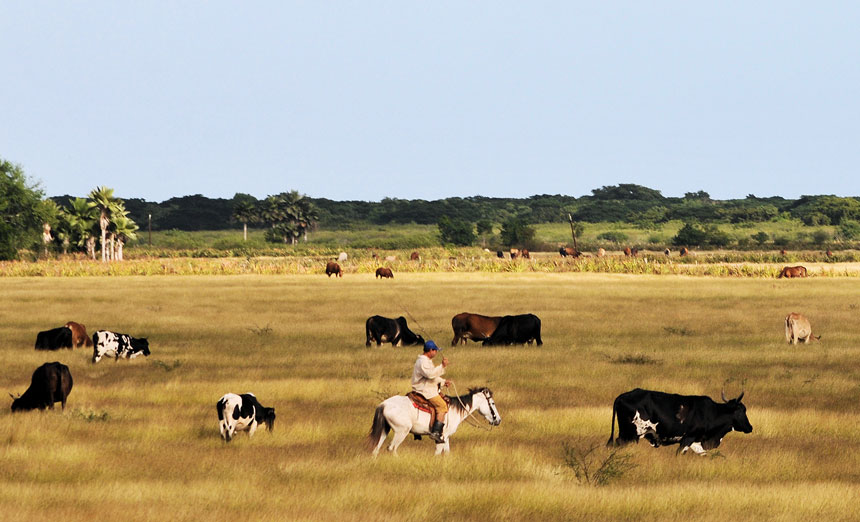
The insufficient supply of water and feed for cattle hangs like a sword of Damocles over several livestock indicators in the province of Las Tunas, which is poised for transformation based on improved herd management.
Las Tunas, Cuba.- In the territory, there are reports of non-compliance in the delivery of meat to the industry and the collection of milk; in the case of the latter, this is due to the diversion of production to better prices on the informal market and other objective reasons, such as the fact that in the areas of Amancio and Jobabo, collection is not carried out on some routes.
However, the fundamental cause is that most livestock owners have not yet implemented one of the most repetitive and least controlled instructions in recent years: owners—whether state or private—must grow feed for their animals.
This task is not being done properly and has been postponed or put on the back burner. Even the arguments used to justify this are no longer convincing, because some farmers do plant feed crops despite having poor soil and a marked shortage of rainfall.
Comparisons are sometimes useful, and it has been proven that farms and units with moringa, mulberry, tithonia, King Grass, sugar cane, and other protein or forage plants have higher yields. There are examples in all eight municipalities.
In addition, with abundant feed, reproduction improves and birth rates rise, fewer calves die from malnutrition, more milk is obtained, and diseases and incidents of theft and slaughter of large livestock are avoided because the animals do not seek out foreign spaces.
These issues were discussed in depth during a recent meeting between the first secretary of the Provincial Party Committee, Osbel Lorenzo Rodríguez, specialists from the Ministry of Agriculture delegation, and the directors of the business system, which includes municipal agro-industrial companies, where the fundamental indicators of the agricultural sector were reviewed, and several agreements were reached based on the analysis, aimed at increasing food production, fulfilling the balance plans, and, in general, meeting the demands of the population and the economy.
They discussed the insufficient areas planted with sweet potatoes; the importance of producing organic fertilizers, entomophages, and entomopathogens; the need to plant more beans and rice; and the excellent conditions in the province for planting cassava.
They also evaluated honey production, the tobacco campaign, delays in payments to farmers, the recovery of the pig industry, illegalities in land use and control, and the failure to meet some of the targets for medicinal plants, which are so necessary in these times.