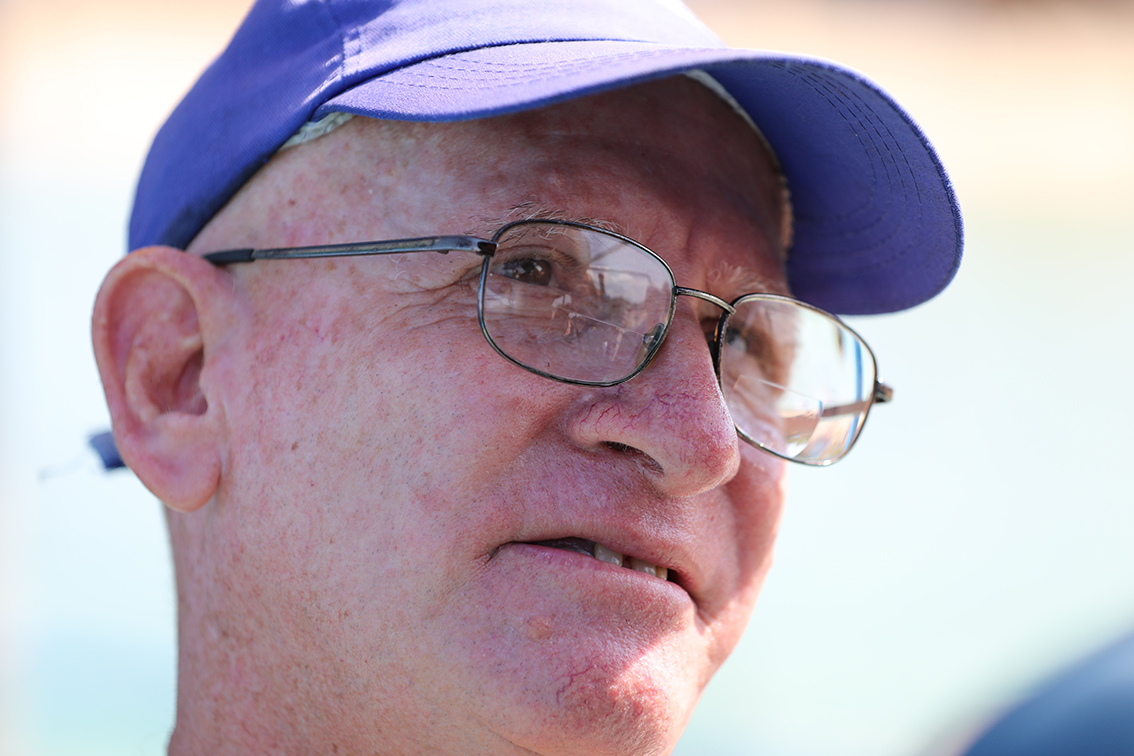
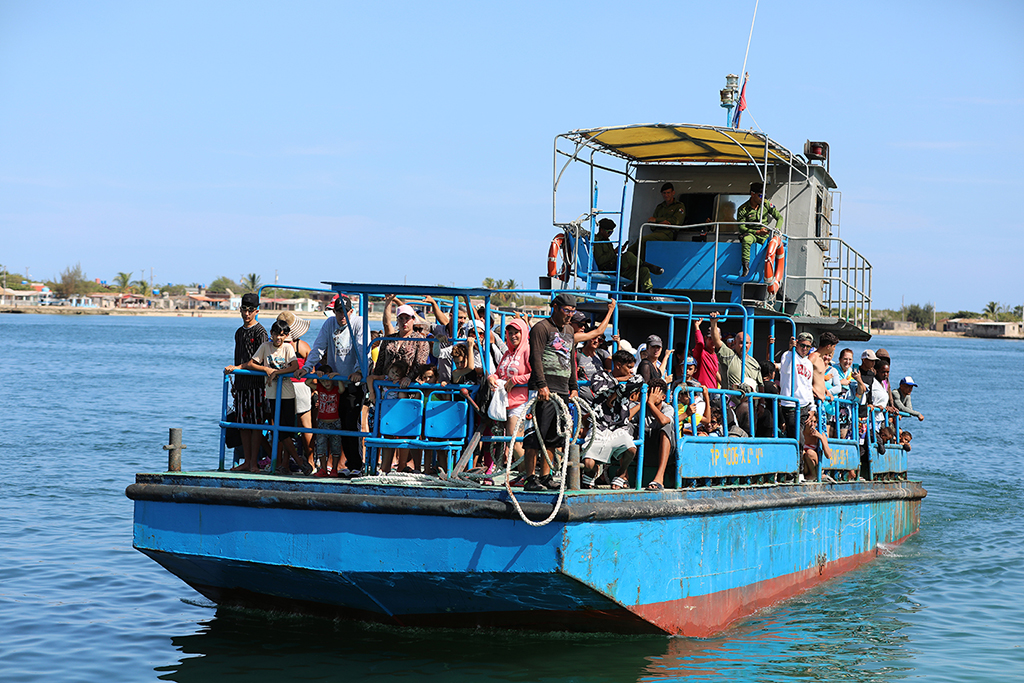
For three years now, Raúl Justo Ochoa has been living the dream of who knows how many children who are always excited to cross the sea channel between El Socucho and La Boca. He is a barge helmsman, and not just any barge, but one that transports thousands of people to the province's most important summer resort during the summer season.
Puerto Padre, Las Tunas.- Somewhat short in stature, with sparse hair, and over 60 years of age, his loquacity surprises this reporter, who approaches him during a brief break in his work.
Raised in a family where words such as keel, length, bow, and stern are part of his everyday vocabulary, Raúl says that sailing has been part of his family's life for more than six decades. “It's in our blood,” he says. So, it's no surprise that he learned early on when the tide rises, or how to interpret the direction of the currents from the position of the anchored boats. However, his profession was different; the barge came later.
"I had a little boat that we used to cross here, but to continue doing so, I had to get a skipper's license. I went to school and got the certification I needed for this, which I do on my vacations," he explains.
- How difficult can it be to drive a boat like this?
“It's not as easy as it looks,” he replies. The first thing, he explains, was to adapt to the dimensions. Going from a boat to something like this, he compares, was like learning to drive a car when you've only ever ridden a bicycle."
“The hardest part is docking. You have to take into account the current, the breeze, the wind, which all influence whether your maneuver is successful,” he describes. "You have to make all those calculations; when to brake, because in a car you just brake and that's it. Not here, but little by little, because you're on the water. When you reverse, the boat still moves forward. It's complex, but beautiful and interesting.
“When you're approaching the dock, you calculate it. You concentrate and, before you arrive, you anticipate the maneuver, how you're going to do it,” he explains.
On busy days, he makes more than 30 trips with the boat full. No more than 90 people, he clarifies, which is the rule that ensures navigability. On those days, the senses have to be sharpened, he emphasizes. The edges of the ship are lost behind the crowd, and his crewmate becomes much more important.
Yes, because even though he is up in the cabin at the helm, this is a team effort with his sailor, who, from the deck, ties and unties the mooring lines, gives the departure signals... all through sailors' signals.
It has only been three seasons, but he already has moments when his composure has been put to the test. Like that reckless swimmer who was floating upside down right in the path of the boat heading for the dock and did not hear the banging on the metal hull with which his sailor was trying to warn him of the ship's arrival. Fortunately, he lifted his head and swam away, he says.
When August ends and the hustle and bustle of vacationers subsides, Raúl will return to his daily work at the Rowing Academy in his native Puerto Padre. There, he will trade the rudder for chalk; the bow will be filled with desks, and the entire deck will be the classroom. Then the barge will be a barge; the sea will be the sea, and so on. He will return to his daily role as an English teacher at the teaching unit attached to the Carlos Leyva school for sports initiation (EIDE in Spanish); he will once again be Teacher Raúl.
Perhaps now this man has achieved complete fulfillment. Not only because he is proud of his family, especially his 5-year-old great-granddaughter and the other one on the way, whose mere mention brings a smile to his face. But also, because he has added something to his summers that certainly boosts the family economy, but above all, that he enjoys. Coming and going through the narrow channel of the Puerto Padre Bay, guiding the boat, which is most talked about by countless vacationers from Las Tunas.