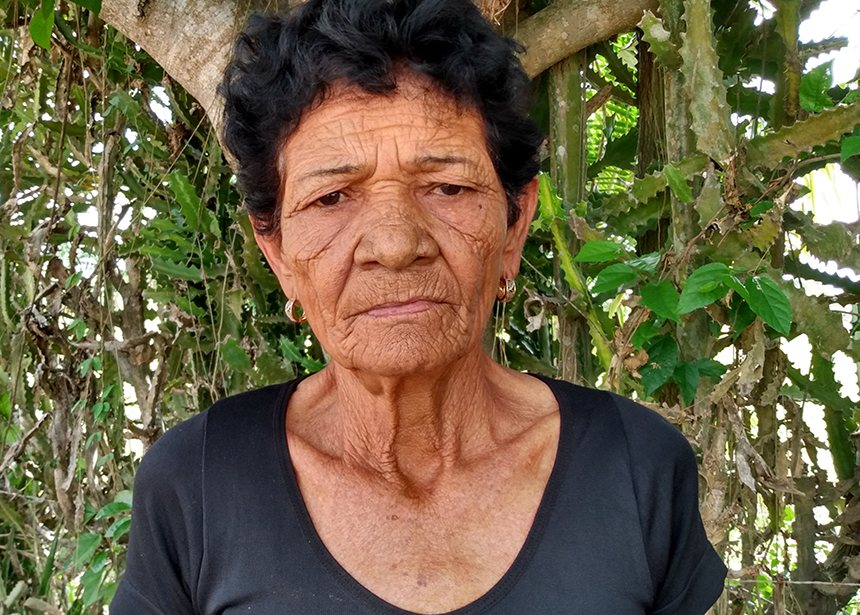
The wrinkles on Virgen Lucrecia Alarcón Almeida's face are a trophy not only for her age, but also for the many feats she has accomplished throughout her life, always determined to do good and bring a smile to those around her.
Las Tunas, Cuba.- This humble woman is one of the members of the José Santiago Ercilla Credit and Services Cooperative in the municipality of Las Tunas, and she manages just over 13 hectares of land in the Sabanita de Cayojo area, near La Jibarera.
There, she demonstrates in all her splendor that she possesses enviable physical strength because “no one should think it's easy.” And it really is complex to deal with drought, lack of supplies, animal diseases, and criminal acts that bring her down, even though she always gets back up again.
“That's a problem that's hitting us hard. It's too much. Keep in mind that farmers who don't sleep during the day can't sleep at night either. I've even been threatened in my own home. A few days ago, they took my mare and told me that if I went outside, they would kill me. I can't let myself be killed, imagine that. They've also stolen my cows.”
Little by little, he lists his losses, which are always valuable because raising a cow is not a task that can be accomplished in a few weeks. His hurried words reflect pain and resignation, coupled with an enormous desire to keep going, to not let these problems stop him.
"You can always count on me, even though I'm 70 years old. As long as I can walk, I'll be there, and that's where I'll die. All my life, I have liked to fight and have my own. When I received this land, I took out a loan to buy cattle, and I was excellent because I paid it off quickly.
"Now I have fewer than 40 head of cattle, but I also have sheep; a little less because the jíbaro dogs kill the young ones. The truth is that those who want to fight, fight. Things are difficult here, but not impossible."
Lucrecia has good support from her husband and also from her son-in-law, who takes on other tasks. However, she says that if one day she has to go back to milking, her hands will be there. They are already a little tired, but for years they massaged udders and extracted milk. As long as it is not necessary, she devotes her time to the ranch.
"Now I don't have any oxen because they were stolen, and everything is slower. I plant, weed, harvest—I do everything. I've had good luck with corn, squash, tomatoes, and other things. I even planted sugarcane, but it didn't work out. Luckily, there are pastures with lots of grass.
“Sometimes I can't even sit down because of the pain. I get up at 4 in the morning and take care of the house while they're milking, and when they finish milking and deliver the milk, I go off to fight my battle. I'm not afraid of anything. They even offered me a house in Havana, but I didn't accept it. If I leave, I'll die quickly.”
She didn't say it, out of modesty. But she is part of a group of farmers from Las Tunas who donate part of their production to maternity and nursing homes, combatants, and vulnerable people. That's why her words are so valuable: “How much more could we do if there weren't so many limitations!”