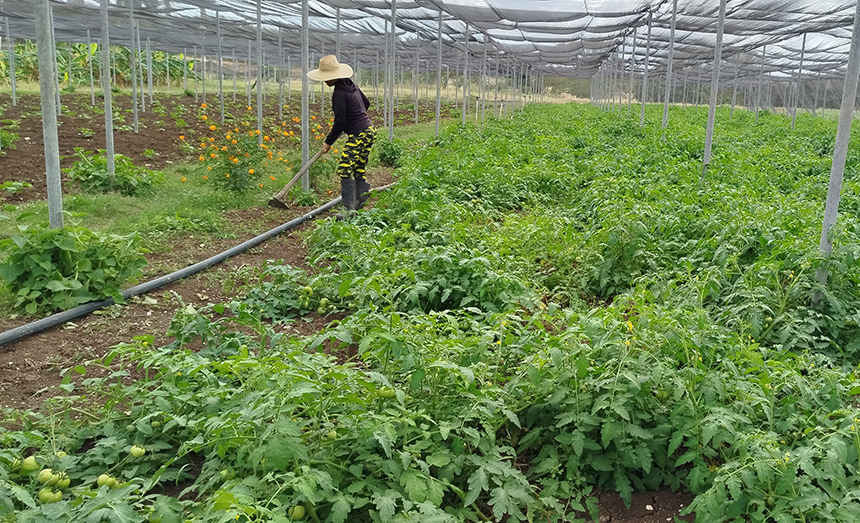
The cooperative and peasant sector in Las Tunas province contributes more than 80 percent of the milk, various crops, and all of the tobacco and honey, just to mention a few examples. Its results would be better if producers had more support.
Las Tunas, Cuba.- This was the sentiment conveyed by the majority of the commissions of the National Association of Small Farmers (ANAP in Spanish), which evaluated the organization's performance in the eight municipalities as part of a comprehensive review of the territory.
Over several days, officials spoke with 840 members who they found in 96 agricultural production, credit, and service cooperatives, individual farms, mini-industries, areas of collective use, and milk collection points, among other spaces.
During the exchanges, the farmers of Las Tunas expressed their dissatisfaction with the insufficient attention they receive from some agencies in facilitating social or productive processes, which was confirmed by Félix Duarte Ortega, national president of ANAP, at the summary meeting of the visit.
The leader stated that during the first half of 2025, support was minimal; for example, local governments did not attend any of the assemblies. The delegation from the Ministry of Agriculture participated in 16 percent of those meetings, the business sector in 15 percent, and the Azcuba Sugar Group in 62 percent.
Several issues affect the work of the organization and its members. One of them is the delay in payments for various items, which amount to nearly 71.2 million pesos. A considerable amount corresponds to disbursements for the marketing of milk, and in this regard, several of those present agreed that it is urgent to resolve this problem promptly.
Another challenge is the bank restructuring process. Although almost all producers have their cards, the 50 percent cash payment guarantee is not being met. Additionally, some cooperatives are located in silent areas, which presents another setback.
According to many farmers, theft and/or slaughter of livestock and other crimes are the worst problems in rural areas. Although there has been a slight decrease in this phenomenon, each incident results in significant losses for the victims.
To counteract the problem, peasant surveillance is being strengthened in almost all production units, and agreements are in place with the Ministry of the Interior; however, the few complaints that are made, only 244 as of the end of August, are contradictory.
Duarte Ortega pointed out that the territory is making progress, but these circumstances must be transformed; the proposals made during the organic process of the 13th Congress must be addressed, and the renovation of fences, Martian squares, and cooperative premises must be completed.
For Osbel Lorenzo Rodríguez, first secretary of the provincial committee of the Cuban Communist Party (PCC), it is urgent to strengthen ties with the grassroots and resolve the subjective problems that currently plague the work of the ANAP and food production. He considered that it was a good time to finalize ideas and undertake new actions, which could contribute to the territory obtaining the venue for the national event on July 26, 2026.