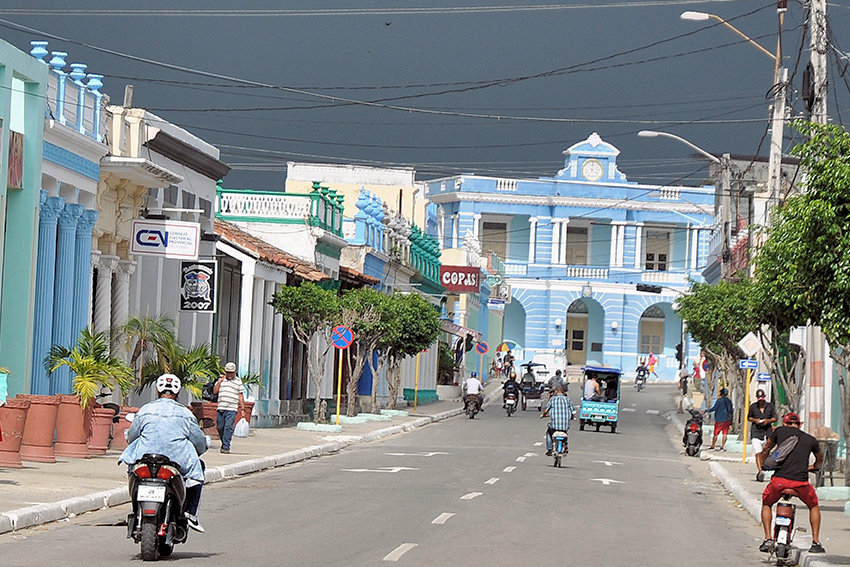
The Provincial Delegation of the National Institute of Territorial and Urban Planning (Inotu) is implementing a comprehensive strategy to plan the development of settlements in Las Tunas, with a vision that prioritizes sustainability, functionality, and citizen participation, explained Tania Vázquez Góngora, the institution's sub-delegate.
Las Tunas, Cuba – Right now, she specified, they are focused on creating planning instruments. “These are plans at a specific scale that allow for a diagnosis and, given their potential, a projection of the desired socio-economic progress, according to the land's suitability,” she explained.
The strategy is comprehensive. For projects like the revitalization of El Diamante, she exemplified, the first step was to engage with the local population. “Without the participation of the community and economic stakeholders, this wouldn't have been possible,” stated Vázquez Góngora. In this area of the northwest of the territorial capital, a landfill was eradicated, facades were beautified, and a main access road was restored, with an eye now on a second phase that includes a children's park and service areas.
The young architect Diana Menzoney Justiz, recently added to the department, emphasized the value of this interaction. “At the University, they teach us that if you're going to work in an area where people already live, you have to take into account what those people need. The transformation is more carefully managed when they themselves participate in the decisions,” she noted.
A key objective on the urban agenda is the 26 de Julio Park, popularly known as La Feria. The Inotu sub-delegate argued that this space has the ideal conditions to become an organized commercial center. “If we manage to revitalize La Feria, we will restore it to its rightful value. It has bus stops, it's a vital transportation route, and it's located in the heart of the city. The intention is not to restrict access, but to bring order for the benefit of the majority,” she emphasized.
Recent extreme weather events, such as the flooding caused by Hurricane Melissa, have underscored the urgency of this work. “Our task is to plan where to relocate homes so that they won't be affected by another event. We are responsible for creating plans that will allow the government to make informed decisions.
The institution, which last month celebrated the United Nations' International Day of Urban October, does not work alone. It relies on a Technical Advisory Council comprised of experts from the University and organizations such as the National Institute of Hydraulic Resources. The final appeal is for understanding and community support. “We need the community to understand that when our workers seek to engage with them, they are not a negative force, but rather individuals with the responsibility to improve a space that belongs to everyone,” Vázquez Góngora concluded.