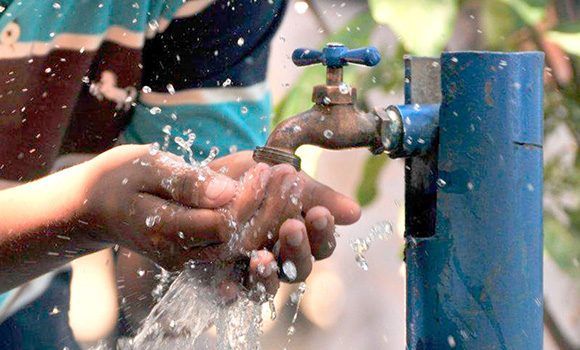
Water supply in the province of Las Tunas continues to be one of the most pressing issues for the population. Despite a favorable year of rainfall in 2025 and significant investments in equipment and infrastructure, technical and energy limitations, along with illegal connections to the water mains, are causing tension in several areas.
In a radio interview, Oscar Carralero, provincial director of Water and Sewerage, and David Legra, municipal director in the capital city, provided a detailed overview of the current situation and the main challenges.
MORE THAN 200 PUMPING STATIONS AND MULTIPLE CRITICAL POINTS
The province has 206 water pumping stations, some of which are out of service due to breakdowns or a lack of resources. According to Carralero, “wherever there is a dissatisfied customer, there is a problem.”
One of the most complex situations is located in the municipality of Puerto Padre, specifically in the area of the micro-sector supplied by the stadium pumping station. The pump was out of service for about 15 days after burning out, and its transport to the only specialized workshop in San José de las Lajas was complicated due to a fuel shortage. It is expected to be back online in the coming days.
In that same municipality, the La Trocha pumping station has been operating for a week with an alternative unit, achieving partial stability, although without fully meeting the demand.
OMAJA AND JOBABO: THE IMPACT OF WATER THEFT
The situation in Omaja is particularly tense. The pipeline from Río Ramírez to that town has three or four major leaks. Of the 28 liters per second that should be pumped, only between 12 and 15 liters reach the treatment plant.
Added to this are the illegal activities: water diversions for agriculture, rice paddies, and livestock. “We are primarily responsible,” Carralero acknowledged, while emphasizing community co-responsibility.
In Jobabo, specifically in Birama, a pipeline installed around 2018 has deteriorated due to illegal tampering with the air valves—automatic valves designed to expel air—which have been altered to extract water.
The problem is not pumping capacity. The wells deliver around 35 liters per second and have 40-liter pumps. However, losses due to leaks and illegal activities prevent the full volume from reaching its destination.
"AMANCIO": RELATIVE STABILITY, BUT AGING NETWORKS
In the municipality of "Amancio," two new pumps were installed in Las Pacas and Galippio, which are operating reliably. However, the area requires network rehabilitation to improve distribution.
In Guayabal, operations are being carried out using alternative equipment, as the original pump burned out approximately a year ago and has not been replaced.
ELECTRIC POWER AND PHOTOVOLTAIC SYSTEMS
The province maintains daily coordination with the National Electric Union through national videoconferences at 8:00 a.m., seeking to protect strategic circuits. Even so, power fluctuations affect the stability of the pumping system.
Las Tunas became a national leader in photovoltaic systems applied to water supply. Currently, there are 142 stations with installed solar panels, of which 19 are out of service for various reasons. Among the most critical is Mejías, in Jobabo, where it has not been possible to improvise a technical solution due to the specific characteristics of the required pump.
THE CASE OF THE PROVINCIAL CITY: STRUCTURAL DEFICIT
The provincial capital faces a stark mathematical reality. According to David Legra, the city needs between 600 and 700 liters per second to maintain a stable three-day water cycle. The historical figure of 500 liters per second is now outdated due to population growth and the expansion of housing.
Today, the situation is as follows:
- El Rincón: capacity of 500 liters per second, but currently pumping around 375 liters per second with three active pumps. A fourth is under repair after being damaged during a hurricane.
- Piedra Hueca: should be supplying 110 liters per second, but today is only pumping 50 liters per second due to a broken pump sent for repair.
- Cayojo: is also pumping around 50 liters per second and has five detected leaks plus three additional leaks due to illegal connections.
- In total, the system barely reaches between 420 and 430 liters per second, well below the estimated demand.
WHY ISN'T WATER REACHING THE PERIPHERAL AREAS?
The answer is technical: the outlying areas are at the end of the distribution circuits. The water that comes from Rincón, for example, delivers volume to large consumers—hospitals, hotels, production centers—before reaching neighborhoods like Aguilera or the airport area.
Without the full contribution from Piedra Hueca and Cayojo, the pressure is not sufficient to supply those areas.