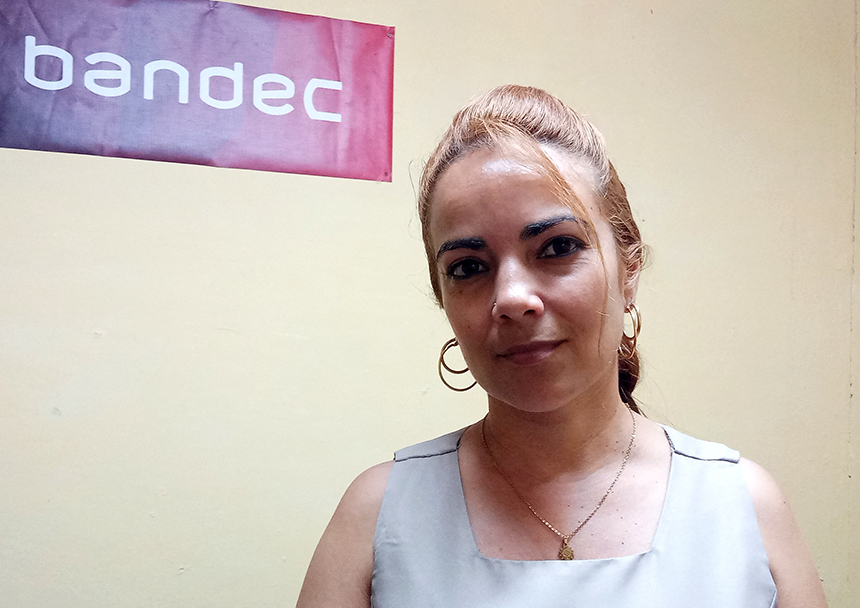
Kirenia Álvarez Batista's routine begins at 5:00 a.m. She has to get her two children, ages 11 and 14, ready and ensure everything is in place so she can be at the vault door of branch 6441 of the Credit and Commerce Bank (BANDEC, in Spanish) in the main municipality by 7:10 a.m. "The cash handling section is what opens the vault. If we're not there, the service doesn't start," she explains with the ease of someone who takes on a great responsibility.
Las Tunas, Cuba.– Kirenia is one of the thousands of women who sustain the country's economy every day from the front lines. Her story reflects the growing role of women in the Cuban banking sector, an area that demands discipline, human touch, and, above all, a great capacity for adaptation.
Three years ago, she worked as a technician in a commercial office of the Water and Sewerage Company. The need to improve her financial situation for her two young children led her to enter the banking sector.
"I started as a bank teller. I was there for about a year and a half. My perseverance led to my promotion to cash supervisor."
-What does your job entail?
"Being a cash supervisor is a rewarding job, but also quite complex. You have to review all the tellers' transactions. They process the transactions at the teller window with the customers, and then it's up to me to check everything. I make sure the signatures are correct, the initial stamps are accurate, and that the amounts for postal and check payments match. Everything has to balance perfectly."
The banking sector, traditionally very demanding, has a significant female presence. How do you exercise leadership from your perspective, especially when you have men reporting to you? "In this case, I don't have that problem of them not letting themselves be 'given orders.' It comes with its own responsibility. But I've always tried to be seen not as a leader, but as a friend.
So that the work flows better. Because sometimes, as a leader, they see you as a more rigid, more serious person. So I try to manage both aspects at the same time."
Being a single mother in Cuba often means shouldering all the burdens alone. Kirenia knows this well. "It's difficult for me sometimes, but I've managed. This is a job that takes up a lot of your time."
Her routine is an example of the daily struggle of millions of Cuban women. In times of economic hardship, being a bank teller or supervisor also involves a psychological challenge. You have to deal with all kinds of people.
"We have to interact with all kinds of people. And even more so in these difficult times. We have to treat customers in the best way possible so they understand the situation the country is going through and leave as satisfied as possible."
Kirenia is just one example of the quiet effort of Cuban women in the banking sector, a fundamental pillar of the country's functioning. On this March 8th, her story reminds us that behind every vault, every teller window, and every transaction, there is a woman who gets up early, raises her children alone, and strives to lead with responsibility, but also with humanity.
"It's a beautiful job," she concludes. And in that simplicity lies the greatness of those who, like her, build a better society day after day.