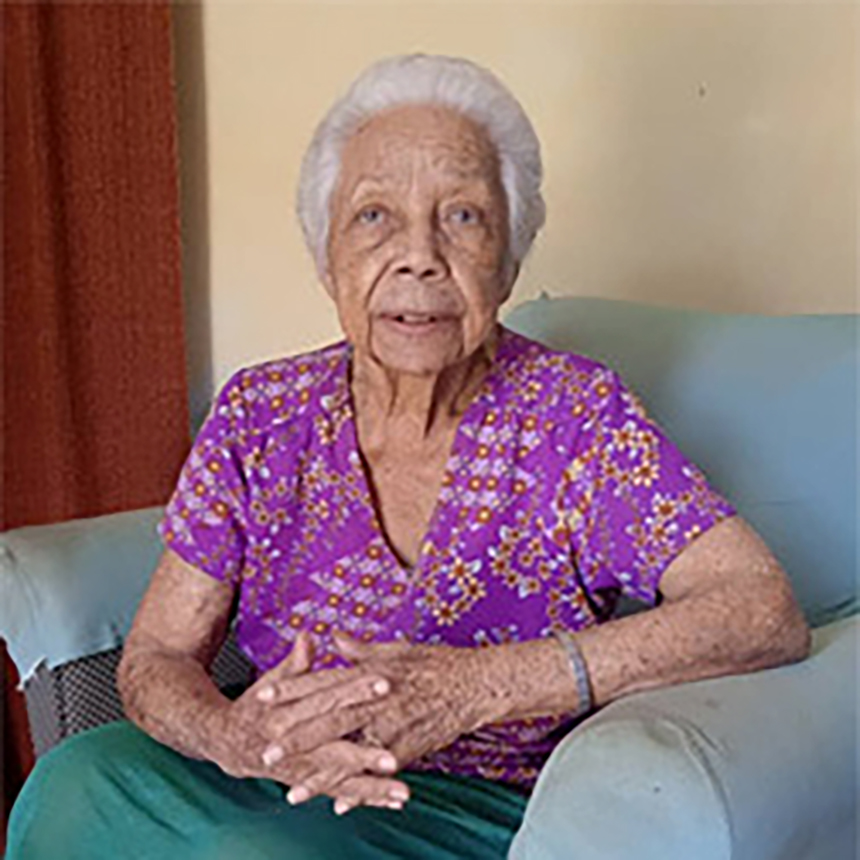
I interviewed her at her home when she was already in her eighth decade. I knocked on her door, and she came to me, somewhere between confused and curious. “How can I help you?” she asked me kindly. When I told her what I wanted, she smiled and invited me in. She, who had served so much coffee over the decades at the Oquendo Café, apologized with an “I'm sorry, sir, but I don't even have any coffee to offer you.”
Claudina Acosta Yánez was very young when she worked as a maid at the old Plaza Hotel. She remained there until the (absurd) demolition of the beloved building in the early 1960s. Left unemployed, she was offered a job as a pastry chef at the neighboring Reymar café. She accepted, but did not stay there long. The nearby Oquendo Café was having problems and was looking for someone to organize it. They talked to her, but she refused. “I don't know how to work with steam coffee makers!” she said in her defense. They insisted and convinced her.
She learned quickly. "The coffee maker had a little tube where the steam came out, and that boiled the mixture of coffee, sugar, and water. Each batch made about 20 cups. When it broke, we had to make coffee with a large strainer and a ‘clown’ of the same size.“ A friend taught her. ”Look, first you boil the water in a bucket, add the powder to release the ink, add the sugar, and finally strain it. See how easy it is?" At first, she worked alone during the day. Then they hired someone for the night and early morning shifts.
“The owner of the Oquendo café was Ramón Nieblas, who lived in Victoria de las Tunas for many years and then emigrated to Puerto Rico,” she recalls. His house was at the back of the café, separated by a wall. When private businesses were taken over, his was one of them. He didn't like that, and he wanted to get even. One morning, he called me and said quietly, ‘Listen, when you don't want to work, break the coffee maker, you understand? Break it!’ I told him no. I'm a decent person, and I don't lend myself to that. I had gone to work, not to sabotage! He never mentioned it to me again."
In a few weeks, the “Oquendo” became famous throughout the city. So much so that it caused jealousy in other establishments in the same line of business. Claudina insists that she did nothing special to win over customers. Was it the quality of the coffee? Or her good nature? “Well, I don't know,” she replies modestly. I added the powder and sugar to the drinks and treated everyone the same.“ She notes that hundreds of people passed by every day. When she arrived in the morning, there were already "coffee drinkers" waiting for her to open the shop.
“Important people in the city drank coffee at the ‘Oquendo,’” she says. But also humble people, such as the elderly and the homeless. One man they called Sapi Sapi was a regular. When he arrived, he would give me a small cup that was always dirty. I would wash it and pour him a little coffee. He would thank me with his eyes. Bus drivers were also regulars. They would park, get out for a moment, have a cup of coffee, and even fill their thermoses for the road. People were constantly coming and going in that tiny place. A 10-pound bag of coffee would run out very quickly.
Claudina retired when she turned 60. It was time to rest, as the work was very demanding. Besides, she had her family. “Coffee maker?” I ask her. And, to my surprise, she replies, “I don't drink coffee!” I go back to my old ways to find out if she remembers the “Oquendo.” “Of course, I spent many years there! Sometimes I remember the neon sign it had and the people waiting for their laundry. But I haven't been to that area in a long time.”