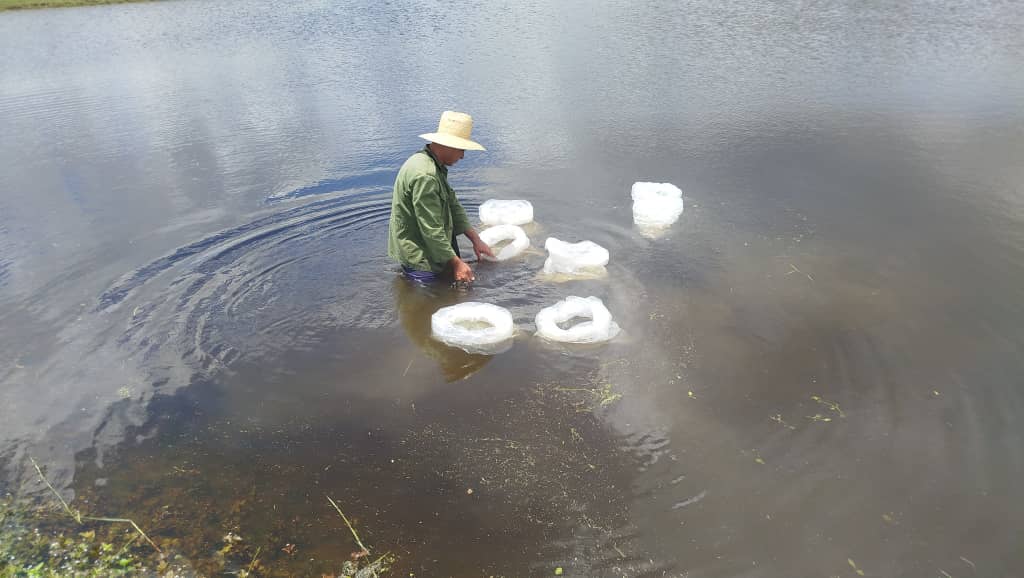
A live shipment of three million cyprinid larvae, including white and spotted tench, arrived from the province of Camagüey at the Los Naranjos fingerling center, located in the municipality of Majibacoa, Las Tunas province.
Las Tunas, Cuba.– The stocking, which has already begun in prepared ponds, aims to ensure a survival rate of over 40 percent, a goal that depends on a rigorous technical process and the daily care of the hatchery workers.
The approximately three-hour road trip presents the first challenge: acclimating the tiny larvae, stated Adalberto Leyva Segura, MSc, director of operations at Pescatun.
"The temperature difference between the water in the bags and the water in the ponds can exceed two or three degrees. To prevent this, the workers keep the bags open for 20 or 30 minutes, allowing them to release carbon monoxide and slowly adding pond water. It's a slow process, but vital to prevent the larvae from suffering thermal shock," he added.
Once the temperatures equalize, the bags are emptied, and the larvae emerge spontaneously in search of their new home. From then on, the team monitors their growth every ten days and keeps an eye on the water's transparency, which should not exceed 30 centimeters.
"This tells us the level of available food, both phytoplankton and zooplankton. These are microorganisms and algae that these filter-feeding animals feed on, constantly filtering the water," he explained.
After 35 days, if everything goes according to plan, the fry is harvested. The initial goal is to reach one million specimens within 35 to 40 days. These first fingerlings will be sent to reservoirs within the municipality of Majibacoa and to small-scale, family-run aquaculture operations.
In total, the province has 6,500 hectares of water bodies, including both reservoirs belonging to the state-owned fishing company and areas managed by local producers, where these fingerlings will be distributed, thus ensuring restocking.