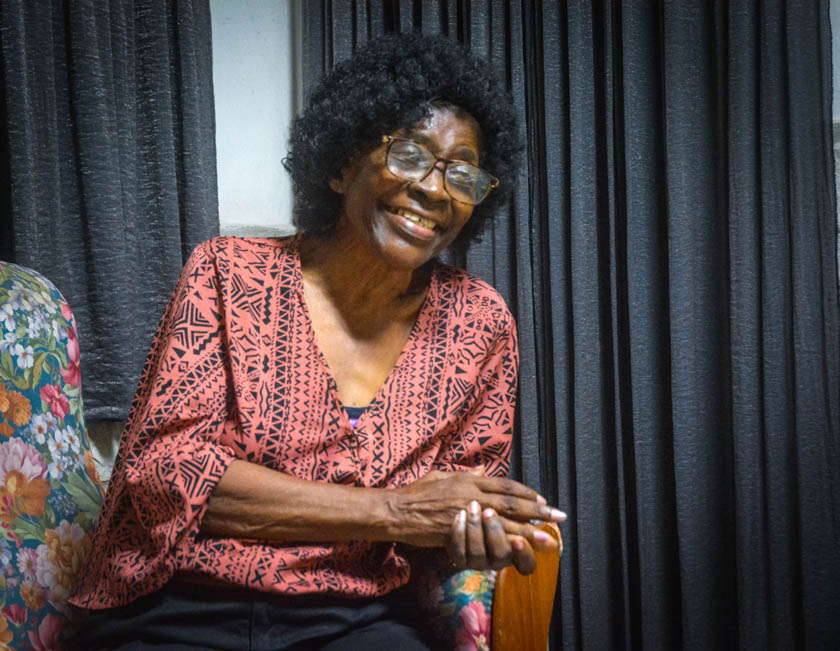
She has the gaze of someone who has witnessed history firsthand, from a schoolyard, with the still-trembling hands of a 17-year-old girl who one day saw a giant walk in. Today, Aleida Best Rivero, with over six decades of teaching experience, recalls -with the delicacy of someone guarding a treasure- those two encounters with Fidel Castro Ruz that marked her life forever.
It was 1966, in Birán, a group of young women were passing the Emergency Teacher Training Course. It was around 5:30 in the morning when Aleida sensed that something different was about to happen.
"I felt the front door of the school open. I stood up, and when I looked, I saw that man, like a giant, approaching," she remembers, still with the same wonder as that early morning. "I was so surprised that instead of going to where he was, I ran away and hid."
The image is etched in her memory: Fidel's imposing figure, the early morning light, and her, small and cuddly, hiding as if astonishment had robbed her of control of her legs. It was the director, Ana Argelia, affectionately known as Gelín, who reacted by alerting the other girls. "All girls threw themselves down in their nightgowns, however they could, to see Fidel," Aleida recounts with a laugh.
But she couldn't. She was overwhelmed. Under a carob tree that shaded the schoolyard, the director remarked to Fidel, "Here in here, we have the national vanguard of primary school boarding schools." Then they called her over. Aleida approached, cowering, her shyness palpable, and Fidel embraced her.
"I was so overwhelmed that I could barely speak," she confesses. "The only thing I said to Fidel was: Fidel, when are you going to Las Tunas?" And he said to me: 'Why do you want me to go to Las Tunas?' And I said, 'Oh, go to Las Tunas, go to Las Tunas!'"
She couldn't say anything else. But that girl who had written the school anthem, who directed cultural activities, and was active in the youth movement, was much more than her nerves. The principal, sensing her state, asked her: "Aleida, let's sing the anthem for him." And then, as if in an act of redemption, she gathered her classmates and they began to sing.
"Desire to teach, education will lead all Cuban children, for that freedom that now reigns in Cuba, we must live in an organized way, studying here in Birán, to be teachers for all of the Cuban Republic..."
Fidel listened attentively. When they finished, he said: "Very beautiful." Then he asked: "What does this tree remind you of?" And the girls in unison answered, "Minas del Frío."
Fidel then called his brother Ramón Castro and told him: "Prepare the arrangements for the girls to go to Minas del Frío." But before leaving, he spoke to them about something Aleida would never forget: the importance of first grade. "First grade is the gateway to a child's educational development," he told them. And Aleida, who didn't particularly enjoy working with young children, felt that destiny was pointing her down a new path.
Then the unexpected happened: it was Aleida's birthday. "It was the greatest gift I have ever received in my life," she says today, her eyes shining.
More than three decades would pass before Aleida met Fidel again. It was the year 2000, this time as a member of the National Assembly of the People's Power. Everything was proceeding normally that day, unfolding with the formality the moment demanded. Suddenly, the solemnity was shattered, and Aleida, sensing the moment slipping away, raised her voice without asking permission:
"Now, only one path, the only path for the true Cuban: you in the worker, and in him, your peasant, and the people, a united act, that says 'Homeland or Death,' is the cry of Cuba."
Fidel asked, "Who spoke?" And Aleida continued reciting her poem to the end: "With the shield, or upon the shield, 'Homeland or Death.'" The atmosphere became unified once more. When it was all over, around two in the morning, Fidel walked through the ranks. But it was Ramón Castro who approached Aleida: "I've come to give you the Castro kisses. This is Raúl's, this is mine, and he kissed her forehead, and this is Fidel's." That was extraordinary for me, Aleida whispers, still moved.
Today, Aleida Best Rivero received the award from the Cuban Association of Educators and the Higher Education Award. But her greatest pride is having been a teacher for 62 years. She was a Primary School teacher, a History teacher, and has taught Research Methodology, Anthropology, and Ethnography, and worked in the Art department at the University of Las Tunas.
"I'm a hybrid," she says with a smile. She has supervised eight doctoral dissertations and more than 120 master's theses. "I've always said I'm a millionaire," she affirms. "In the 62, almost 63, years I've been teaching, it's been the greatest thing that's ever happened to me. I believe I was born to be a teacher and I will die a teacher."
Her children, as she calls her students from Hortaliza 4, are scattered around the world: doctors, nurses, engineers, teachers, professors. And among them, Raúl Verdecie, a great professional in Cuban television.
"I feel that as long as I live, I will remember the teachings of our Commander, I will always fight and work for this society," says Aleida. "Even with all the difficulties we have, we know that if we all unite, we will move forward. That is my hope and my faith."
She fondly cherishes the memory of her encounters with Fidel Castro Ruz, the giant who one day walked through the door of her school and remained forever in her memory.