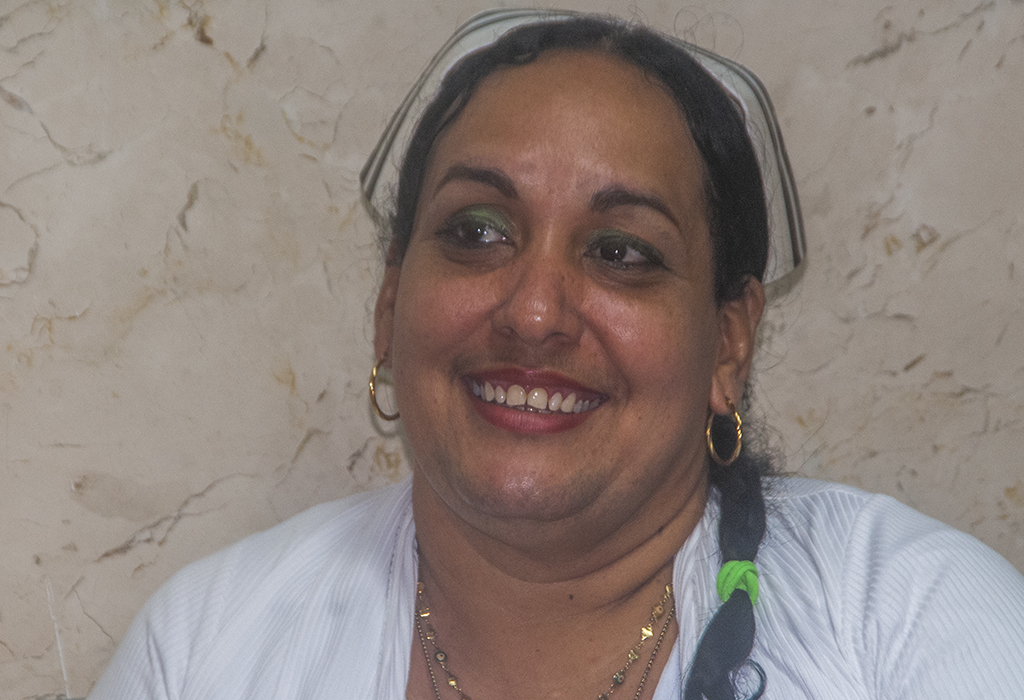
When Ludmila Ávila Caballero talks about her profession, she is filled with a sense of pride that is almost palpable. It doesn’t matter that 24 years have passed since she began as a nursing assistant in Gynecology, or that she’s had to rise to the challenge in delivery rooms outside of Cuba... She’s still there, steadfast, convinced that nursing isn’t just a job, but a calling.
“If I were born again, I’d be a nurse all over again,” she repeats with a certainty that is disarming.
Nothing in her family predestined her for nursing. There was no history of white coats in the Ávila Caballero household, but little Ludmila knew it from a very early age. “I always knew I was going to be a nurse,” she confesses without hesitation.
Although she acknowledges that a law degree was tempting —driven by her admiration for her sister, a prosecutor— the call of healthcare was stronger. “I really like what she does, but this is where I belong,” she says.
THE TRIAL BY FIRE: THE LEAP INTO THE UNKNOWN
The year 2012 marked a turning point in her career. Sent to Venezuela as an obstetric nurse, Ludmila encountered a reality that went far beyond her previous experience in Cuban Gynecology.
“There, they told me I had to take on everything as if I were a doctor,” she recalls. Deliveries, dilation and curettage procedures, and other interventions that in Cuba are the exclusive domain of physicians became part of her daily routine. “We handled over 40 deliveries in 24 hours. I was exhausted, but it was an opportunity that shaped me as a professional,” she confesses with her characteristic sincerity.
She speaks of her first mission as an indispensable learning experience, though not everything was pleasant. She had the scare of her life when she left the maternity hospital where she worked. She was riding in a van when she was held up at gunpoint. “I threw myself to the ground in fear and landed flat on the road. I scraped all the skin off my knees and elbows,” she recounts. The trauma was so severe that she spent nearly a month unwilling to leave the house.
However, neither violence nor fear could break her calling. “We carry on with our work, and I’m still in love with my profession,” she states firmly.
HUMANISM IN TIMES OF SCARCITY
Today, Ludmila faces the most complex challenge of her career: running a hospital in Las Tunas with an understaffed team and limited material resources. “Here, we look for strategies,” she explains pragmatically.
“When we’re short on IV catheters, we use a ‘mochita’ troquer; we look for other options.” She has even donated her own sheets to indigent patients who have no family. “A nurse has to be human, above all else. In addition to medical care, they have to give a little love,” she reflects.
Despite holding a management position, Ludmila remains, at her core, a frontline nurse. “If I have to insert an IV, I do it. If a patient needs IV fluids, I do that too,” she states emphatically. For her, direct contact with patients is the fuel that keeps her passion alive.
With her characteristic honesty, Ludmila doesn’t hide her concern about the next generation taking over. “We’re working to raise awareness among the staff. The younger generations don’t think the same way or share the same ideas, but they’ve shown they can take on great responsibilities when necessary. It’s up to us to inspire the younger generation to fall in love with this demanding profession.”
Even so, she hasn’t lost hope. She knows that nursing is hard work, but it’s also the most beautiful job in the world.
Ludmila Ávila Caballero’s life is a living testament to what it means to serve. Her story, marked by risk, scarcity, and tireless dedication, reflects the spirit of Cuban nursing: a profession that, despite everything, continues to beat strongly at the heart of Las Tunas Hospital.