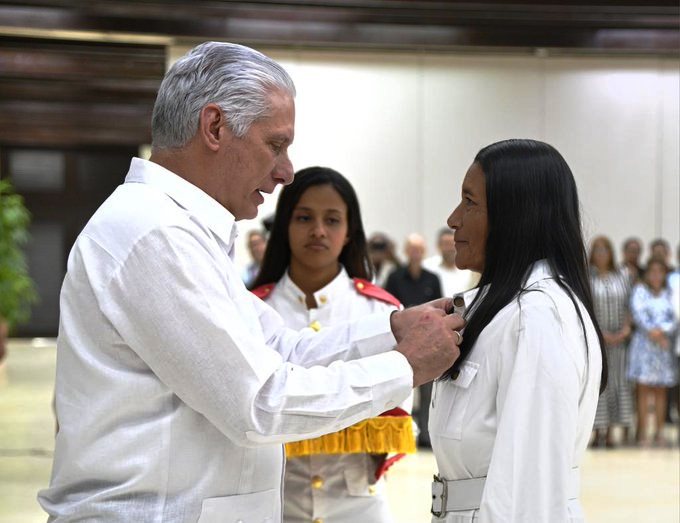
 Miguel Díaz-Canel Bermúdez, President of the Republic, confers the title of Heroine of Labor upon Magdelaine Sosa Menencia.
Since last April, Magdelaine Sosa Menencia has worn on her chest —and carried in her heart— the star that distinguishes her as a Heroine of Labor of the Republic of Cuba, an honorary title recognizing her outstanding career spanning more than three decades of service to education and the training of new generations.
The foundations of this high distinction were laid in El 55, “a rural village in the municipality of Jobabo, where I lived until I was 5 years old, and of which I have fond memories,” she says with a touch of nostalgia.
She was born into a humble family, and that rural environment —nurtured by the love and integrity traditional among the men and women of the Cuban countryside— forged the values that serve as a compass for her life’s journey.
This is how he sees it, and he expresses gratitude for the lessons taught by his parents: “The values instilled and nurtured by my parents —Miguel Sosa Sosa, a tractor operator, and Rosa Menencia Agüero, a store clerk— and the influence of my grandparents. During that time, he recalls, there was both kindness and strictness. They raised my sister and me with a great deal of discipline and respect. That combination has been the cornerstone of my personal and professional life.”
FROM HOME TO SCHOOL TO WORK
“At home,” she says, “I was taught that greatness is not measured by what you possess, but by the ability to work with integrity and serve others. Good behavior was not enforced through shouting, but by example. I was raised with the conviction that love is demonstrated through actions, that work ennobles, and that integrity is non-negotiable.”
“Playing house and playing tag with friends, taking turns in different roles,” she says, were her favorite childhood games, “but my passions,” she adds, “were playing teacher and reading. From a very young age, I devoured books of all genres: children’s books, novels, and science books. Reading was my refuge and my window to the world.”
That’s why it’s no coincidence that she chose teaching as a profession —one she has practiced with devotion. When she began her student life, that little seed had already been “planted,” and what started as a pastime grew into a responsibility. “In school, I was always a teaching assistant for some subject,” she says, attributing the decision to her love of books and her almost insatiable desire for new knowledge.
She notes that the excellent teachers she had also influenced her: “They made me fall in love with our country’s history. They were role models for me; they inspired me,” and she earned a master’s degree in Educational Sciences and has been approved to pursue a doctorate in this field.
At what was then the José Martí Higher Pedagogical Institute in Camagüey, her aspirations found fertile ground. “I graduated in 1992 and was assigned to the Manifiesto de Montecristi Agricultural Polytechnic Institute (IPA) in my hometown to fulfill my Social Service obligation,” and from then on, she could no longer “break away” from technical and vocational education.
After two academic years of teaching, she was promoted to department chair, and she took on, almost consecutively, other responsibilities such as department chair, assistant director of academic affairs, assistant director of vocational training, vice principal, and, since 2005, principal of this school, which she has turned into an extension of her home and an institution that demonstrates how much can be achieved through hard work and responsibility, even amid shortages and challenges.
The values instilled by the humble family that raised her are the source of her inspiration and the foundation of a leadership style that her colleagues appreciate, recognize, and follow. And this heroine speaks in the plural: “We conduct the teaching-learning process with pedagogical rigor and human sensitivity. Technical and Vocational Education goes hand in hand with ethical training. Our learning process is dialectical; the workshop and the field are our laboratories, without neglecting values. We teach the students that agricultural work is dignified. We foster discipline through high standards, but also through dialogue.”
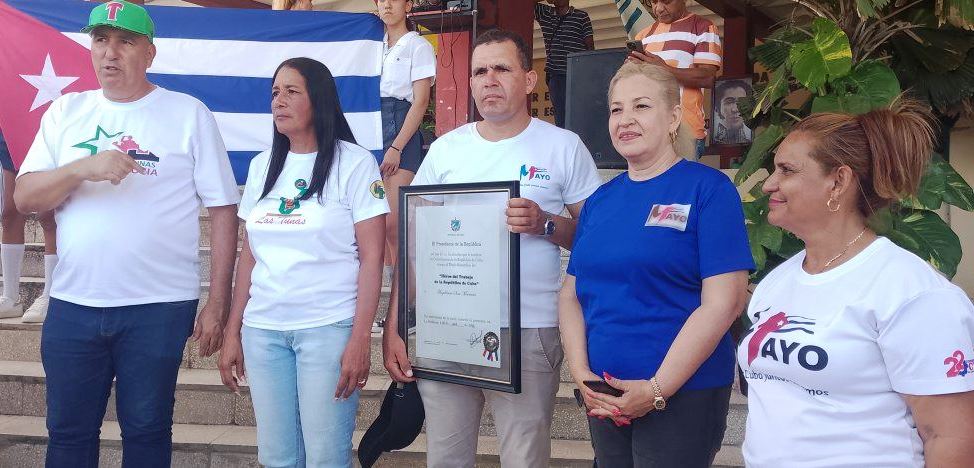 Las Tunas authorities welcome the Labor Heroine upon her return from Havana.
PERFORMANCE, SATISFACTION
“Training these young people is the most sacred mission a human being can have. I have seen how the inexperienced hands of a teenager become steady hands, operating a combine harvester or assisting with the birth of an animal. We are not simply training students; we are training the next generation of Cuban society
—an important part of its working class. In a few years, these young people go from being apprentices to becoming the breadwinners of their households and the driving force behind our economy. Seeing them enter the workforce is the greatest reward for our collective effort.”
The heroine has many experiences that take root within the walls and fields of the IPA, experiences that fill her spirit with satisfaction for a mission made possible “thanks to the unconditional dedication of my faculty colleagues during the most difficult moments —the ones that truly forge character,” she says.
Among the memories she treasures, she recalls, “when a piece of farm equipment was missing, the group would repair it with their own hands through ingenuity and sacrifice; spending entire nights on watch to protect human lives during hurricane evacuations; or saving a harvest because a cyclone was approaching.”
She has etched into her symbolic universe “the face of a student who arrived at the center with a rebellious attitude and behavioral problems, and who, thanks to strict discipline and the affection of our teachers, is now a leading producer in the municipality of Jobabo,” she exclaims.
THE RESULTS, THE AWARD
“The day I received the news that I would be honored, I felt a whirlwind of emotions. One never works with awards in mind, but rather to do things well out of a sense of responsibility for shaping the next generations. So, the first thing I thought of was my team.
“These achievements aren’t just mine, and this title isn’t for me; it’s for every teacher, every student, every teaching support staff member, and everyone who has been part of ‘Manifiesto de Montecristi,’ my polytechnic, over these past 32 years.
“It is also recognition of a management model in which the effort is shared. We are all proud that our president, Miguel Díaz-Canel, visited us and then proposed this distinction, because it tells us that we are on the right track, and that our daily efforts to turn the school into a productive training and development center for the community have not been in vain,” she emphasizes.
The workers at the IPA Manifiesto de Montecristi, led by Magdelaine Sosa Menencia, Heroine of Labor of the Republic of Cuba, have transformed this institution into a National Reference Center for agro-industrial specialties and a “Labor Feat Collective,” among other designations that also highlight its contribution to the community and the high levels of efficiency in its management.
“Our center stands out nationally for managing 12 projects —two of them international— related, among other topics, to local development, the environment, and research, both regional and sector-specific,” Magdelaine affirms, viewing the award as an inalienable commitment to defending the homeland.