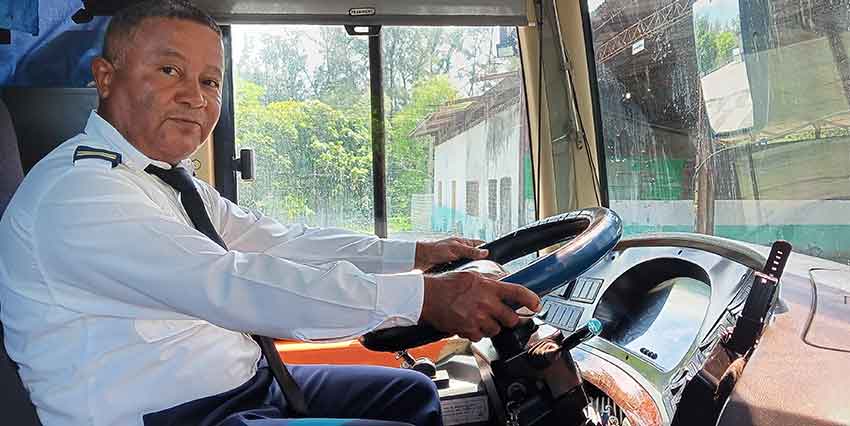
His colleagues and the managers of the Ómnibus Nacionales business unit agreed that Asbel Cutiño Rivero embodies the spirit of transport workers and that his life story serves to honor them.
Asbel's career is a symbol of perseverance, overcoming adversity, and dedication. This is an opinion shared by the workforce, whose members saw him arrive in April 2006 at the unit's spacious premises, wielding brooms and dustpans... “It was the only job available at the time,” he says now, “and it was also an opportunity to get closer to my lifelong dream: driving a bus.”
He decisively left the branch from Las Tunas of the State Reserve Institute, “where I drove a small car with a fourth-class license, but I kept thinking about buses, which is why I made the change, even though many people thought it was a bad idea,” he notes.
IN PURSUIT OF A DREAM
He remembers that as a boy he was obsessed with the idea, then he learned that it was a high-risk profession with a lot of responsibility, challenges he was willing to face—and does face—and that did not make him abandon his intentions.
“When I saw my cousin Gilberto Cutiño driving a school bus, I felt a healthy envy. I wanted so much to achieve the same thing, and I wasn't going to give up for anything,” he says categorically, recalling that he only worked as a cleaning assistant for a few months. “Then I moved on to the maintenance brigade and spent my days doing odd jobs, minor construction work, office maintenance, and other areas...”
He says he did whatever was necessary without complaining and felt the same excitement he had as a child when he saw the buses coming and going or moving around the square. He sensed that it wouldn't be long before he reached the desired rung on the ladder. “I didn't stay with the brigade for long either, because I moved on to the Yutong bus cleaning team, where they allowed me to start training for my second license.”
Then the possibility arose of becoming a parking lot driver, but it didn't happen, "because a position opened up to drive the guard car that picks up and transports personnel; they gave me a test run from Las Tunas to ‘Amancio’ to Las Tunas, and the results were positive.
“Now I was close to realizing my dream,” he exclaims with the same intensity as that day in 2008, when, with his long-awaited license, he felt he was close to the reward for his perseverance.
ALMOST A DECADE LATER
Asbel explains that to get on the platform, that is, to drive a Yutong, he had to complete the five years required by the regulations and earn the category of driver A. After meeting those requirements, he left for Havana, attended the National Bus Company School, and on April 5, 2016, he returned to Las Tunas with the approval and skills required to drive these buses.
“Almost a decade later, I achieved my personal and professional goal,” he says, his words recalling the excitement with which he took hold of the steering wheel of a brand-new Yutong bus.
Asbel emphasizes that when he takes the wheel, he leaves all his problems at home, “because driving requires a lot of concentration.” He emphasizes that he does so with the people he carries on board in mind and with his family's farewell: “Take care of yourself, we'll be waiting for you here.”
OF ROUTES AND SHORTAGES...
Passengers on various routes connecting the city of Las Tunas with Havana, “Amancio,” and Santiago de Cuba are familiar with his sense of ethics and individual responsibility. “Everything depends on us (the drivers), mainly the safety of the passengers and the means of transport.”
That mission is another of Asbel's obsessions: “I only think about the well-being of the customers during the journey. That the trip is smooth and that they are taken safely to their final destination. To meet their expectations in a good way. I learned that from my colleagues and the management of the unit during those years of waiting, and I reaffirmed it at school, an institution to which I, like my colleagues, am grateful for the training.”
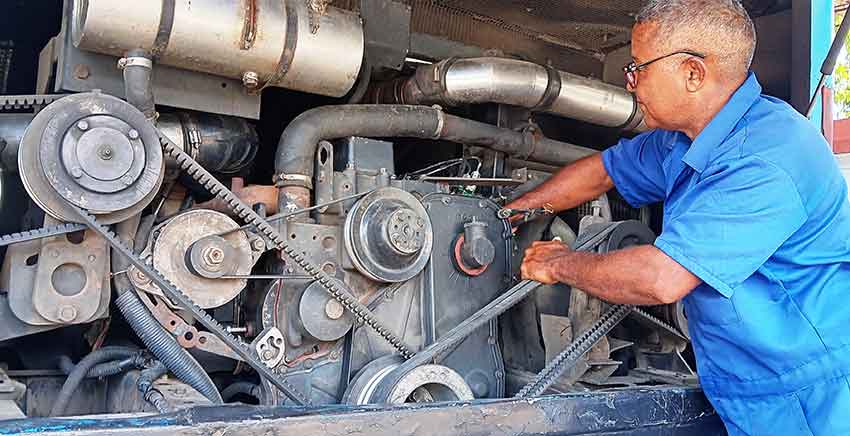
The collective also praises his empirical knowledge of mechanics and his willingness to collaborate in the repair of these much-needed means of transport, which are severely affected by the shortage of spare parts, tires, and other resources that the US blockade makes more difficult to acquire.
“For these reasons and because of his commitment, it is common to find him dressed in overalls and with a wrench in his hand, improving the technical condition of his car or helping any of his colleagues after completing a trip. He is an example to all of us and to the young people in the unit, to whom he instills values. Here we have three engines running that Asbel has repaired,” says Aramís Castellanos Díaz, senior specialist in the Department of Science and Technology.
And in closing, he says: “There are people who are schools, and that is the case with Asbel.”