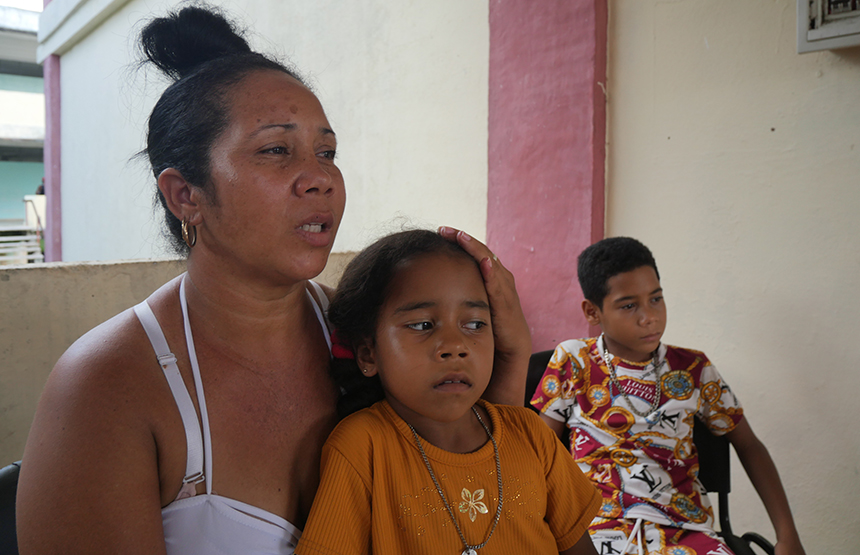
On the morning of October 27, as the sky began to darken with clouds, the sound of the river grew louder than the voices in the neighborhood. Daineris Reyes Martínez left Guamo, a town in the municipality of Río Cauto, with the sun hidden and the feeling that a hug was enough to sustain her.
"I was holding my two children by the hand, along with my grandfather, my father-in-law, my mother, my nephew, and my sister-in-law. No one said it would be a farewell to our belongings, only an urgent need to find a safe place."
The train was the promise that moved us, but the day became more and more complicated, with delays and contained fear, until the river showed us how much it could wipe away in a single night.
“I packed the basics with hands that couldn't think straight, clothes for the children, and important documents. We left Guamo around 10:00 a.m., all crammed into the doorway. The order was to move, to find somewhere to wait out the storm.”
The train was late, but it arrived to save our lives. The wait was tense, as I cared for the children, answering questions with short words and repeating that everything would be okay, even though my voice was shaking.
"When we finally left, the trip was not smooth. The feeling and the bad thoughts of leaving everything behind and staying away from home, without knowing for how long, grew with every kilometer. During the journey, the train we were traveling on had technical problems. We were in the front; the other half was left behind. There were screams, people running, hands pushing to help or to find someone. They tried to get the train moving and couldn't; we were stuck with our hearts in our throats."
“We arrived in Jobabo around one o'clock. Everything was organized at the terminal; they put us on a bus and brought us to Las Tunas. Entering the city was like entering another life that was waiting for us. They took care of us with what they had: water, food, and a place to sit without fear of the water reaching us. The care was a concrete relief in the midst of the confusion.”
The children, the five-year-old girl and the seven-year-old boy, looked at her with wide eyes. The stories that had once been routine became tools. She invented short stories to calm them down, games to entertain them, and help them forget for a while the home they had left behind. Their questions came, and like children, they didn't understand the situation at all. Daineris didn't have clear answers to their questions; she just said yes and promised a happy return, like someone sowing hope.
"The river flooded our house and took everything. Furniture, animals, and the little we had were gone. There were things I never imagined I would lose. My husband is still in the area, in a boat, trying to rescue what's left. I've had very little communication with him. The silence of not knowing about the rest of the family weighs heavier than the noise of the storm."
Here in Las Tunas, the days are organized around cultural activities and group games for the children. Some people tell you that they also lost everything, and others offer help. There are moments of relief and tears that mix at bedtime. “I get up with the children, prepare what is necessary, and look for new ways to educate them so that they do not lose their customs.” Every gesture is a map to regain some normality.
The loss hurts every day. It is not just about material things; it is about losing a shared history in a house that no longer exists. Despite everything, today, some people listen and help without any interest; that's how we Cubans are. That sustains us.
“I think about rebuilding walls and memories, about finding a moment to breathe without thinking about the rain that came. I think about my husband in the boat, about the children who will learn again to play among borrowed things, about the day when I will open a door and perhaps begin to rebuild my life.”
As long as they are all together, one task remains unchanged. Keeping calm, carefully naming the losses, and gathering the strength to start over. That need becomes the compass that guides every step in Las Tunas and the promise that is repeated so that, when the time comes, they can rebuild the house that the river took away.