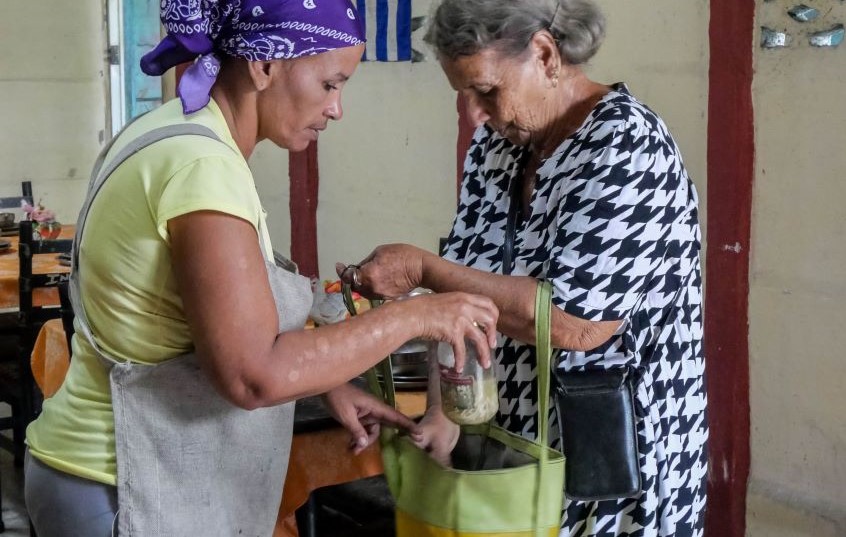
Rafael, his elbows on the table, lifts the lid off the blue pot and shows the spaghetti inside, intended to sustain him on any given day, when the newspaper 26 decided to investigate the supplies of the Family Care System (SAF in Spanish). The faces of the elderly, more than their words, paint a grim picture of a service that, right now, leaves much to be desired.
"I know that the situation in Cuba is difficult, but we are human beings. We have been eating spaghetti for lunch and dinner for over a week because there is no rice. It's acceptable for a short time, but it's criminal all the time. And yesterday, for the main course, they gave us unfried croquettes. These are small things that could be improved... I say," argues Rafael, staring at his bowl.
A short distance away, other diners at the SAF in El Diamante add quietly that this daily intake of flour is a bomb for the blood pressure of those who are generally over 65 years old. “And most of us don't even have medication,” they say.
Near La Feria, Alberto shares a similar scene as he waits for the dining hall to open. "A few days ago, we spent more than a week eating flour because of the rice shortage. The most difficult thing is that the food is almost always the same. They give us minced meat all the time. We dream of enjoying a chicken leg once a month, at least," he jokes.
BETWEEN THE SMOKE AND THE SEASONING
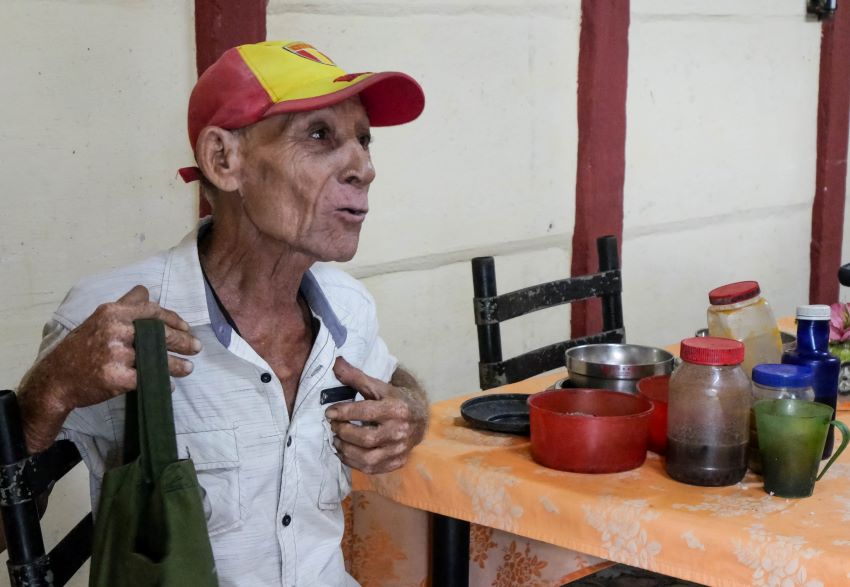
More than a year ago, liquefied gas ran out in the kitchen of La Algarroba, in this capital city. Behind the stove, Yanara Álvarez Rodríguez points out that she gets up at 5:00 a.m. because she lives in El Cornito, picks up whatever she can find, and by 6:00 a.m., she is already there, lighting the fire to ensure that the food is ready when the elderly arrive.
“The main problem is what to cook with. Right now, it rains every day, and the firewood gets soaked because this roof doesn't work. It takes me over an hour to light the stove. Only sometimes do we have charcoal,” the girl points out."
In the municipality of Puerto Padre, the obstacles also reek of neglect. At SAF La Primera, part of the La Anacaona base business unit (UEB in Spanish), and La Sombrillita, part of the Sierra Cristal UEB, several changes are urgently needed. The deteriorating roof, peeling walls, and neglected environment are indicative of the lack of attention given to a service that should be a priority.
At the doors of the facility, Javier Leyva declares, “This is bad.” He mentions his dissatisfaction not only with the white rice and rice soup he receives for lunch and dinner. “Here, there needs to be a little more consideration for those of us who are dedicated to our work and are now over 70 years old,” he notes.
Concerning supplies, the reality is not much different in the 17 entities of this type. La Defensa, part of the El Campesino UEB, made a difference months ago: a variety of options and a sparkling building. But today, the menu and the criteria show the opposite: “Sometimes there's just a little soup,” they claim.
In this context, it is worth highlighting the good deeds of producer Cristina Concepción, who donates food to the nearest SAF almost every day. Other farmers do the same, but it is not enough to feed the more than 1,500 beneficiaries in the municipality.
BEHIND CLOSED DOORS
Currently, there are 116 establishments of this type throughout the province that ensure food for people in need for various reasons. They all share the commitment and challenge of achieving quality service, especially in a period of economic crisis and inflation such as today.
Miguel González Velázquez, director of Labor and Social Security in the province, tells 26 that 115 are active. "The number of beneficiaries here amounts to 4,127. At the end of August, 3,595 were covered. At the SAF, we primarily protect those receiving social assistance, retirees, and people with disabilities, as well as residents living in vulnerable conditions.
"In these difficult times, we have received complaints about the variety and quality of the offerings, and in many cases also about the price of the products. It has been established that each meal should not exceed 13.00 pesos, meaning that the total for lunch and dinner would be 26.00 pesos.
“We are following this issue closely. We know that there have been problems with rice and the main course. Self-management by administrators is quite pronounced at the moment, and quality has been compromised.”
ON SELF-MANAGEMENT AND ITS NUANCES
Dalgis Pupo Hernández, director of Gastronomy for the Las Tunas Business Group, says that since the Tarea de Ordenamiento (Reorganization Task), the sector has planned to incorporate the SAFs into the UEBs (Unidades de Empresa, or Business Units) in each territory, created by Decree 28 on the improvement of commerce.
“This was done to make up for the food deficit that is not covered by planning,” explains Pupo Hernández. "Today, our main source of supply is self-management, given how badly suppliers have been affected."
"We also have the possibility of incorporating 100 percent of the SAFs into the production system. But the reality is that some do not comply with the delivery of food due to various difficulties, which has an impact on the kilocalories that should be consumed."
Dauge Rodríguez González, administrator of Reymar, lists the many challenges he faces in his daily exercise of self-management, a major undertaking in the current climate.
He addresses a long list of obstacles, but points out that the biggest hurdle he faces is paying farmers by transfer. “Producers do not want to accept money on cards, and I do not exclude anyone from this. They say that they then have no way of withdrawing the cash.”
"Another issue is the excessive prices of food, salads, spices... You force yourself to go and get food in the countryside because you assume it will be cheaper; however, farmers have evolved, and now they add up the cost of fertilizers and other things they need and sell you at a high price, right there in their homes. Let no one think that this is not the case."
"Price caps also limit trade. For example, when I go to a farmer's house who sells a pound of cucumbers for 100 pesos, I can't buy them because I'm only allowed to spend 30 pesos, as stipulated by the Ministry of Finance and Prices. So what do I do? Another consideration is that, with transportation being so expensive, it's sometimes more cost-effective to purchase the most necessary items directly from the local markets. It's a very complicated mechanism."
“We have contracts with state suppliers, but they fail to comply when they don't have the raw materials. Acopio stands out; their informality with contracts and high rates is incredible.”
"I'm sure you've heard that the SAFs generate losses for the UEBs because resources are purchased at high prices and sold to beneficiaries at very low cost. The losses in the SAF have an impact on the dishes I sell in the restaurant, but with good management, this is offset. Meanwhile, the issue of rice is complex: of the 60 deliveries required for the month, we sometimes receive 20; it depends on the country's availability. That's why we have to give them more spaghetti."
The manager of "Reymar" reiterates the heavy burden he carries on his shoulders, but assures us that they work there with a sensitivity to hygiene and to producing well-prepared meals, even if the main course is not succulent. “This task belongs to all of us, and we have a long way to go to improve; we know that, but we undertake it with love, because the diners deserve it. Tomorrow, any one of us could be there.”
UP CLOSE
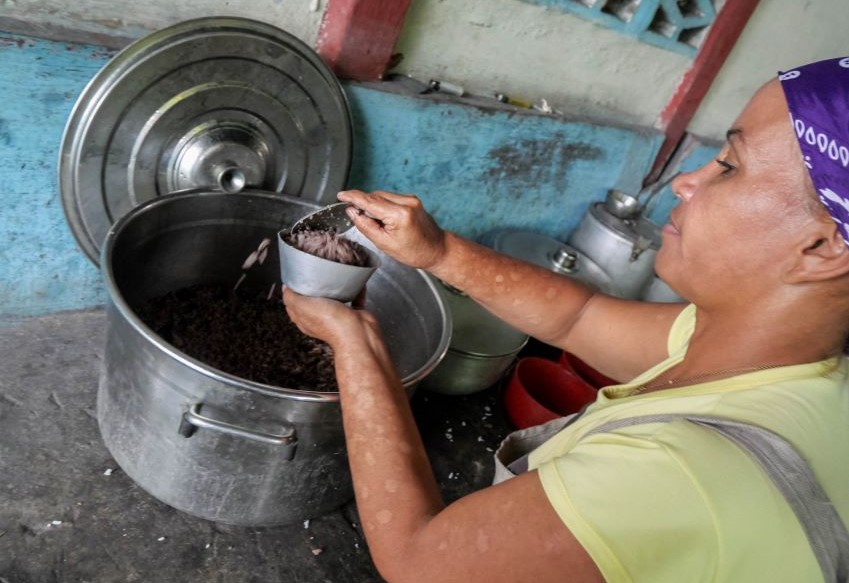
Yudeisy Reyes Acosta, head of the Balance Department of the Provincial Directorate of Economy and Planning, tirelessly supervises the SAFs' performance in Las Tunas.
“Our job is to balance all the products that are delivered for social consumption,” she explains. "The aim is to cover 100 percent of the priority agencies, Health, Education, and the SAFs, even though the balance is very low."
“We no longer receive chicken supplies, egg supplies are at 24 percent... Grains have been very complicated, as have sugar, rice, and oil. All assortments have been affected in 2025. This means that consumers cannot be given the required percentage of food.”
With such meager state supplies, the province's main authorities are committed to self-management of the UEBs and are exploring other alternatives to bring vitality to the service.
Oleidys Saucedo Licea, coordinator of Programs and Objectives for the Provincial Government, explains to 26: "In previous years, we had a wide variety of products. In terms of meat, for example, we had chicken, pork, beef, and ground beef, which helped us meet the established kilocalorie requirements. Currently, we do not receive those quantities, and even so, we must balance our accounts according to the number of people who come to these soup kitchens and supply them for 30 days a month."
“To do this, we even evaluate police seizures of food products and distribute them. Recently, we were able to make a delivery of beans in this way. We prioritize sectors according to the regulations.”
“Suppliers are required to deliver the food to the location. That is another problem, as most do not comply due to fuel issues and lack of transportation.”
“In the case of dairy products, ice cream, yogurt, and milk, we do not receive equal quantities because farmers do not honor the agreement. Soy yogurt, which complemented our offerings, has been in short supply because the country has not imported any soy this year.”
VALUE PRAXIS
Amidst the convoluted landscape and the dissatisfaction immortalized in the voices of the diners, arriving at La Algarroba is a kind of relief for the beneficiaries. They tell us that in recent times they have even received transfers from some, motivated by the varied offerings on the menu.
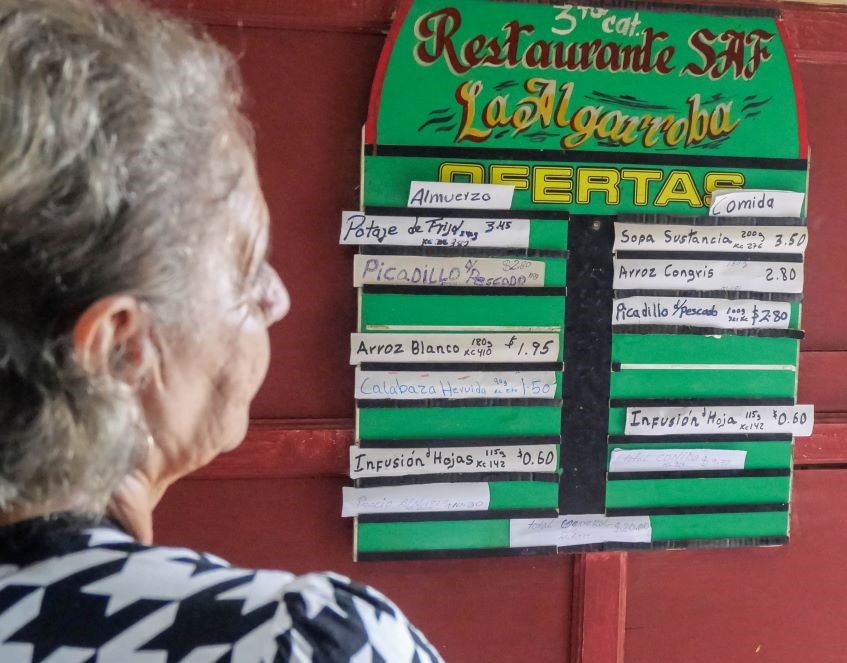
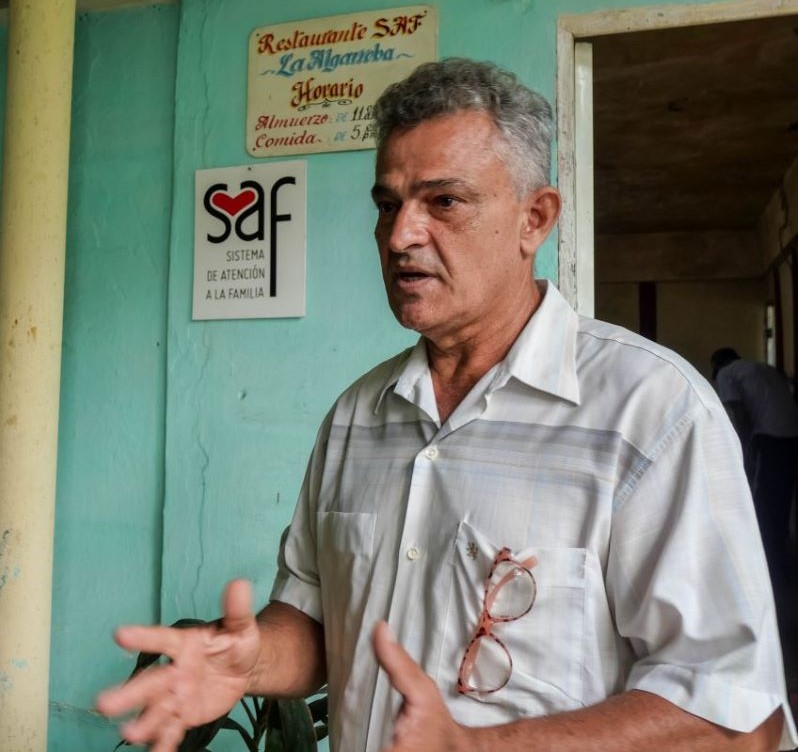 Guillermo González González, head of the center, comments that they have achieved a high degree of self-management there. It is common for them to offer white rice or congrí, soup or stew, picadillo, and other dishes. They celebrate collective birthdays for the elderly, and every day there are soft drinks or hot tea so that “they leave feeling full.”
“We belong to UEB 1876, and I can assure you that rice is a priority here, as are grains. Even if they are purchased at high prices and result in losses, they are always included on the menu. The prices do not vary, even when a liter of oil costs 900 pesos. We have protected this place with a sense of belonging.”
Another positive experience comes from Pablo Vilá Bravo, administrator of the El Ajíaco SAF in Amancio. There, thanks to a bank loan of more than five million pesos, the premises were refurbished, and after 3:00 p.m., they provide restaurant service. The profits are the lifeblood that guarantees a varied supply for those covered by this social protection.
...
Like La Algarroba and El Ajíaco, other good examples are emerging to the delight of users. Still, most SAFs show shortcomings in self-management, which go hand in hand with the high prices UEBs face, poor transportation, fuel shortages, and even the inoperability of e-commerce. State suppliers that do not fulfill their contracts also contribute to the gray areas.
Maintaining a benefit that costs only 26 pesos and guarantees lunch and dinner to people in vulnerable conditions demonstrates the strength of Social Security in Cuba and the importance it has always attached to it. However, the existence of these spaces alone does not guarantee such an achievement. Right now, more effective actions are urgently needed to address the daily reality of these units.
Regardless of how harsh the times may be, the SAFs require more vigorous multisectoral and governmental support to ensure that they can be a helping hand to those who cannot meet their most basic needs on their own. The nobility of this endeavor deserves to be rewarded.