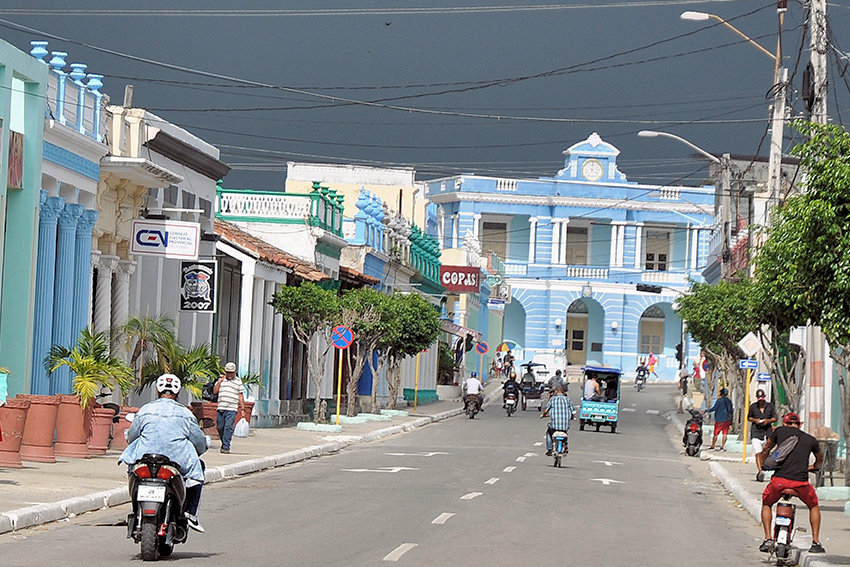
Fuel is scarce, yet at the offices of the National Institute of Land Use Planning and Urban Development (INOTU in Spanish) in this eastern Cuban province, work continues. Paradoxically, it is amidst extreme shortages, exacerbated by the energy blockade imposed by the United States, that urban planning takes on its greatest meaning.
Tania Vázquez Góngora, the institution's sub-delegate, sums it up with a maxim that could well be applied to any sphere of life in Cuba: when resources are scarce, what little one has must be used as intelligently as possible. And that, precisely, is what land use planning is all about.
"Our organization is not immune to difficulties," she notes. "We have lost specialists for various reasons, and we don't have all the staff we would like to fulfill our mission," she admits. This social objective is broad: land registry, control of illegal activities, construction permits for the population, and, as the foundation of everything, urban planning.
THE HEART OF THE MATTER: LAND USE PLANS
"Without land use plans, there are no sound decisions," states Vázquez Góngora. "If we don't know how our cities should grow, what the regulations are for each area, and what uses are compatible with each space, the specialists in permitting or inspection are working blind."
Therefore, despite fuel limitations, INOTU in Las Tunas faces a major challenge: updating all the land use plans for the province's urban settlements. The list is extensive and covers all eight municipalities.
In Puerto Padre, for example, the plans for the municipal capital, Vázquez, Carúpano, Maniabón, Delicias, and San Manuel must be updated. Manatí, which updated its Puerto Manatí plan in 2024, now needs one for its main city. "Jesús Menéndez" will work in Chaparra. In Majibacoa, work will be done in the towns of Calixto, in the area known as Vivienda, Las Parras, and Omaja. Las Tunas has three urban settlements: the provincial capital, Bartle, and Becerra. Jobabo, "Colombia," and "Amancio" (the latter including Guayabal), in addition to the main city, complete the picture.
"We are in the diagnostic stage," explains the sub-delegate. "Municipal governments are calling on agencies to provide key information. Health, for example, needs to tell us the real needs for clinics or facilities in each neighborhood. Education, Culture, Sports... everyone has something to contribute."

"EL DIAMANTE": WHEN THE COMMUNITY EMPOWERS ITSELF
Among the most remarkable examples of what can be achieved even with limited resources, Vázquez Góngora mentions the experience of the El Diamante area in the city of Las Tunas. There, a space that had degraded into a garbage dump, with serious traffic and social problems, was transformed thanks to the convergence of wills.
"The proposal came from the residents themselves, who demanded change. There was no state budget for a large investment, but with the support of the community group, local economic stakeholders, and neighbors, we managed to restore access to a road and create a more attractive and functional space," she recalls.
The experience demonstrates a thesis that the sub-delegate defends with conviction: the city belongs to everyone, and therefore, everyone is responsible for its care. "We cannot intervene in a place without knowing its identity, its history. Not every space can have a park or a central area. We have to listen to those who live there."
Now, attention is focused on the La Martilla area, a zone in the provincial capital with the potential to become a similar space. The proposal, which is already being evaluated by the Municipal Administration Council, includes not only recreational areas but also a novel solution for our times: a connectivity point with charging capabilities for electric cars and motorcycles using photovoltaic systems.
"These studies originate from the planning departments, but they also incorporate proposals from economic stakeholders and the local population," clarifies Vázquez Góngora. "Land-use plans aren't created solely by our specialists. We have to consult with those who live in the area."
RENEWABLE ENERGY: ALSO INVOLVED IN PLANNING
 Another area where INOTU specialists play a leading role is in identifying areas for the installation of photovoltaic solar parks, a national priority for addressing the energy crisis.
“These parks have very specific technical requirements,” explains Vázquez Góngora. “They must be located no more than 8 or 10 kilometers from an existing electrical substation, and our province doesn't have many. Our specialists study the potential in each municipality, ensuring compliance with regulations.”
Several are already under construction or planned: the Nueva Línea park in Puerto Padre; Blanca Rosa in Majibacoa; Villa Verde in Manatí; Tunas 220 in the municipality of Las Tunas; and Punta Brava in Amancio. Others will be added, always with the approval of the Planning Departments.
But the commitment to renewable energy doesn't end there. INOTU's municipal offices are also involved in authorizing solar panel kits for essential services.
"Although it's not always understood, this equipment, which includes lithium batteries, must be evaluated in conjunction with agencies such as the Ministry of the Interior (MININT) or Civil Defense, because in the event of an accident, measures must be in place to protect nearby homes."
The Provincial Delegation itself is already benefiting from this strategy. A kit of 10 solar panels, currently being installed by the company Durkal, will allow the servers and equipment to remain operational during the day, thus ensuring the continuity of procedures and services for the public.
"We work with three possible scenarios," explains the sub-delegate. "An optimal one, where conditions are ideal, and there are no fuel or resource limitations. An intermediate one, with some restrictions. And a third, critical one, like the one we are currently experiencing in 2026, with a significant energy impact."
For each scenario, the planning processes include projections. The idea is that, even under the worst conditions, the city's vital services can be maintained. "That includes everything from hospitals to electric vehicle charging stations, as well as the INOTU's own procedures.
"None of these actions would be possible without the zoning plans. They tell us how and where. They are the legal tool that allows specialists to make decisions, inspect, authorize, or propose," he concludes.