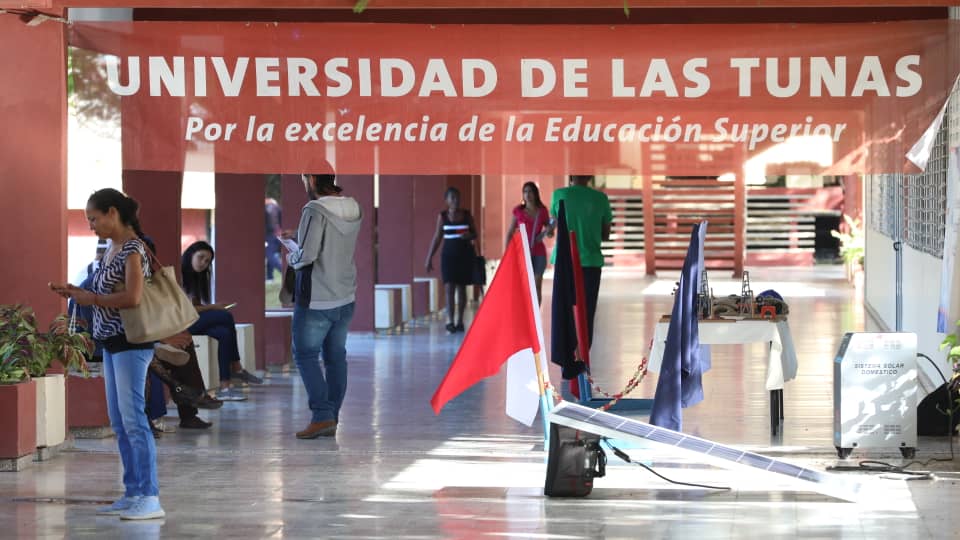
Calm has been absent from the halls of the University of Las Tunas (ULT) this first week of December. Experts from the National Accreditation Board (JAN) have gathered on its premises to finalize the institution’s external re-evaluation, a challenge in which the university aims to surpass the results that earned it accreditation in 2019.
Las Tunas, Cuba.– The success of this process, which uses the year 2024 as a benchmark, will be crucial for consolidating its public certification of quality level, which constitutes, among other things, an endorsement for the institution's other projects. It will also impact the recognition of its academic and scientific staff, as well as the increase in national outreach and international promotion, enabling easier enrollment of international students and the opening of editions of certain programs in other countries.
Doctor of Science Leyder Ortiz Pérez told 26 that they arrived at this point much better prepared. “ULT has 30 active degree programs, and 14 of them meet the criteria for accreditation, which is a great strength, but not the only one.”
“The results are better in terms of publications, international projects have been successfully implemented, the methodological work exhibits progress, and undergraduate training is more organized, for example.”
“Furthermore, the impact on the local communities is noteworthy, because the municipal centers have become involved in local development. We have concrete examples in ‘Jesús Menéndez’ and Jobabo, with commendable experiences, responding to the needs of the communities.”
The young specialist elaborated on the important agreements they have with local businesses, the spaces that have been created (such as the Wellness and Support Centers), and the inclusive approach present in every new project they undertake.
Although these efforts represent undeniable strengths, the final decision relies on the National Accreditation Board, so it is necessary to continue waiting after these intense days.
Now, the technical evaluation committee is finalizing a comprehensive review report to be presented at the next Board meeting, which could take several months. There, the members will vote after a thorough examination. Thus, the verdict is issued and first submitted to the Minister of Higher Education, and then to the university rector's office.
This process reached its highest point this week, with students, professors, and experts embracing the review with optimism and satisfaction, because when the work is constant and intense, the challenge of growth is all the more rewarding.