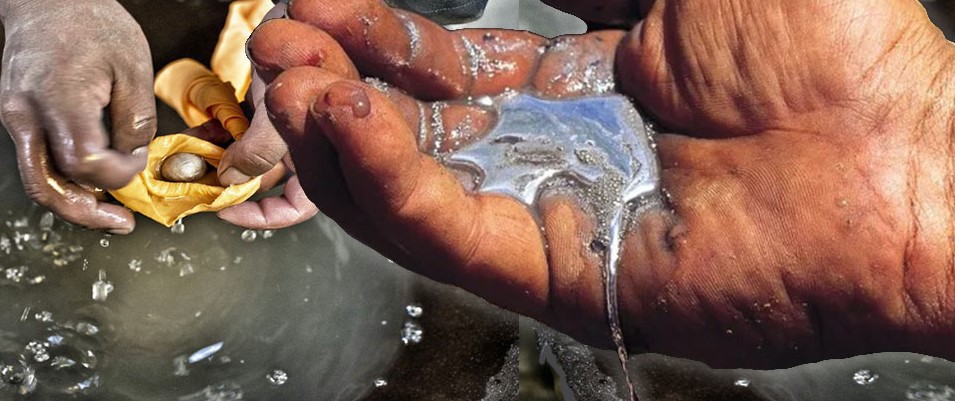
What began as an informal economic activity to ensure survival in some towns in Cuba’s Eastern Balcony region has turned into a public health crisis of alarming proportions.
Las Tunas, Cuba.- Dr. Alejandro Mestre Barroso, a specialist in toxicology, has warned of the devastating impact that illegal gold mining is having on the health of our province’s residents, specifically in the municipality of Jobabo and the communities of La Guásima and Jobabito.
Mercury, used indiscriminately in the artisanal gold extraction process, is leaving a trail of neurological, renal, and psychiatric diseases that threaten to triple national morbidity statistics.
Dr. Mestre Barroso explains that mercury, a heavy metal, exists in three forms: elemental, organic, and inorganic. While elemental mercury (such as that found in thermometers) is not toxic to humans, the organic and inorganic forms are “extremely toxic.”
“The main target organ is the central nervous system,” warns the specialist. The consequences range from neurodegenerative complications to cardiovascular and renal damage, with short-, medium-, and long-term sequelae.
In the illegal gold mining practiced in the region, workers use a technique known as “Asobe” (elemental mercury) to amalgamate the gold. The process is rudimentary: it involves washing the soil, adding mercury to trap the gold molecules, and then burning the amalgam. When heat is applied, the mercury evaporates, leaving behind gold nuggets.
However, this evaporation transforms elemental mercury into highly toxic inorganic mercury. Added to this is the mercury released during the washing of the soil, which flows into ponds and rivers, where microorganisms break it down and convert it into an even more lethal substance.
The first warning about illegal mining in the province was issued in 2024. Shortly thereafter, Jobabo Hospital requested a consultation regarding a case of “rare Parkinson’s.” After examining the patient and delving into his medical history, the doctors discovered that he was a worker at the illegal gold mine.
“It appeared to us to be toxic Parkinson’s,” notes Mestre Barroso. “As we toured the area, we realized that this was the town’s main source of income; everyone there was a miner.”
The consequences are alarming. Jobabo has one of the highest rates of kidney disease patients in the province, as well as high rates of psychiatric patients. Mercury is linked to schizophrenia, paranoid and depressive disorders, and polyneuropathies.
“We’re seeing young patients, aged 25 to 30, with acute kidney failure due to mercury-related complications,” says the toxicologist. “Since 2024, we’ve treated more than 25 patients. If we look at national statistics, that figure is three times higher.”
READ MORE
Eight People Arrested for Illegal Mining in Jobabo
The most concerning trend is the demographic shift: those affected are getting younger and younger, ranging in age from 18 to 25, and include both men and women. “We could view this as a warning sign of the rise in illegal mining,” he warns.
Far from being curbed, illegal mining has expanded. Following the warning notices in 2024, two more were issued in 2025, and another in early 2026. The activity is no longer limited to Jobabo; mining is now taking place in El Cornito and La Guásima.
“This not only affects the local population, but people are also coming from other municipalities. We can’t pinpoint exactly which municipality has the highest incidence, but the highest levels are in Jobabo and La Guásima.”
A CONVENTION THAT COULD SAVE US
Cuba has been a signatory to the Minamata Convention since 2019, an international treaty that seeks to protect human health and the environment from mercury emissions. The convention is named after the Japanese province of Minamata, where, in the 1950s, a pesticide factory contaminated the sea with mercury, causing birth defects and neurological diseases among the population.
In Cuba, the Cienfuegos Center for Environmental Studies is responsible for addressing this issue. According to Dr. Mestre Barroso, teams are collecting samples from affected areas and sending them to Cienfuegos to determine mercury levels.
LEARN MORE
Minamata Convention on Mercury
“A person who experiences any symptoms and seeks medical attention early on may be treatable. There are antidotes that, depending on the clinical presentation, can mitigate the effects.”
However, once the damage becomes chronic, it is very difficult to reverse. For this reason, Dr. Mestre Barroso insists on raising awareness among the public and authorities about the dangers of illegal gold mining.
“This isn't just a problem in Jobabo or Las Tunas,” he concludes. “It's a public health issue that requires an immediate and coordinated response. Mercury is unforgiving, and its victims are getting younger and younger.”