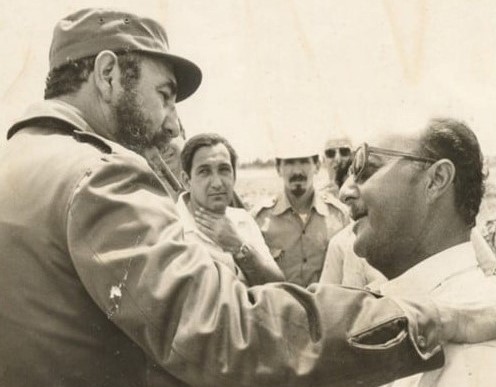
In Fidel Castro's memory resides not only the political and revolutionary leader, but also the restless young man who shared school adventures at the Dolores School in Santiago de Cuba. There, within the Jesuit walls, a friendship was born that would mark his life: the one that united him with Balbino Pérez Suárez (1926-2014), son of a prosperous merchant from Puerto Padre, owner of the El Encanto Store.
Balbino fondly recalled those youthful excursions: trips to Puerto Boniato, El Caney, and, above all, the risky foray into the abandoned mines of El Cobre. "They almost had to come looking for us... but we were half lost, because of him, since he was the one who came up with the idea," he recounted in an interview with journalist Julián Puig Hernández. For Balbino, Fidel was already a born explorer, uniform and all, long before founding the National Scouts.
Balbino's admiration for his friend was also reflected in his academic performance. "He didn't study at all... but he was excellent," he confessed, recalling how Fidel got top marks just by paying attention in class, while he resorted to notes hidden in handkerchiefs and pockets. During recess, the young Castro preferred basketball and soccer, although he didn't always fare well in baseball, where he wanted to be a pitcher.
Decades later, life brought them together again. First in 1978 and then in 1981, at the Las Tunas Glass Container Factory, Balbino met the Commander-in-Chief once more. Fidel recognized him immediately, with the spark of his memory and the warmth of an embrace that broke down all protocol. Standing before a photograph from his school days, he identified each of his former classmates: “Mastrapa, Prada, Martínez, René, Balbino…”
Balbino carefully preserved these images and documents, along with mementos of later encounters with Raúl and Ramón Castro. The latter dedicated his book, Fundamental Problems to Solve in the Cuban Sugar Industry, to him, with words that revealed fraternal affection: “For our brother Balbino Pérez, the Castro brothers love you.” For him, these memories were a legacy he wished to pass on to his grandchildren, convinced that they contained the noblest part of his life.
“He remains young and with tremendous energy and enthusiasm to continue his prodigious work,” Balbino commented after the meeting in Las Tunas. “We are contemporaries, but he is in better shape, despite his extraordinary responsibilities as a statesman; that day, my blood pressure rose from the immense joy of greeting my dear friend.”
The story of Balbino and Fidel reminds us that the Revolution was also built on personal affection, loyalty to childhood friends, and shared memories. In the "One Hundred Years with Fidel" campaign, this episode takes on special significance: it shows the Leader of the Cuban Revolution not only as a statesman, but also as a human being capable of preserving intact the friendship that accompanied him since his youth.