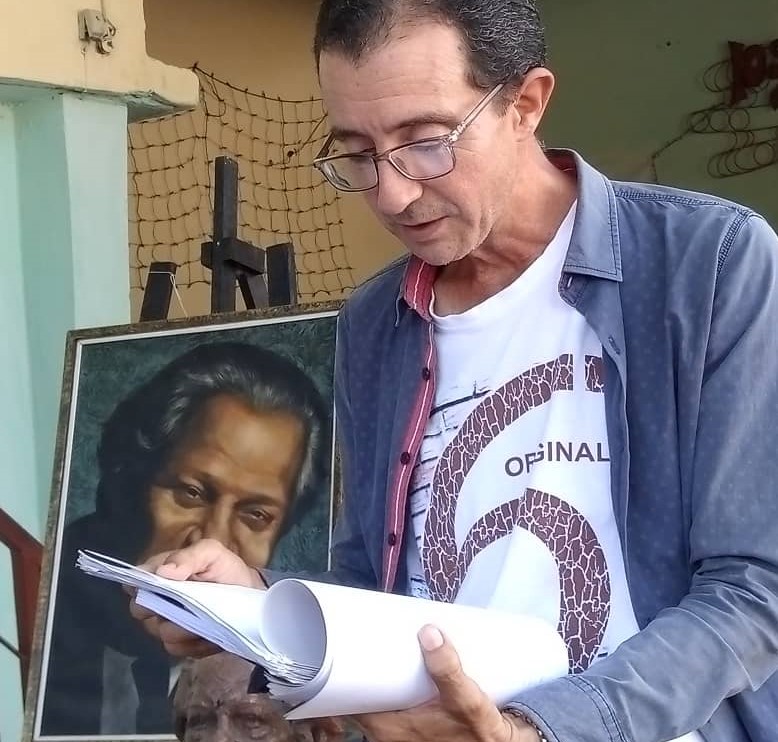
Herbert Toranzo may not be the most high-profile author or the one who appeals to the widest audience, but his body of work is noteworthy, and no one can deny that. His ingenuity has produced more than 20 books, and the list of his achievements includes such prestigious awards as the "Calendario," "City of Santa Clara Foundation," and "Cucalambé."
Las Tunas, Cuba._ Recently, another accolade came along to further solidify his path, as he was named the winner of the Antonio Borrego provincial poetry contest, organized by the Writers’ Branch of the Provincial Committee of UNEAC. The result was announced at the headquarters of Las Tunas’s artistic vanguard, during the “Inquieto oficio” literary gathering and also as part of the celebrations for Las Tunas Culture Day. It was a fitting moment, given the significance of the author honored at this event, who is considered the most popular poet of his generation.
With his poetry collection Te vendo mi autoría, Herbert Toranzo —a native of Ciego de Ávila now living in Las Tunas— won the coveted award in a region that (as we know) boasts great champions in the world of literature.
The contest jury, composed this time of Adalberto Hechavarría, Javier Castro, and Armando López, unanimously awarded the prize after evaluating the submitted works. In this regard, the jury’s decision recognized “his originality and formal daring, as well as his mastery of a poetic language of great metaphorical density, capable of exploring—with irony and lucidity—the limits of authorship, identity, and literary tradition. Equally notable is its organic structure, organized into sections that engage in dialogue with one another—from The False Book to The True Book —and a personal voice that combines metapoetic reflection, dark humor, and remarkable expressive maturity.”
“I’m not in the habit of writing overly conceptual books on a single theme; rather, I write from within myself, focusing above all on the psychological and even the psychiatric,” he confesses.
As for the title: “It has to do with the concept of authorship, and everyone can interpret it in their own way. As a line at the beginning of the book says: ‘Everything is perfectly negotiable.’ That includes, of course, being the author of any literary work."
"If we look at it from a biblical perspective: ‘Everything is vanity.’ Authorship is no big deal. I’m selling it to you because I haven’t known what to do with ‘it,’ to see if you can put it to better use than I have. After all, I can’t make a living from ‘it’ right now… There are a thousand possible interpretations,” he adds.
Although we may know Herbert better for his work as a decima poet, he has written a great deal more free-verse poetry. In fact, “Antonio Borrego” emerged from this type of verse form. “I also write fiction. I have three published short story collections. I’m working on a novel…,” he adds.
Regarding Borrego, in particular, he is grateful to have known him because although Herbert was living in Ciego de Ávila at the time, he traveled fairly frequently to the Balcón de Oriente. “I’d run into him all the time. We’d chat occasionally. He struck me as an interesting person. I also always admired his poetry, especially his rhyming verse; he was a great sonnet writer. I was deeply saddened by his death; it was a great loss for Las Tunas and Cuba in general. Winning this contest named after him honors me and brings me great joy,” Toranzo emphasizes.
Thus, the author of works such as La Torre de Donovan, Las calles del purgatorio, Poemas casi humanos, and Pruebas de mi inexistencia continues his journey in the “restless craft” of writing.