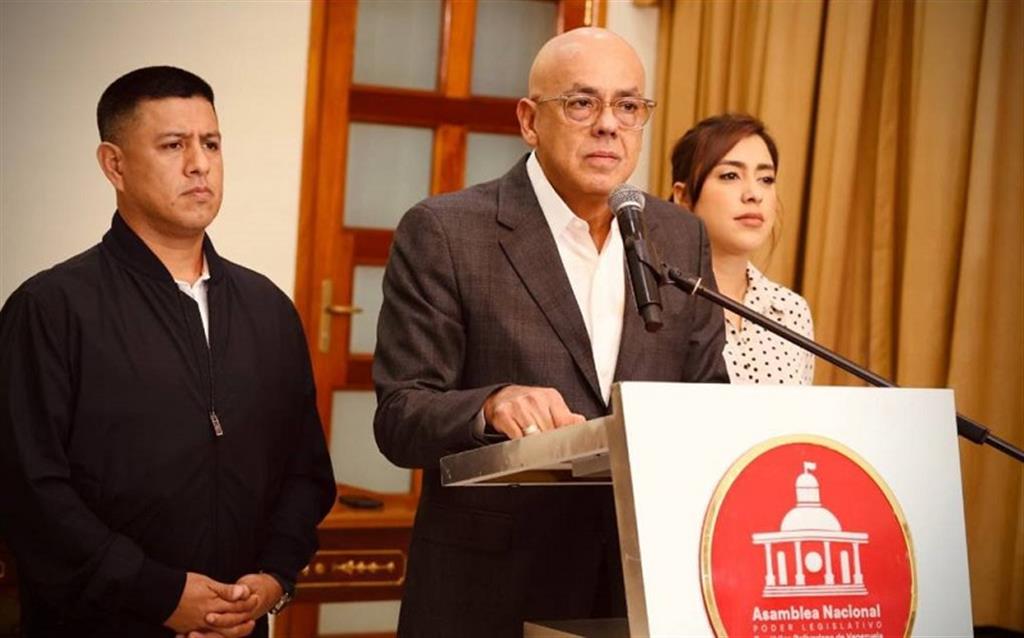
This Sunday, the president of Venezuela’s National Assembly, Jorge Rodríguez, raised a series of critical questions about the alleged US anti-narcotics operation in the Caribbean Sea.
The high-ranking Venezuelan official questioned the true effectiveness of the mission, suggesting that, far from reducing illicit drug trafficking, the strategy could be a “sham” to attack Venezuela and bring about regime change. Rodríguez’s statements underscore a deep distrust of the motives behind US actions in the region.
In a forceful pronouncement, Jorge Rodríguez challenged the lack of measurable results from the US anti-narcotics operation in Caribbean waters. The president of the National Assembly asked directly: “Is anyone measuring the prevalence of illicit drug use in the United States right now?” Is anyone measuring whether the trafficking, the micro-trafficking of fentanyl, cocaine, and marijuana, has decreased in the United States at this time?
These questions seek to confront the official narrative of the war on drugs with concrete data that, according to Caracas, is conspicuously absent.
Rodríguez predicted that when the real figures are published at the end of 2025, it will become clear that “the consumption of illicit substances in the United States has only increased.” His argument is clear: if consumption has increased, it is a direct consequence of the increased supply, which indicates that “the trafficking of illicit substances to the United States continues,” despite the military presence in the Caribbean. This logic dismantles the premise of the operation’s success.
The origin of the opioid epidemic in the U.S. lies with its large pharmaceutical companies.
The president of the Venezuelan Parliament categorically disassociated Venezuela from the current opioid epidemic in the United States and rejected any connection between the South American country and the trafficking of this substance. Rodríguez pointed out that the main cause is fentanyl, an opium derivative that “enters the United States of America through the routes you know; Venezuela has absolutely nothing to do with it.”
According to Rodríguez, the origin of the opioid epidemic in the United States lies not in the Caribbean or Venezuela, but in the American “big pharmaceutical companies” themselves. The president of the National Assembly pointed directly to companies like Purdue Pharma, which he held responsible for the current crisis.
He explained that fentanyl is a consequence of the codeine they sold indiscriminately in the 1990s, after fabricating misleading reports claiming it was not addictive. “That’s where the opioid epidemic caused by fentanyl that we are currently experiencing in the United States of America comes from,” he stated, revealing a different perspective on the drug problem.
Furthermore, lawsuits in that country against opioid manufacturers have highlighted the responsibility of the false communication campaigns that have promoted the use of these products over the last 25 years, the same period in which the consumption of these substances has skyrocketed. This also points to a failure of national bodies such as the United States Food and Drug Administration (FDA), the federal agency in charge of regulating pharmaceutical companies.
The U.S. narrative about its anti-narcotics operation is “a big farce.”
Finally, Rodríguez denounced the lack of coherence in the accusations against Venezuela, noting that the allegations “can’t even agree on whether it’s the Cartel of the Suns or the Tren de Aragua.”
This inconsistency reinforces his argument that the operation and its accusations are “a big farce, a big slander against Venezuela.” The president of the National Assembly reiterated that his country will conduct a rigorous and thorough investigation of the events to bring the truth to all relevant multilateral organizations.
Rodríguez also criticized the “war on drugs” strategy, pointing out its ineffectiveness in targeting the lowest-level players in the drug trade. He expressed surprise at an anti-drug effort that “fails to capture the small-time smuggler,” although the boats intercepted are usually shallow-draft.
The president of the National Assembly argued that the logic of the anti-drug fight dictates capturing these smugglers to “work one way up and go after those who are truly responsible for the drug business.” According to Rodríguez, this approach is not being applied, suggesting other interests behind the operation. (CubaSí)