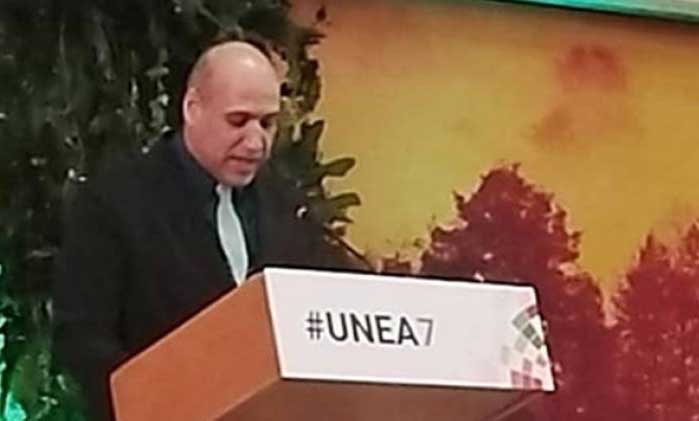
Cuba reaffirmed its commitment to environmental multilateralism during its participation in the 7th Session of the United Nations Environment Assembly (UNEA-7), which concludes today in Nairobi, the capital of Kenya.
Rudy Montero Mata, First Deputy Minister of Science, Technology, and Environment (CITMA), formally informed the organization that Cuba supports the pursuit of “sustainable solutions for a resilient planet” under the principle of common but differentiated responsibilities.
Citma released the text of Montero Mata’s address, delivered as head of the Cuban delegation composed of Inés Fors Fernández, Extraordinary and Plenipotentiary Ambassador of the Republic to Kenya, and Pavel Morales Díaz, Director of Research and Development at Inversiones GAMMA S.A.
He warned that more than 30 years later, the world continues to fall behind in the fight against climate change, biodiversity loss, and pollution; and that some of those with the most to contribute —or to make amends— still refuse to join the struggle for a sustainable, equitable, and just development model.
He noted that Cuba is closely following progress in the implementation of Resolution 6/1 on the circularity of the sugarcane agro-industry, adopted during the sixth session of the Assembly.
According to Montero Mata, Cuba arrived at the 7th Session “with a renewed Law on the System of Natural Resources and the Environment in force, and a draft Law on Science, Technology, and Innovation currently under debate.”
He recalled that the State Plan for Confronting Climate Change, better known as Tarea Vida, has now been in place for eight years, and that last February the country presented version 3.0 of its Nationally Determined Contribution (NDC), “with concrete mitigation commitments, even as Adaptation remains our national priority, with significant results.”
Among these achievements, he highlighted the protection and rehabilitation of coastal areas and disaster risk management in the face of natural hazards, citing the example of powerful Hurricane Melissa, which caused considerable damage but was met last October without loss of human life.
For the First Deputy Minister of Citma, “science and the environment should never be victims of political manipulation, yet the reality is different: the economic, financial, and commercial blockade imposed by the United States on Cuba for more than 60 years is the main obstacle to the full implementation of environmental and scientific-technological development strategies in our nation.”
He emphasized the willingness of U.S. scientists to collaborate with their Cuban counterparts and the frustration they feel due to current restrictions, their commitment to environmental causes, and the shame provoked by the climate denialism of their current government.
In this regard, he stressed that Cuba—despite an economy heavily affected by such widespread pressure and by environmental crises it did not cause—has cultivated strong human capital made up of renowned scientists who share their expertise with sister nations of the Global South, “to whom we reiterate that Cuban science is at your service in the search for solutions that benefit our peoples, our economies, and our environment.” (CubaSí)