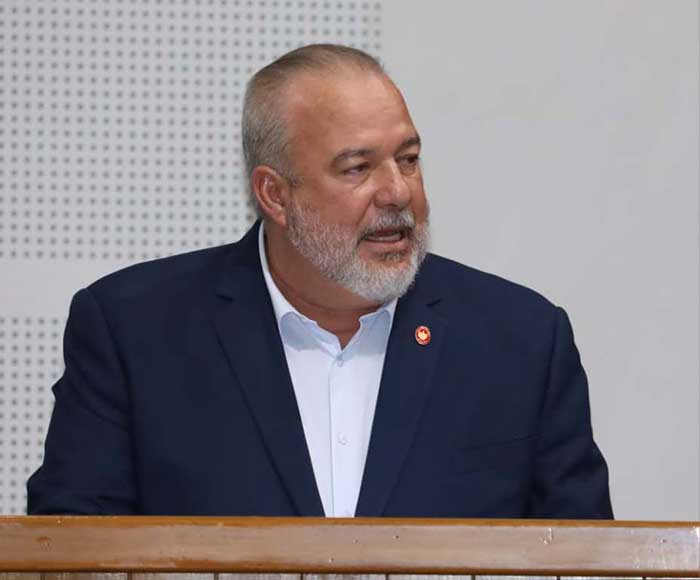
The Cuban Parliament today analyzed the implementation and impact of the Government Program to Correct Distortions and Boost the Economy.
Havana, Cuba.- To this end, Prime Minister Manuel Marrero informed the deputies of the progress of the Macroeconomic Stabilization Program.
On this subject, he stated that the consumer price index closed in November with an annual change of 14.5 percent, a result that, although it slowed down, is still considered high.
He also stated that the money in circulation grew by 135 million compared to last year, which shows an excess of money in the economy.
Marrero ratified the approval of the new mechanism for control and allocation of foreign exchange, published on December 11 in the Official Gazette.
“Partial dollarization is a temporary but necessary measure to boost economic activity, promote linkages and increase foreign currency revenues,” he said.
Similarly, 45 closed schemes were reported approved, of which 31 are currently operating, along with the consolidation of fiscal control actions.
The results of this last activity produced a debt of 9.833 774 billion pesos (4.159 billion pesos higher than reported in July); the collection of 53.4 percent of the tax debt, and the temporary or permanent closure of more than 23,000 establishments.
“We are creating the favorable conditions for moving to a higher stage in the implementation of the country’s Macroeconomic Stabilization Program,” he concluded.
CUBAN PARLIAMENT ANALYZES MEASURES TO INCREASE PRODUCTION
The Cuban Parliament analyzed several measures aimed at increasing national production, with an emphasis on food.
Referring to this goal, Cuban Prime Minister Manuel Marrero stated that agricultural production is recovering, although it remains far from meeting the population’s demand.
He also affirmed that all regions of the country are meeting the indicators for urban, suburban, and family agriculture, and that more than 30,000 family gardens or plots and 40,000 organic gardens have been incorporated into this sector.
He further noted progress in contracting various production methods for next year and pointed out that the process of preparing food balances at the municipal level has shown improvements, although shortcomings persist.
Regarding payment delays to producers, he stated that they amount to approximately 1.192 billion pesos, figures that have decreased but are still high.
Furthermore, he noted that, to incentivize the import of raw materials and intermediate goods, the extension of deadlines for existing bonuses and exemptions was approved, and 100 new tariff classifications were incorporated.
“Given the existing complexities, it is essential to understand that the safest foods we will have are those we ourselves can produce,” he emphasized.
CUBA FOCUSES ON DEVELOPING SOCIALIST STATE ENTERPRISES
The National Assembly of People's Power (Parliament) analyzed the resizing, development, and management of socialist state enterprises. On this topic, Cuban Prime Minister Manuel Marrero announced the creation of the National Institute for the Administration of State Enterprises, which is currently developing its structure and selecting its personnel and workers.
“During the year, 77 new state enterprises were established, bringing the total to 330. 816 private companies and two non-agricultural cooperatives were also registered.
The regulation of wholesale trade for non-state economic actors was approved, eliminating the requirement that wholesale operations be carried out exclusively through state entities,” he noted.
According to Marrero, the decentralization of the authority to approve the creation of private entities and non-agricultural cooperatives is progressing slowly.
“This authority has been granted to 65 municipalities, and a methodology for monitoring and supporting entities that declare losses has been implemented,” he added.
The Prime Minister highlighted the positive impact on economic recovery of the new measure regarding partnerships between state-owned and private business entities, approved by the Council of State.
This regulation gives the possibility of entering into economic partnership agreements with contributions and the creation of joint ventures.
The business models also include franchise agreements and the participation of Cuban nationals residing both in Cuba and abroad.
CUBA WORKS ON RECOVERING THE NATIONAL POWER GRID
Prime Minister Manuel Marrero stated that Cuban authorities are working diligently to recover the National Power Grid. During his address, he highlighted that $1.15 billion has been allocated, despite challenging financial conditions.
This has allowed for the recovery of 422 MW in distributed generation, bringing the total to over 1,000 MW, and an additional 228 MW in centralized generation.
Furthermore, 778 MW have been synchronized with the installation of 41 photovoltaic solar parks, which are producing more than 30 percent of the country’s total generation during peak sunlight hours.
“Despite the work done, the situation of the national power system remains very complex, with an average daily deficit of 1,500 to 1,700 MW.
In recent days, the deficit has exceeded 2,000 MW, causing service disruptions 24 hours a day, exacerbating public discontent and damaging the economy,” he noted.
He also added that the deficit is mainly due to the instability of electricity generation and the shortages of fuel for distributed generation, with approximately 1,000 MW of capacity unavailable for this reason.
CUBA COMMITTED TO SOCIAL JUSTICE, SAYS PRIME MINISTER
Prime Minister Manuel Marrero affirmed that despite external pressures and internal challenges, Cuba remains committed to social justice, sovereignty, and the unity of the people.
Presenting the results of the government program to correct distortions and revitalize the economy to the National Assembly, Marrero emphasized that the defense of the homeland, the protection of the population, and national security are strategic priorities of the Cuban state.
In this regard, he stressed the crucial role of the combatants from the Ministries of the Revolutionary Armed Forces (FAR) and the Interior (MININT), who, in close collaboration with the Party, the Government, and mass organizations, have intensified their training in response to the worsening situation in the region.
Marrero reported that progress is being made in restructuring the central government to reduce the number of agencies within the Central State Administration.
In the health sector, he said, despite the actions taken, infant mortality is worsening, with a rate of 9.8 per 1,000 live births, compared to 7.0 in the same period of the previous year.
Meanwhile, in Education, the implementation of the Program to Improve the Quality of the Teaching Process continues.
The Prime Minister noted that one of the greatest national challenges is demographic trends, as Cuba is projected to end 2025 with 9.6 million inhabitants, a figure that will decrease to 7.7 million by 2050. (PL)