 |
| The future of these houses is to be integrated into broader and more sustainable urban models. |
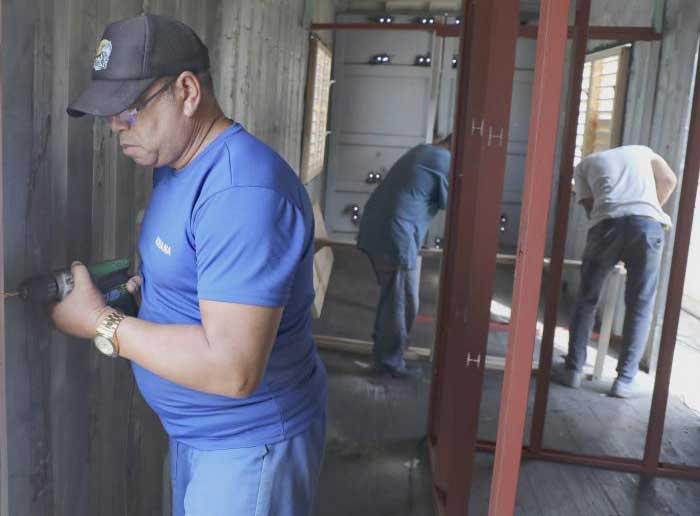
No. This is not a luxurious home. There are no large spaces to move around in or decorated tile floors. Right now, this place smells of freshly cut wood and burning iron. There are sparks and screws on the floor, and men talking and working.
"It's a container. There's not much you can do," admits the man perched on scaffolding as he welds the frame of one of the windows. He assures us that, for those who need a home, this option "is very good."
***
It is after 9:00 a.m., and at the Metal Productions Business Unit (UEB) in Guanabacoa, several containers are being transformed into homes to be distributed in some municipalities of Havana.
Given the number of men working, it seems like they will never finish, but "little by little, divided into teams, we have made considerable progress."
A container is nothing more than a large standardized steel box designed to transport goods. Inside, there is nothing but empty space. However, the ones here, with a capacity of 29 square meters, already have door frames and window frames.
Upon entering, one encounters the small living room, which leads to the first bedroom. To the left is the kitchen-dining room, less than two meters long, followed by the bathroom.
Before reaching the second bedroom, there is a back door leading to the "small service patio," which, along with the seven windows, will allow ventilation in what will soon be a place to live.
"This has a veneer structure inside to withstand the heat a little, and we will also line the bathroom, but with a smoother material," says Juan Reyes, who is adjusting the screws for the doors.
He says he has been working with his team of carpenters for a week without a break because "we must finish as soon as possible."
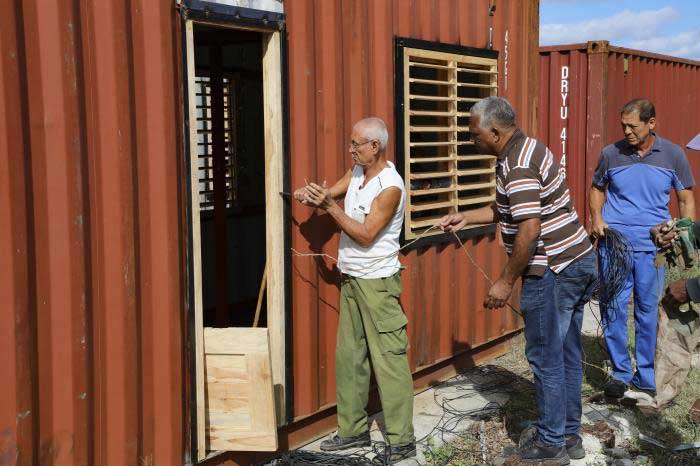 |
| There are seven windows and two doors to ensure ventilation. |
***
Around 3,500 used shipping containers, which arrived in Cuba with renewable energy sources, will be transformed into modular homes with all the necessary living conditions.
According to Delilah Díaz Fernández, director of the Housing Program at the Ministry of Construction, all entities with construction capabilities have been called upon for this project. Through the territorial governments and the Provincial and Municipal Housing Directorate, everyone who can work on this type of solution has been hired.
She says that these homes will be offered with the essentials of a "decent home." The foundation will not be attached to the ground, and anti-corrosive paint is included as part of the finishing process. However, "freedom to innovate with local solutions has been given."
"Nevertheless, once the person becomes the owner, maintenance will be at their own expense."
The truth is that, in line with the reality faced by the Housing Program: housing deficit, high prices, lack of construction materials, and insufficient production, this housing construction system —financed by the State Budget— stands out for its speed and low cost.
Local governments are responsible for allocating these homes "to people who work in photovoltaic solar parks, those affected by weather events that have caused total collapse, and people in vulnerable situations who are waiting for a home."
To receive the home, the beneficiary must pay an amount set by the bank, which "varies in each case depending on the materials used and the finish of each construction. That is why we have insisted on using endogenous resources," explains Díaz Fernández.
***
Lots of noise. Pressure, and then movement. A man places the first piece of plywood on the wall of the container. The iron structures that form the frames of the house are also ready to be covered by this thin layer. They say that they will cover the entire space with this plywood.
"Then we will install the electrical cables, the boxes, all the outlets, the lamps. But the power supply is on site," says Oscar Díaz Díaz, deputy head of production at the UEB.
Bursts of conversation drift from one of the containers. It seems that the power has gone out in this area, and while they try to start the generator, the whole process will have to stop.
The director of the Housing Program at Micons says that things like this—fuel and electricity—slow down construction work, as well as the transfer of houses to settlement areas.
So, while a woman sweeps the wooden floor and says, "This won't look bad, it will look nice," some workers choose to lie down on a truck. And while they "fix the power," as they did days ago, today they will also finish late.
"And when we finish these 35 houses," which are for the La Solita neighborhood in Arroyo Naranjo, everything will start all over again "because we have more municipalities to cover." Perhaps next time, with greater agility.
Taken from Granma