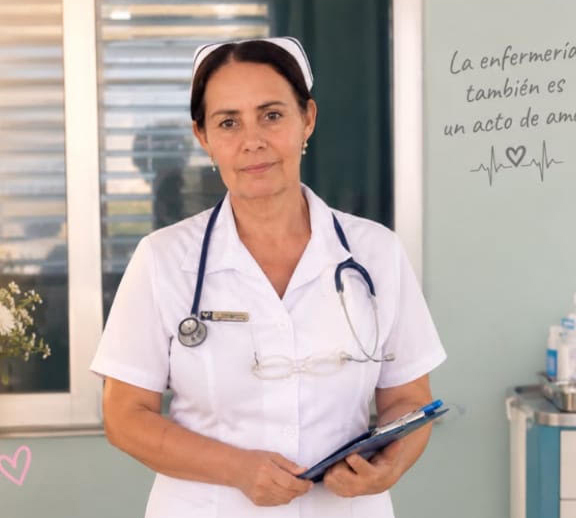
There is a stretch of road in Cabinda, Angola, that Virgen will never forget. There, right in the middle of the street, under the blazing sun and amid the pain of a woman who could no longer take another step, she experienced one of the most intense moments of her 33 years as a nurse.
She was on her way from the apartment complex where she lived to the hospital, as she did every day, when she saw the scene: two women assisting a woman in labor right in the middle of the street. The baby wasn’t coming out, experiencing shoulder dystocia. One of the women accompanying her was crying and gesturing desperately.
The car stopped. Virgen got out. Without a moment’s hesitation, she crouched down, lifted the mother’s legs high, and, with the skill of someone who has done this thousands of times, delivered the baby.
“I was the doctor,” she recalls today, with the humility of someone who doesn’t seek applause.
The woman had walked all the way there with bags and belongings, bent over in pain, unable to reach the hospital. They helped her into the car and continued the journey. The delivery had already taken place, but life went on.
...
That anecdote, which took place during her first mission in Angola, perfectly sums up who Virgen Cruz Fernández is: a woman who doesn’t hesitate, who takes action, and who has made delivering babies her reason for living.
After graduating in 1994, she arrived at the Dr. Ernesto Guevara de la Serna General Teaching Hospital in Las Tunas to work in the Perinatology Unit. Two years later, she was already in the delivery room. And from there, a whole life dedicated to maternity care.
“I like working with pregnant women and newborns, even though there’s a latent risk involved and they’re the priority of the Cuban healthcare system,” she confesses.
In 2013, she left for the province of Cabinda, in Angola, as an instructor in a Cuba-Angola partnership program to train traditional midwives. She taught until 1:00 p.m., and at 2:00 p.m., she began her clinical work at the hospital. Day after day, for three years.
“Over there, we worked practically on our own. We handled the deliveries, newborn care, and all prenatal care. We only called the doctor when there was an emergency we could no longer manage,” she recalls.
NURSING: BETWEEN COMMITMENT AND PASSION
Virgen does not come from a family of nurses. Her brother is a surgeon, but she was the first to wear the white uniform —and with such conviction that she believes it was simply a matter of fate.
“Nursing is my reason for living. Practically, since I was a child. I came to work at this hospital when I was 19, and I’ve always been here. In my 33 years as a nurse, the only time I took a break was for my year of maternity leave. Never again,” she says.
She has a son, an officer in the FAR, and a one-year-old grandson. Regarding the birth of her own son, she says it was “the most precious thing in the world, even though the pain still hasn’t faded from her mind.” “I know what it feels like both on top of and underneath the stretcher; that knowledge makes us better professionals.”
At nearly 54 years old, Virgen admits she’s “a little worn out,” but she doesn’t stop. Now she is taking on a more difficult task, one with greater responsibility and complexity: heading the nursing department.
“I like being here; I like helping; I like my colleagues—how every day a team sets aside their personal problems and comes in with great dedication to help women bring children into the world. There couldn’t be a better profession,” she says.
"GUEVARA" HOSPITAL: THE PROVINCE’S OBSTETRIC HEART
What many people don’t know is that Guevara Hospital doesn’t just handle births in the provincial capital. Currently, this institution handles births for the entire province and surrounding areas of Granma and Holguín. This is an enormous burden that falls on the shoulders of professionals like Virgen.
“Right now there are 12 patients here, and 12 companions would make 24 people crammed into this tiny space,” she explains, referring to the facility’s limitations, though she manages to ensure that patients have support during the postpartum period.
Respectful childbirth —a program designed by the World Health Organization— is one of her causes. Virgen was trained in these principles at an international workshop and for a time implemented that program at the maternity ward.
“It’s about humanizing childbirth. It’s about making the mother feel confident, ensuring that childbirth isn’t a traumatic experience for her, and preventing her from saying, ‘This happened to me, and I don’t want to give birth again.’”
She admits that in her community there is a willingness to move forward, but there are many material limitations that pose a real obstacle. She envisions a more humanized maternity ward —one that is more pleasant for both patients and healthcare staff.
A LEGACY OF LIFE
When COVID-19 struck the world, Virgen didn’t hesitate. She set up her workspace at the hospital and went as long as 14 days without going home. She cared for patients who tested positive, assisted with deliveries and C-sections, and helped them recover in a small room she had set up for them.
“Always there, in the same place, so as not to expose the other patients. Those were very difficult times, but life had to go on, and that’s why we were there. Of course, there was fear and anxiety about not being at home, but we did it right,” she says.
She has witnessed the beginning of life thousands of times. She has been through complicated deliveries, emergency C-sections, moments of anguish, and moments of joy. She has supported first-time mothers and women who have given birth multiple times. She has witnessed the miracle of life in Las Tunas, in Angola, during the COVID-19 and Zika outbreaks.
And she’s still there, steadfast, in her nurse’s uniform, with her 33 years of experience, her passion for childbirth, and these challenging times that bring fatigue and sap motivation. But for Virgen, motherhood transcends even the hardships of daily life. There, every birth is a miracle. And every miracle is one more reason to keep going.