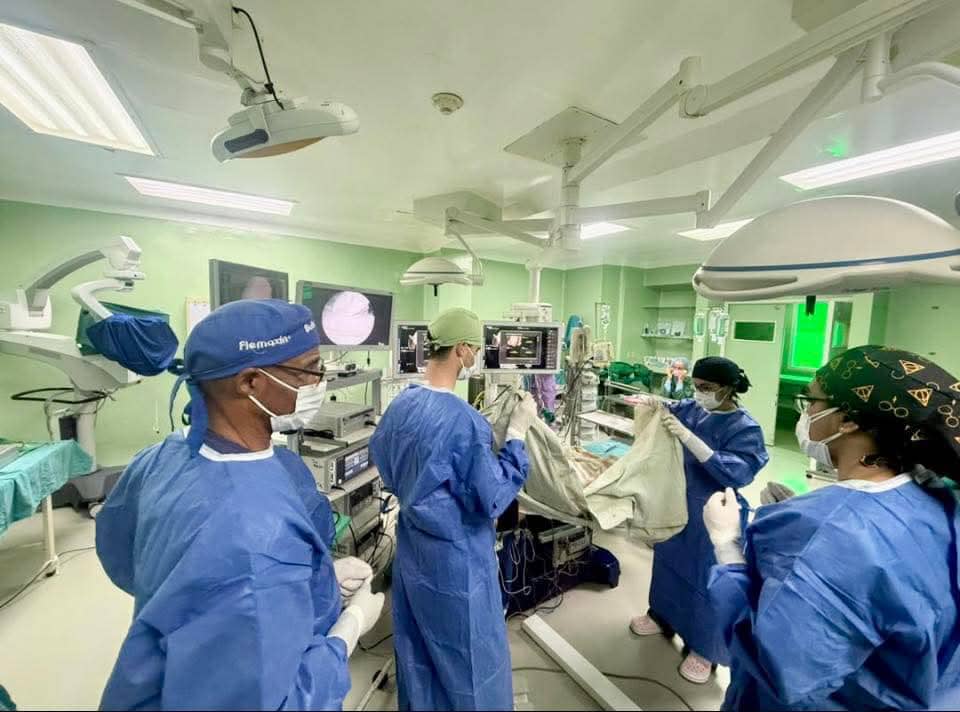
He could see better. That was one of the first certainties confirmed by the medical staff after completing a skull base surgery, which kept an 11-year-old boy from Las Tunas in the operating room of the Institute of Neurology and Neurosurgery (INN) in Havana for six hours.
Las Tunas, Cuba.– He arrived with a diagnosis of an invasive tumor in the sellar region, extending to the base of the skull, with involvement of the sphenoid sinus and clivus. The complexity of the case immediately activated a team of specialists from that institution and the Juan Manuel Márquez Pediatric Hospital.
The surgical decision was clear: an endoscopic endonasal approach extending to the skull base, minimally invasive, supported by neuronavigation, neuromonitoring, and intraoperative pathology. All of this was made possible, in large part, by the technology installed at the center, where the most complex cases in the country are operated on.
Before beginning, the patient safety protocol was activated. The voice of Dr. Orestes, director of the INN (National Institute of Neurology), set the tone: “Let’s begin. What time is it? Tell me the patient’s name and diagnosis.”
In the operating room, time seemed to stand still. The team included anesthesiologists Misiel, head of the surgical unit, Dr. Lisbeth, and Dr. Meiver; neurosurgeons Lismary, head of the INN service, Miriela, head of the Neurosurgery service at the Juan Manuel Márquez Pediatric Teaching Hospital, and Dr. Carlos Urbina, a Nicaraguan neurosurgeon completing a fellowship in minimally invasive surgery. Behind them was a chain of nurses, technicians, and support staff, rarely seen in photos, but without whom nothing would happen.
At the end, the essential moment occurred: the child left the operating room, extubated. The pediatric intensivist was waiting for him in the operating room itself. The ambulance from the National Integrated Medical Emergency System (SIUM) arrived as planned for the immediate transfer to the Intensive Care Unit of the "Juan Manuel Márquez" Hospital. Everything went smoothly.
The child, who also had visual impairments, reported an improvement in his vision.
Cuban medicine doesn't deny the shortages, but confronts them. In this case, it did so with rigor, discipline, and the effort of many people who, despite increasingly difficult circumstances, such as the lack of transportation, get up early to save a life. It wasn't an operating room epic. It was work. It was science.
(With text by journalist Milenys Torres)