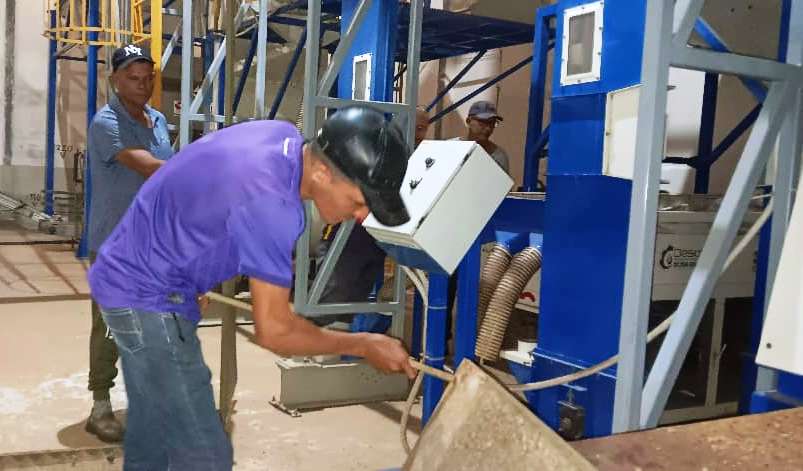
 General view of the Las Tunas Grain Processing, Drying and Packaging Plant.
“The blockade has hit us hard, and as a direct consequence, it’s very difficult to acquire, for example, pedestal bearings, which aren’t just any kind of bearings; greases and lubricants, essential for proper operation.” This is emphasized by José Luis Aguilera Fernández, director of the Las Tunas Grain Processing, Drying, and Packaging Plant, a majestic facility owned by the Agro-Industrial Grain Company (EAG) of this eastern Cuban region, located along the Southern Ring Road in the capital city.
The manager recalls that almost five years have passed since the plant's opening, and that despite the obstacles of the imperial blockade, “We are already exploring options for a major overhaul. Although we lack some resources that were once plentiful but are now scarce.”
He says that “The plant is well-maintained,” and in all its areas, both inside and out, this statement reflects the workers' sense of ownership and their care for the building and the technology, to preserve them from the natural effects of time and use.
Meanwhile, Jorge Luis Rodríguez Coello, from the Maintenance department and secretary-general of the union section, adds that they are currently undertaking general conservation, including painting, and repairs to the structure and the processes. “We are confident in the full recovery of production.”
RESILIENCE: THE KEY WORD
The adaptation of the drying kiln to use biomass —rice husks, marabou wood, and other environmentally friendly fuels that replace the use of energy from non-renewable sources— is further proof of the company's resilience and its search for alternatives in the face of adversity.
This innovation also distinguishes the original project, designed for the improvement of corn and beans, which now allows for the drying and cleaning of rice and chickpeas, as well as "the alternative production of corn flour for human consumption and for native animal feed," explains Luis Ángel Tamayo Ricardo, the plant manager.
Luis Ángel adds that they have also expanded their services, and "now customers can request them from other provinces, including new economic actors. The grains come out of our machines completely clean, shiny, and packaged," he concludes. However, it's an opportunity many producers are missing, and beans are still being sold on stalls, both legal and makeshift, very dirty and full of foreign matter—something that should be prohibited by law.

A BIT OF HISTORY
Although many people considered the investment in a predominantly agricultural region with low production of beans and corn, its fundamental raw materials, a mistake, this plant didn't just appear out of thin air, nor is it the result of improvisation and good intentions alone. It's part of a well-thought-out agro-industrial development strategy with a vision for the future that, until now, has thwarted its founding objective.
The project is part of the Cooperative Rural Development Project for the Eastern Region of Cuba, financed by the International Fund for Agricultural Development (IFAD). In this province, it benefits the municipalities of Las Tunas, Jesús Menéndez, Puerto Padre, and Jobabo, as announced when construction began.
Then the industry's technological package arrived, and “more than 800 irrigation systems were sold at modest prices to the same number of farmers, who, by agreement, undertook the task of planting and harvesting corn and beans for this purpose. They would be, by agreement, its main suppliers,” recalls José Luis.
THE SUPPLIERS?
After about five years of operation, “The irrigation equipment deteriorated, and spare parts for maintenance were lacking. Now many are broken, others were sold to just anyone, and some of the Lombardini motors —the heart of the irrigation system— have gone their separate ways and are used in trendy, rustic vehicles,” says Luis Ángel.
And as if that weren't enough, “Some farmers —initially committed to supplying the system— changed their crops. They no longer plant grains; now, they plant plantains, cassava… which aren't compatible with the irrigation system,” adds José Luis.
The manager explains that the grain processing plant has been largely forgotten lately, and “Anyone in the country might think it’s just there for show. That’s not the case at all,” he emphasizes, defending the survival and practical utility of a unit that symbolizes progress and whose workforce, though diminished by current challenges, will not let it disappear.
THE IMPACT
The plant can process up to 60 tons of grain daily, and “Right now, it’s operating at 20 to 25 percent of its installed capacity. Some workers are on furlough, and we’re maintaining our representatives in the municipalities because we’re still interacting with farmers and buying grain to stabilize production and, as far as possible, meet the population’s demand,” José Luis reaffirms.
“This is happening, adds Luis Ángel, because some agreements are being broken due to a lack of fuel to prepare the land, irrigate the crops, and transport the product. Some of the harvest is also being diverted to other destinations.”
“In 2025, it was inactive for almost the entire year. If we add up the days, we were only working on average for a month, due to a lack of raw materials,” recalls the plant manager.
“In the first months of this year, coinciding with the peak harvest, we processed just over two hundred tons of rice. Of these, 116 tons went to the national reserve, and the rest have been used to protect, in one way or another, hospitals, policlinics, schools,” explains José Luis.