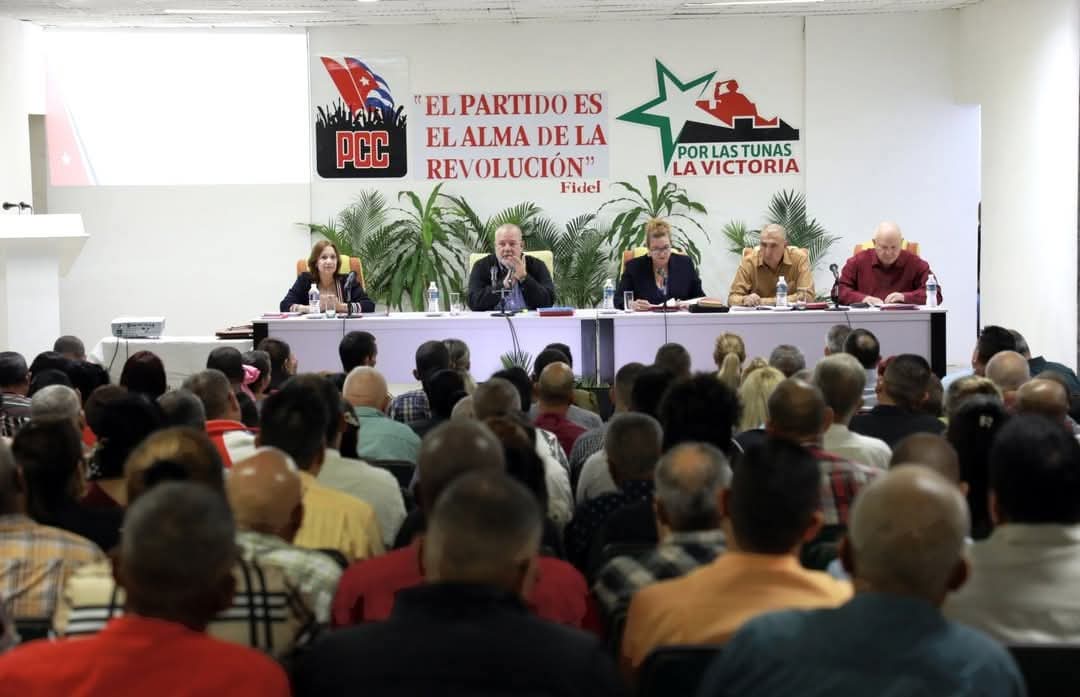
“The Government Program to correct distortions and revitalize the economy is our compass, our roadmap, the guiding thread for our work to solve current problems,” stated the Prime Minister of the Republic of Cuba, Manuel Marrero Cruz, at the extraordinary Provincial Government Council meeting held in Las Tunas, in which highlighted the territory's potential to transform the existing circumstances through integrated work among all stakeholders.
Las Tunas, Cuba.– In his exchange with participants, the member of the Political Bureau of the Party explained that the country has approved regulations and decisions —some not yet implemented— that will contribute to the results projected for this year.
“How do we achieve this? By doing things differently, because we live in different times,” he said, adding that Commander-in-Chief Fidel Castro Ruz was the one who called for constant change on May 1, 2000, through his concept of Revolution.
“We say we are in a war economy, but we don't act accordingly, because we continue with inertia, waiting for things to happen. Our survival and the development of each region will depend on individual and collective effort.”
The Cuban head of government referred to food production as a matter of national security. In this regard, he learned about the province's actions, outlined in the implementation of the agreements from the 11th Plenum of the PCC Central Committee, the 6th Ordinary Session of the National Assembly of the People's Power, and the Council of Ministers, during the analysis of the plan and budget for 2026.
These actions include the establishment of 14 production poles, attention to livestock efficiency indicators, the increase in areas dedicated to rice cultivation, the identification of new exportable products, and the assessment of various crops, among others.
However, Marrero Cruz mentioned existing difficulties in the province that urgently need to be addressed with different solutions. For example, the quality and distribution of water to the population, community hygiene, and the health situation in several municipalities.
He indicated that attention to social centers must be strengthened and criticized the slow pace at which shipping containers delivered to the province are being processed for conversion into housing, a matter of utmost priority, as Las Tunas has accumulated some two thousand families affected by weather events awaiting solutions.
The Prime Minister added that it is imperative to identify the obstacles preventing progress and resolve them. He also reiterated that the U.S. blockade is the fundamental impediment to the country's development, but that this imperialist policy cannot justify the poor performance and inefficiency of some companies.
He insisted that the primary scenery is the municipality. "That's where economic activity unfolds," therefore, "we must understand the needs of the population and the potential of each territory."
He also asserted that governance cannot be achieved through meetings and reports alone. “The real battleground is in the communities, where we must act with truth and great sensitivity, convinced that every day we wage a battle for the benefit of the people and the economy,” he noted.
The Prime Minister commented that more than 3,450 proposals to the Government Program to correct distortions and revitalize the economy were submitted by the various government structures and political and mass organizations in Las Tunas. “Now it’s time to work to overcome the current crisis and do it right, with all economic actors working together and making a greater effort.”
For her part, Ana María Mari Machado, Vice President of the National Assembly of the People’s Power and the Council of State, emphasized that work systems must respond to the priorities of these times.
Several ministers and deputy ministers spoke at the meeting about the potential of the Las Tunas region to achieve self-sufficiency in various agricultural products, the need to consolidate social policies, taxpayer oversight, and the elimination of financial irregularities.
Governor Yelenis Tornet Menéndez gave an account of her administration to the Provincial Council.