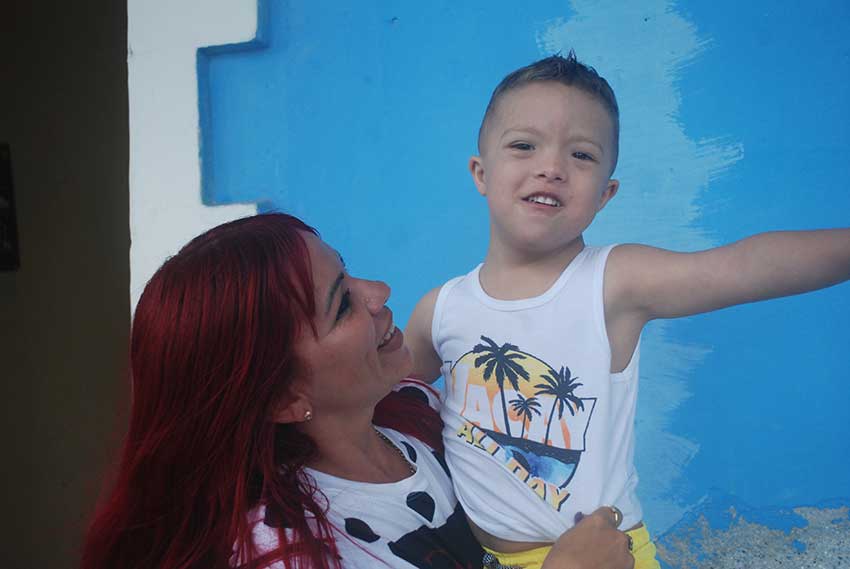
Alexander Orlando Bello Ballagas is three years old. He is a cheerful child, one of those who can enter a room and win everyone over with just a smile. He has almond-shaped eyes, a wide nasal bridge, and a personality that, according to his mother, is identical to that of his father and sister: shy at first, but once he gains confidence, he gives himself completely.
Today, Alina Ballagas Téllez's life has a different hue; she smiles and is grateful for having bet everything on her baby. Those were complex and uncertain days, where every medical opinion weighed heavily on her physical and psychological well-being. Nine difficult months, filled with many tests, failed attempts, and differing opinions, but with the desire and certainty that her child would come into the world.
To carry her pregnancy to term, Alina had to confront her own fear. There was a time when she didn't want to hear the word "loving." Sitting in her living room, this 36-year-old mother recalls the hardest months of her life.
"It was a wanted, planned, and longed-for pregnancy," Alina begins, as if she needs to make it clear from the very first sentence that Orlando wasn't an accident, but a dream come true. However, in the first trimester, an ultrasound raised concerns. The nuchal translucency (NT) scan showed that the baby's nuchal fold was increased. "That's a sign that it could be Down syndrome," she explains.
It was at the Provincial Genetics Center where, at 17 weeks, she underwent an amniocentesis. "They couldn't tell me if there was a 90% chance of confirmation. All the measurements indicated that it was a normal baby, without malformations. They gave me a choice, and we decided to continue with the hope that there wouldn't be any problems." That hope remained intact until the day of delivery. Even before, a team of 10 specialists performed a comprehensive ultrasound. "They measured everything. The baby was normal, the heart was fine, everything was fine. But when Orlando was born, his features spoke for themselves." At first, it was hard, very hard; it hurt, I cried enough to fill an ocean.
They did the karyotype test, the one that would confirm if Orlando had Down syndrome. That test also came back negative. "It was six painful months, six months of waiting, in which one moment I felt fine, and the next I was crying."
"I was afraid of society, because sometimes it's cruel, it knows no bounds. Also, the different opinions among the specialists who treated the child. We would go to the doctor's office, and one would say, 'The child has hypotonia, that's characteristic of Down syndrome.' We would go to the hospital, and they would say, 'Mom, who told you that child has hypotonia? That child doesn't have anything wrong with him.' Then they would say he had a heart problem, and he didn't. A month later, they said he had laryngomalacia, and that wasn't it either. There were many blows."
Six months later, the results we had been waiting for finally arrived: Orlando had moderate Down syndrome. It was that day I understood what was happening. "At that moment I accepted what was happening, and since then I've been happier."
That same day, something happened that completed the circle. The specialist recognized certain distinctive features of Down syndrome in the baby's father. "When she saw him, she said, 'Dad, you don't know that you have certain features of a perfect physical Down syndrome.'" He didn't know either. Nor did they know that the couple's other daughter had those characteristics.
From that day on, Alina and her family made a conscious choice: to raise Orlando like a normal child, without pity, overprotection, or privileges. "He has been raised just like his siblings. When we've had to spank him, we've done it; when I've had to punish him, he's punished. He goes to daycare; he has the same routine as his siblings." He sits at the table to eat with us and eats on his own.”
“Despite medical predictions of developmental delays, because children with Down syndrome often don't walk until after age two, speak late, and have dental problems, he defied all expectations. Before his first birthday, he already had teeth, he was already talking, and walking. Everything was like a normal baby.”
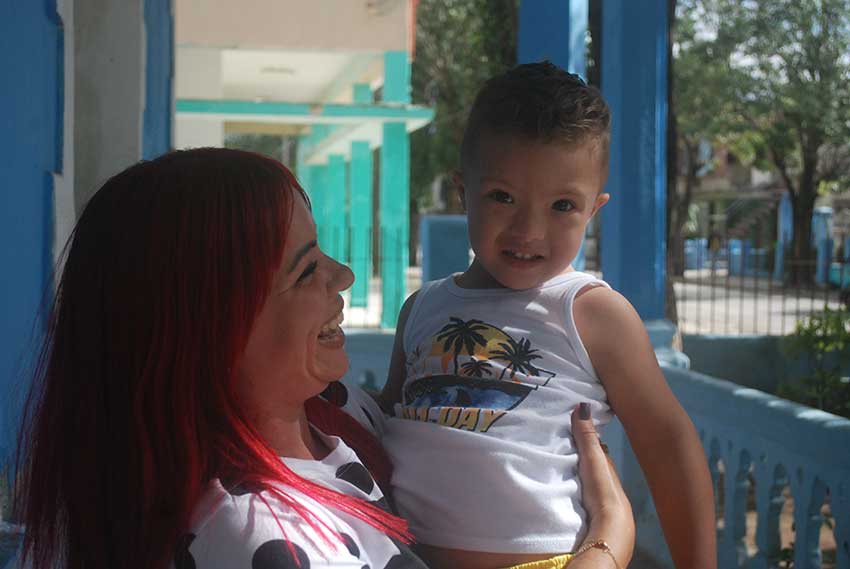
Today, at three years old, Orlando attends the Pequeños Capullos childcare center from Wednesday to Friday. On Mondays and Tuesdays, he receives early intervention services at the Jorge Aleaga special school. “Thanks to the childcare, he became more sociable and independent, and here at the special school, he has undergone a wonderful transformation. The teachers are excellent; I have never seen a teacher mistreat any child. The speech therapist works wonderfully with him, teaching him colors, how to draw... He already knows his colors, he scribbles, and he proudly shows his drawings."
Through the Diagnostic and Guidance Center (CDO), Alina discovered a foundation that changed her perspective: Chromosome of Love, created for children with Down syndrome. "It's wonderful. We meet every month so the children can get to know each other; they do skills activities. That helps them a lot."
But the fundamental pillar, Alina insists, has been her family. "We are very close, very loving. His siblings adore him. The oldest is 14, his sister is 7, and he imitates them in everything. If the girl climbs onto a table, he climbs up. If she says a word, he repeats it." So much so that now, Alina has to watch her language. "I'm forbidden from saying bad words. One day, I let slip 'damn,' and now Orlando repeats it for everything."
This mother speaks with the authority that comes from having gone through the pain and emerged stronger. That's why her message for others who receive a similar diagnosis is clear and powerful.
"It's a painful process, a long one to accept, and if you don't have emotional support, a supportive circle of family and friends, many don't make it, because you can't hide the truth. I remember a phrase that really bothered me from doctors: 'Oh, but they're such loving children.' And I would tell them, 'But I don't want a loving child. I want a healthy child who's well. Don't say that to me, because it upsets me.'"
Today, she laughs at that phrase herself. Because Orlando is loving, yes, but he's also so much more. "He's affectionate and also a bit vain; he likes to be dressed up nicely. I put cologne on him, and he looks at himself and says, 'Wow, handsome!'"
But the most important thing is that he's a happy, independent child who eats by himself, sleeps in his cot at the childcare center, and plays with the neighborhood children without anyone looking at him differently. "They come into the world to be happy," his mother says. "And to mothers I say: don't be blind, raise them like normal children. If you keep them at home out of pity, even if they're sick, even if you protect them, you don't let them develop. If you let them develop like a normal child, life is better."
Today, when Alina looks back, she sees only a worthwhile path. "So many tears I cried and so much laughter he's brought me. To this day, thank God, my child has been a blessing. A child who isn't sickly and who has brought so much joy to the family."
And while the little one plays nearby, oblivious to the storm his arrival caused, his mother sums up in one sentence what she has learned in these three years: "I want him to learn so that when he grows up, he can have an independent life, a normal life. I know he might not have the same life as my other children, but I want him to be happy, not stagnant. We will always work with him and his well-being in mind."
Today, Alexander Orlando, at three years old, with his learned colors and his spontaneous hugs to strangers, is living proof that with love, everything is possible.