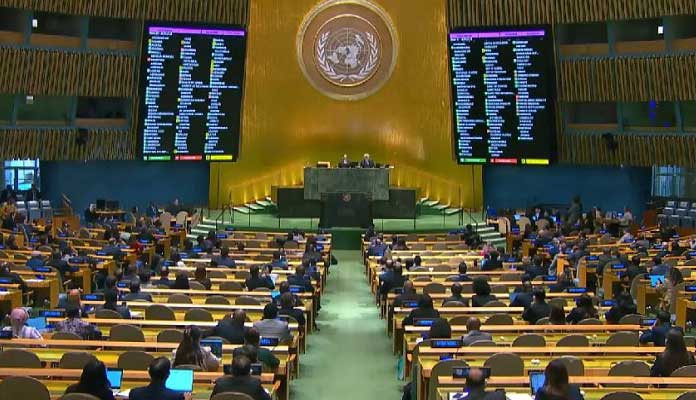
Despite U.S. diplomatic blackmail and pressure, 130 nations voted at the UN General Assembly to demand an end to the blockade against Cuba, reaffirming international rejection of the policy.
Despite diplomatic blackmail and pressure from Washington, 130 countries voted on October 28 in the United Nations General Assembly in favor of the resolution calling for the lifting of the economic, commercial, and financial blockade imposed by the United States against Cuba.
Another 17 voted against, and 25 abstained. The outcome, corresponding to the 34th vote on this initiative presented by Cuba since 1992, confirms that the policy of siege against the Cuban nation continues to lack the support of the majority of the international community.
However, it would be wise not to ignore the signals this vote sends. In 2025, the resolution received 165 votes in favor, compared to seven against and 12 abstentions. The reduction in support and the increase in negative votes and abstentions represent a setback.
This is even more striking given that the policy being denounced has not eased, but rather intensified, with increasingly severe consequences for the Cuban economy and the daily lives of its population.
The fact that some countries that traditionally supported the Cuban demand have changed their stance or preferred to abstain forces a direct look at the reach of the U.S. diplomatic offensive.
Threats and pressure can condition decisions, even when the facts that should underpin them point in the opposite direction.
For two days, dozens of speeches at the United Nations headquarters laid out arguments against a policy that restricts Cuba's development and hinders access to resources, technology, medicine, food, and fuel.
Its effects are not statistical abstractions: they impact households, hospitals, transportation, services, and the development prospects of an entire country.
The Donald Trump administration has intensified this strategy of economic suffocation and raised pressure on third-party states to distance themselves from the Cuban position.
In this context, the vote acquires a significance that transcends the numerical outcome: it also reflects the extent to which a world power can go in attempting to condition the sovereign will of other nations.
Cuba poses no threat to the United States or any other country.
It is a nation demanding the right to live free from a policy of hostility that has persisted for over six decades. The General Assembly resolution is not legally binding and, on its own, does not end the blockade. However, its political and moral value lies in making visible a demand sustained by a vast majority of UN member states.
Defending the rights of a people, their sovereignty, and their development opportunities should not depend on the circumstantial convenience of relations with a power, nor remain subject to the fear of potential reprisals.
Some governments have yielded to pressure; others have chosen abstention. The majority, however, once again spoke out for lifting the blockade. There are 130 countries maintaining, with their vote, that political differences do not justify the economic punishment of a population nor authorize imposing conditions from the outside.
That position does not solve Cuba's difficulties, but it prevents presenting isolation as an accomplished fact and serves as a reminder that the legitimacy of a policy is not measured by the ability to impose it, but by the recognition it deserves before the world.
The Cuban claim remains standing. And with it, the demand that law, sovereignty, and justice prevail over coercion. (CubaSí)