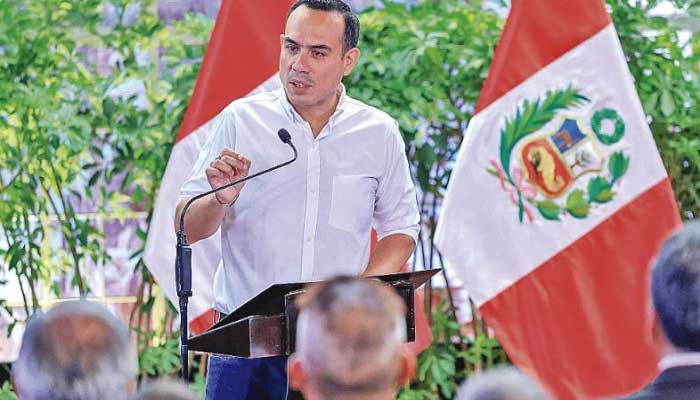
 President José Jerí was dismissed on Tuesday.
Peru's Congress is set to elect a new interim president of the Republic today from among four candidates, following the censure of José Jerí, who was removed from the legislative presidency and thus from the head of state position amid scandals involving clandestine meetings with businessmen and irregular hiring of young women.
Peru's Congress (parliament) will elect today, from among four candidates, a new interim president of the Republic to replace José Jerí, who was censured as head of the legislature, thereby removing him from the leadership of the State.
Candidates for the succession include leftists Edgar Reymundo, from the Juntos por el Perú bloc, and José Balcázar, from Perú Libre, as well as right-winger Maricarmen Alva, from Acción Popular, and centrist Héctor Acuña, from Honor y Democracia.
According to established norms, the four aspirants to exercise the presidency for less than five months will contest a first round from which only one winner will emerge if any achieves half plus one of the votes.
Otherwise, the two most voted will settle the election in a second round, and the winner will serve as president until July 28, when the winner of the April 12 elections assumes the head of state.
Regarding former President Jerí, he left the Government Palace last night after a relaxed farewell gathering with those who were his ministers.
Outgoing Prime Minister Ernesto Álvarez —former president of the Constitutional Court— ruled out that the State has been left headless, awaiting today's election, and stated that the president of Congress, Fernando Rospigliosi, embodies political power, being number two in the official hierarchy.
He added that, as president of the Council of Ministers, he and the ministers who comprise it must remain in their positions, keeping public administration functioning, although without making decisions, pending the new ruler to appoint their replacements.
Jerí was removed yesterday during a congressional plenary session lasting several hours that culminated in 75 votes in favor of censure, 24 against, and three abstentions, despite pressure from business groups opposed to the change and a similar statement from United States Ambassador Bernie Navarro.
The drastic decision was motivated by clandestine meetings Jerí held with businessmen who do business with the State, revealed by the press, and by falling into gross contradictions in his attempts to justify these activities.
Also influencing his removal were the frequent and prolonged visits from young women he received at the Government Palace, who, after those visits, were hired in various state agencies. (CubaSí)