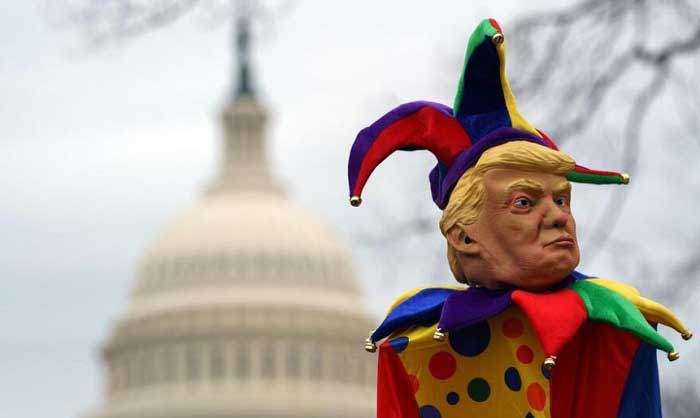
POTUS is the acronym for President of the United States, followed by a number that corresponds to the consecutive term; So, Trump 2.0 would be POTUS 47.
Well, POTUS47 is currently facing serious governance problems, political siege —especially of an electoral nature— seemingly insurmountable economic challenges, and to top it all off, growing international isolation.
Starting with the "breaking news," the conservative Supreme Court's decision to declare illegal most of the tariffs that Trump has imposed on everyone and everything during these almost 13 months. It's still too early to assess the concrete implications of this measure, which could mean he has to return a whopping $133 billion, apparently to importing corporations, or perhaps to American consumers, who, according to the Federal Reserve, have absorbed 90% of the controversial tariffs.
In short, however you look at it, it's the harbinger of a real mess, with socioeconomic repercussions. And well, Trump/POTUS, being Trump, reacted by raising tariffs worldwide to 15%. We'll see how this story unfolds because behind this Supreme Court decision are at least 12 lawsuits filed by governors, all Democrats, who last year pursued what would ultimately be a happy ending for them, politically speaking, and for their party as well.
Paradoxically, the news may offer some relief by reducing the pressure these tariffs have exerted on the Consumer Price Index, i.e., inflation. While inflation, with a 2.7% increase by the end of 2025, showed moderate behavior, it harmed the economy, according to the Federal Reserve. This is because it occurs amid accumulated inflation and alarming fiscal imbalances, which ultimately call into question Trump's promise of rapid, widespread relief accompanied by economic stability.
Speaking of this negative context, and in any case related to it, job growth slowed, increasing the unemployment rate slowly but steadily. In concrete terms, this means there are more than 1 million fewer jobs available, the highest figure in the last 20 years.
On the other sidewalk, where the super-rich live, the situation is certainly different. During Trump's first term, beginning in 2017, he passed the Tax Cuts and Jobs Act, which resulted in significant tax breaks for this small and privileged group, amounting to about 2-3% annually on personal income, adding some $13.6 billion annually to the wealthiest 10% of the country, according to the Congressional Budget Office (CBO).
The Tax Cuts and Jobs Act is set to expire in 2026, but there's no news about it—understandably, since those affected also include media owners. In any case, the law itself made it clear that its eventual expiration does not include the so-called corporate tax rate, the 40% nominal rate, which is a record in terms of tax burden reduction. Thus, the super-rich, who naturally own the corporations, lose a little on one hand, but the lion's share remains. It's almost a joke.
Continuing with this inventory of socio-economic challenges, we must add the sustained increase in external debt, which acts perhaps as the main lever for financing the equally unstoppable fiscal deficit, which, in round numbers, is the highest in the world. While the debt is approaching the equivalent of more than 95% of GDP, the fiscal deficit is the highest in US history, exceeding 5.8%. As is well known, thanks to the so-called dominance of the American dollar, Trump can deal with, or rather, kick the can down the road, a colossal crisis.
This is the core, the economic structure that explains the growing political tensions of POTUS47. And the way Trump has found to address this issue is by generating a kind of induced, coldly calculated violence, like that practiced by ICE against the migrant population, leaving the rest of the citizens, who live in the invaded communities and neighborhoods, as “collateral damage.”
But this singular war against the Latino population has, in reality, a deeper meaning. Deeply class-conscious, Latinos are deeply contradictory, being both indispensable workers and simultaneously artificially despised by the establishment. The reason is simple.
From the Trumpist perspective, it was convenient to make Latinos public enemy number one, not only for sinister racial reasons, which certainly exist, but also because the terror in Latino communities makes it highly unlikely that Latinos will demand labor rights; so any self-respecting Latino earns less for the same work, if you understand the simplified sarcasm.
And it's no surprise that Trumpism champions this fascist policy. Remember that part of the MAGA base consists of agricultural landowners, and even Trump himself is involved, linked in his origins to the real estate and construction businesses, as well as the service sector—precisely the sectors where the most Latinos are employed.
So there's a whole range of social tensions, seemingly traveling at breakneck speed, summarized as increased inequality, a higher cost of living for the middle and working classes, and a state that, like the Titanic, is floundering between gigantic icebergs, such as external debt and a fiscal deficit, with a frankly unfavorable outlook at this point.
And on top of all this, there are the equally unmanageable pressures from the military-industrial complex, which has forced the federal government to choose between maintaining certain benefits, such as support for healthcare systems, or maximizing profits from arms sales, which, according to Secretary of Defense Mr. Hegseth, broke export records in 2025 —something he celebrated alongside Mr. Rubio and Trump, as if they were talking about medicine or baby food.
It's very helpful to put what's coming next into perspective, considering the previous arguments —namely, the midterm elections, which can be likened to a kind of battle of vanities, in the biblical sense of the term, according to Ecclesiastes 1:2.
The contest between the two main contenders, Republicans and Democrats, follows a series of state and local elections where, as a predominant indicator, a Democratic candidate has always prevailed. Among them are some very high-profile figures, such as the current mayor of New York City —a socialist, they say, in the capital of global capitalism— and even a former CIA officer turned governor and spokesperson for progressive values—unbelievable.
It’s certainly premature to speculate, with any degree of accuracy, on what the results of these elections, scheduled for Tuesday, November 3, 2026, might be. Many things can still happen, and the betting is on what more POTUS47 can do to derail his party, thereby losing its majority in the House of Representatives, and, with good luck for the opposition, also securing the elusive majority in the Senate.
When asked how Trump is facing this likely defeat, which, according to him, could even lead to impeachment, he is naturally doing what he usually does: trying to circumvent the established rules. Hence, he has already invented a law to reformulate the traditional rules of the game, that is, the state system for organizing the election, blaming, as usual, supposed waves of undocumented immigrants who "vote" for the Democrats.
And we won't delve into the Jeffrey Epstein saga here, because it's a soap opera that's part of the aforementioned war of vanities, which has ended up being an impressive Zionist-style espionage story, as we know, where respect for children's lives is nonexistent in any of its forms. And, as could be expected, POTUS47 also appears in thousands of files.
In any case, it remains to be seen how this scandal will impact the fundamentalist Christian base that swarms in MAGA, and it wouldn't be surprising if this matter becomes intertwined with the many others surrounding the president, who holds the record for the most legal cases among all the US presidents who preceded him.
Addressing the Trumpian mess in foreign policy at this point would surely contribute to a better understanding of the immediate future of POTUS47's misrule. But strictly speaking, and without belittling its importance, history shows that, except on rare occasions, this issue doesn't appear in voters' minds, or perhaps with much less intensity.
Of course, as already explained, there’s a rejection of military adventurism, something that is certainly agreed upon in MAGA, but it's not usually due to anti-imperialist scruples, but rather because there's a feeling that these kinds of warmongering policies bring more harm than good, to put it bluntly.
Along the way, constant and controversial polls appear showing a sustained trend of declining popularity for POTUS47; his approval rating hovers around 35%; even on immigration policy, after the "excesses" of ICE, the majority also disapprove. 50% reject the White House occupant.
In this regard, and beyond the enthusiasm these figures provoke, prudence is suggested. After all, subjectivity and the politically motivated behavior of polling companies also play a role in this matter. Remember, Trump has already won twice, when the "most respectable" polls and common sense indicated otherwise.
To put it briefly, and beyond the climate of Trumpian confusion, one of the hallmarks of this administration, it seems the American far right, which bet on an undeniable resurgence of imperial grandeur, has encountered numerous obstacles in achieving it. The world is different, and American society needs a reset, but certainly not in the direction the decadent plutocracy expects, beyond the buffoonish king, POTUS47, whom they put in charge of the "rescue operation." (CubaSí)