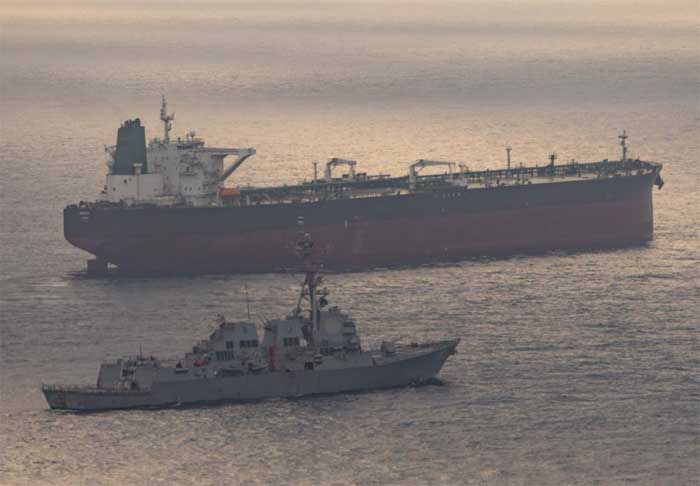
United States Central Command Commander Admiral Brad Cooper explained why Washington has not reopened the Strait of Hormuz despite asserting that Operation “Epic Fury” achieved its objective of “significantly degrading” Iran’s military capabilities.
During testimony before the United States Senate Armed Services Committee, the military official stated that Iran’s drone and missile industrial base, as well as its navy, had been degraded by 90 percent. “My professional assessment is that Iran will not restore its navy to previous levels for an entire generation,” Cooper emphasized.
Although the admiral argued that Iran’s weakened military capabilities no longer pose a major threat to the United States or its allies, he acknowledged that Tehran still retains sufficient power to intimidate commercial vessels and neighboring countries.
“Iran’s ability to disrupt trade through the strait has been drastically reduced, but its voice is still heard loudly, and those threats are clearly perceived by the commercial and insurance sectors,” the Admiral explained. “It is a very large country and still retains some military capability,” he admitted.
At the same time, Cooper stated that the United States possesses military options to reopen the Strait of Hormuz, but stressed that such a move would ultimately be a political decision made by U.S. leadership.
Mutual Naval Blockade
Although nearly forty days of intense hostilities ended with a ceasefire between the United States and Iran on April 7, tensions remain high due to failed peace negotiations, continued verbal exchanges, and the mutual naval blockade affecting commercial shipping between the Persian Gulf and the Arabian Sea.
In early May, Iranian forces again warned commercial and oil tankers against transiting the Strait of Hormuz without prior coordination with the armed forces, which currently control the strategic maritime route.
Iranian forces initiated a partial blockade of the Strait of Hormuz in response to what Tehran described as an unprovoked joint aggression by the United States and Israel against the Persian nation. Iran is currently advancing legislation that would impose transit tolls on vessels using the waterway.
On May 9, officials from the United States Central Command stated that the naval blockade against Iran ordered by President Donald Trump remained fully in effect, later adding that 65 commercial vessels had been diverted and four others disabled. (CubaSí)