

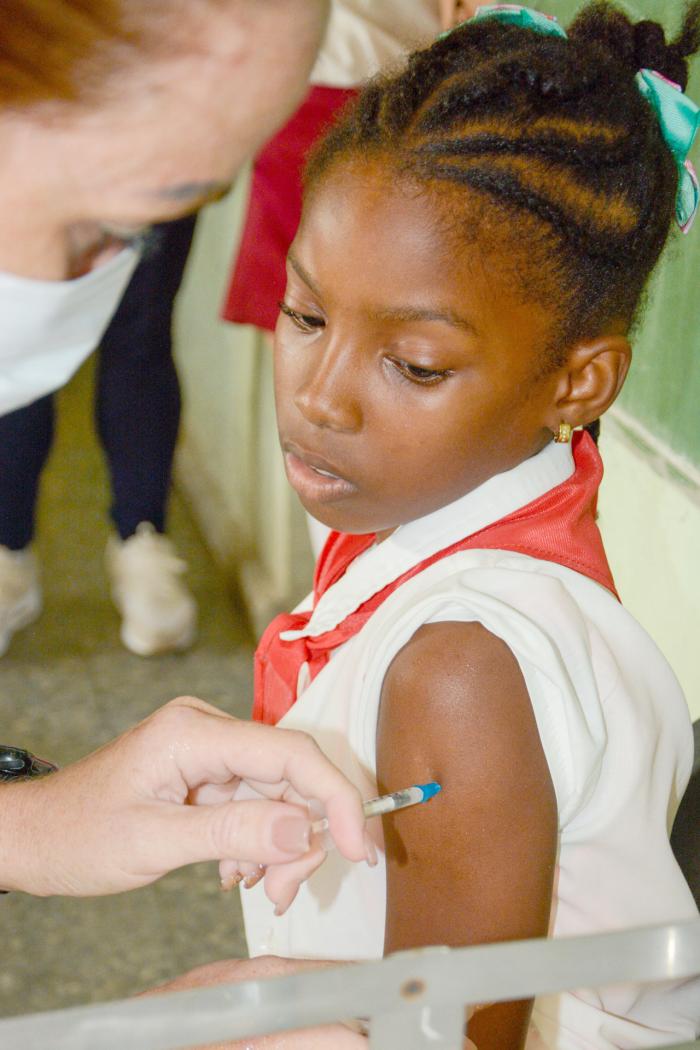
The Cuban Ministry of Public Health, with PAHO/WHO endorsement, has incorporated the Cecolin vaccine against Human Papillomavirus (HPV) into the national immunization schedule.
This is a key preventive measure to eliminate cervical cancer; it began last October and plans to immunize more than 68,000 girls throughout the country.
The Ministry of Public Health responded to the most common questions from families about this campaign, which aims to create a protective barrier for the entire community.
– Is this vaccine safe and effective?
–Yes. The Cecolin vaccine, produced by the Chinese company Innovax, is safe and effective and has been prequalified by the World Health Organization (WHO). The immune response it elicits is stronger than that of a natural infection, providing solid and lasting protection.
– What if my daughter is sick on the day of vaccination?
– If the girl has an acute infectious disease (such as fever, or if she has Chikungunya at that time), vaccination should be temporarily postponed. It is recommended to wait until she recovers. If she has already recovered from a disease such as dengue or Chikungunya, she can be vaccinated without any problem.
– Do vaccinated girls acquire real immunity against HPV?
– Absolutely. The HPV vaccine provides effective immunity and is a fundamental tool for cancer prevention. It specifically protects against the most common high-risk types of HPV, preventing infection that could lead to cancer years later. It is a health decision that looks 15 or 20 years ahead.
– At what age will girls be vaccinated and where?
– The vaccination is intended for all girls who have reached the age of nine at the time of vaccination. It will be administered nationwide in three main settings: in elementary schools (with medical personnel present), in all polyclinic vaccination centers, and in certified peripheral locations in each territory.
For girls in special schools, all nine-year-olds will be vaccinated, regardless of their grade.
Why vaccinate at such an early age if HPV is transmitted through sexual contact?
The vaccine is most effective when administered before the onset of sexual activity, i.e., before the person can come into contact with the virus.
By vaccinating at age nine, we ensure that girls are protected before any possible future exposure, maximizing cancer prevention.
– If my daughter is already 14 and has not been vaccinated, is she unprotected?
– Not necessarily. Vaccinating nine-year-old girls with high coverage has a very positive community effect, known as herd immunity. By creating a large cohort of immune individuals, the virus's circulation throughout the population is significantly reduced, indirectly protecting other age groups. The strategy prioritizes vaccination at the most effective age to break the chain of transmission.
– Will boys also be vaccinated?
In this first stage, only girls will be vaccinated. This is because approximately 70% of cancers caused by HPV are cervical cancers. Scientific evidence shows that achieving high vaccination coverage in girls dramatically reduces the risk of infection for boys, thus benefiting the entire community.
– Can a person who already has or has had HPV be vaccinated?
Yes, they can be vaccinated. There are more than 200 types of HPV. The vaccine does not treat or cure an existing infection, but it does prevent future infection with types 16 and 18, which are the types that pose the highest risk for developing cervical cancer. Therefore, vaccination still offers additional protection.