


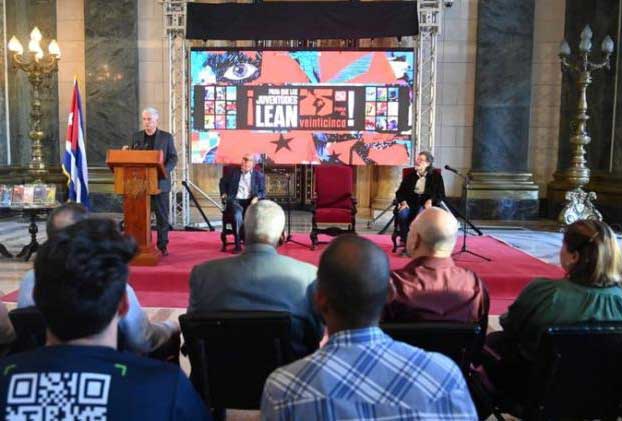
"Take these books and read them alone, yes; but also read them aloud, share them, discuss them, criticize them. Let each book pass from hand to hand until the paper wears out, but the ideas multiply." This beautiful and liberating exhortation was extended this Wednesday by the President of the Republic of Cuba, Miguel Díaz-Canel Bermúdez, to Cuban youth, in an afternoon that would open gates to a sure antidote against barbarism: reading.
The event took place on the occasion of the "25 for 25" project—an initiative of Mexican President Claudia Sheinbaum—which will make it possible to distribute 2.5 million books free of charge to adolescents and young people between the ages of 15 and 30. The special recipients belong to 14 Latin American nations, including Cuba.
The idea took shape this Wednesday from the National Capitol, in the Hall of Lost Steps, when the First Secretary of the Central Committee of the Communist Party of Cuba—simultaneously with the inaugural presentation by his counterpart in Mexico City's Zócalo—launched the educational and cultural project, which is an initiative of the Government of the sister Aztec nation and its Economic Culture Fund (FCE).
Before some one thousand young Cubans gathered in the beautiful Hall of the Havana Capitol, the President stated that when he was invited to speak at the launch of the "25 for 25" project, he said "yes immediately, for three reasons:
First, the initiative came from a sister nation to which we owe and love much. Second: it concerns printed books, with known authors and works and others we would love to read. And thirdly—though it could also be the first—(the project) is conceived for young people between 15 and 30 years old, from several countries of Our America."
"So, thank you for the opportunity, dear Claudia, Paco (Ignacio Taibo II), Ambassador (of Mexico in Cuba, Miguel Díaz Reynoso), and Abel (Prieto Jiménez). Thanks also to the team at Casa de las Américas that embraced this cultural event as its own."
The President told the youth, and a broad group of leaders of the Revolution, that "as an engineer by training, I am passionate about technology and enjoy the tremendous advances taking place every day in the digital world, but I have never been able to detach myself from the love for printed books, nor from the emotion of reading, turning the pages eagerly to absorb the knowledge they contain."
"I think," he affirmed, "that there is nothing like a good book to unleash the imagination. And if it is a printed book, the pleasure of reading is then added to the pleasure of treasuring ideas and phrases with which you deeply identify, to the point of marking them in those books that age by your side, full of notes."
"We must thank the government of Mexico, its President, and particularly Paco Ignacio Taibo II, who knows Cuba so well and to whom we owe such good books, for including us in this beautiful project," emphasized the dignitary, who noted that the act "is an act of justice with the Cuban Revolution and its historic leader, Commander in Chief Fidel Castro Ruz."
Díaz-Canel Bermúdez then recalled what Fidel said in his eagerness to promote reading as a fundamental source of knowledge: "We do not tell the people to believe. We tell them to read," the Guerrilla Giant had expressed.
"From that will," recalled the Head of State, "one of the first cultural institutions of the Revolution was born on March 31, 1959. I speak of the National Printing House, whose first book is none other than 'The Ingenious Gentleman Don Quixote of La Mancha,' by Miguel de Cervantes Saavedra, with illustrations by Pablo Picasso and Gustave Doré."
"In that printing house, directed by Alejo Carpentier, a genius of our letters, the primers and basic texts of the great Literacy Campaign were also printed, which in less than a year turned Cuba into a territory free of illiteracy and forever into a nation passionate about reading and always thirsty for knowledge."
The Cuban President shared this, one of the most beautiful passages of the Revolution: "Those who lived the effervescence of those days recount that when the Literacy Campaign was being prepared, in a public speech, Fidel promised to reward those who became literate and wrote a letter to the Ministry of Education in their own handwriting. The prize was a book on the History and Geography of Cuba, and some notions of the world."
The President dedicated part of his reflections to Fidel and his tireless battle to constantly elevate the culture of the people. At another point, he stated that he had extended himself a bit in his words, assuming the declared purpose of the "25 for 25" project to bring young people closer to the taste for reading, not just out of school obligation: "Know that leaders like José Martí and Fidel Castro managed to possess an encyclopedic culture that dazzled their contemporaries, thanks to books," highlighted the Head of State. He then emphasized:
"Fulfilling their dreams, the Cuban Revolution has not ceased to stimulate literary creation and production, from that National Printing House that transformed into the Cuban Book Institute, to the very revolutionary provincial publishing houses, the book campaigns and fairs, which over time have transformed into authentic festivals of the book and reading throughout the Cuban archipelago."
Díaz-Canel commented that, as explained to him about the project, one of its objectives is "to dispute part of the time of young people who today concentrate almost entirely on social networks, video games, and brief audiovisual content—and increasingly many of them more banal and simple—offering them a truly uplifting alternative."
"It is not, of course, about prohibiting recreational activities, but about opening new paths in the appropriation of knowledge and demonstrating that literature can be fun and excitingly intense until reading becomes an attractive option and not a school obligation."
"Without a doubt," stressed Díaz-Canel, *"this collection can have an important impact on the youth of Latin America and the Caribbean, especially regarding access to books and contemporary and 20th-century Latin American literature, by removing one of the strongest barriers to reading in less developed countries: the cost of the book and the lack of well-stocked libraries."*
"The gratuity of the project opens the possibility for adolescents and young people who have never been able to buy a book in some countries, by a Latin American author, to physically have it in their hands and share it with their peers."
In the President's opinion, "another indisputable success, coherent with the project's own policy of gratuity, is the distribution strategy, in schools, universities, cultural centers, reading rooms, and all kinds of related collective spaces, favoring its extension and reach."
For these reasons, the Cuban President said he felt very honored to "give the starting signal for the beginning in Cuba of the project," an idea he described as "a bridge of paper and ink that unites the youth of our America."
Regarding the friendship between Mexico and Cuba, the dignitary assessed that "we share a history of centuries, of struggles for independence, social justice, and the dignity of our peoples, in the course of which a culture of so many and such diverse links flourished, that in not a few cases it is impossible to differentiate what passed from Mexico to Cuba, and what from Cuba to Mexico."
The Head of State asserted that "these books that Mexico today places in the hands of Cuban youth give continuity to that heartfelt and profound dialogue of so many centuries."
"25 for 25" is born, according to the President of the largest of the Antilles, with a simple and powerful conviction: "The youth of Latin America and the Caribbean deserve to have books in their hands, not just in display cases. They deserve stories that speak of their neighborhoods, their pains, their hopes; voices that dare to question, to imagine other possible and better worlds."
"Each copy of this collection," he added, "is an invitation to look with different eyes at the past and present of the region. In these pages, there are dictatorships and resistances, loves and losses, rage, and also tenderness. They are books written by Latin Americans who dared to say no to injustice and yes to the dignity of the peoples."
"Thank you, sisters and brothers, for including us in the project. By starting it here, the place of Cuba in the political and cultural history of the continent is recognized, but there is also a bet on its future, on the young people who today study, work, create, and resist on this Island," emphasized the President, who at another point stated that "reading is not a luxury nor a school punishment; it is a right and a form of freedom."
"Each page is a question that no one can answer for you. Each story is an opportunity to imagine how you want the world you are going to live in to be."
"Today, as we launch this campaign, in Cuba we call on schools and universities to turn these books into workshops, reading groups, and spaces for critical dialogue." He also mentioned libraries and cultural centers, to bring the books "to those who have never had a book of their own;" to families, "to accompany their daughters and sons in the adventure of reading;" And, above all, the young people, "to make this collection their own and turn it into part of their own history."
"Thank you, Mexico, for sharing with us the transformative power of books!" Díaz-Canel Bermúdez said towards the end of his remarks.
When sensitivity is paramount, almost everything is moving. That is why it was gratifying to hear in the preamble to the President's speech, the president of Casa de las Américas, Abel Prieto Jiménez, who expressed that this idea of giving away books is very beautiful when there are others in the world who give away bombs. "Books and not bombs are what humanity needs," highlighted the prestigious intellectual.
For his part, the Ambassador of Mexico on the Island, Miguel Díaz Reynoso, highlighted that the number of young people present and such a majestic place was exciting. The event, he said, distinguishes the affection Cuba feels for Mexico.
The diplomat spoke of the transcendence of giving privileged space to books, to culture, to hope; he conveyed a "very fraternal and very warm greeting" from the first woman President of his nation; and about the texts, he commented:
"They are ours, and the idea is to recover them, reprint them." That will be the case, he explained, so that young people do not forget: "We must reprint what can enlighten us and give us paths of who we are," highlighted the ambassador.
At the end of the launch ceremony, each young person received a free book. It was hopeful to see many of them suddenly stop: seeing them immersed, browsing the copy in their hands, with the purest and most encouraging curiosity in the world. (CubaSí)