

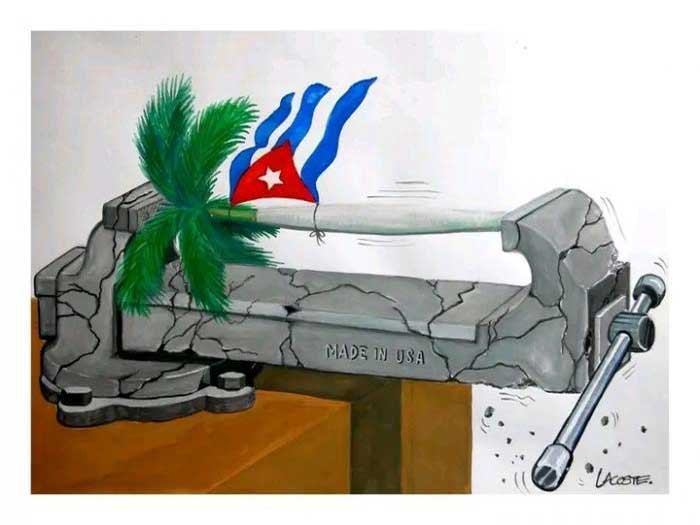
 The new Executive Order presents accusations without supporting evidence as if they were facts. Illustration: Enrique Lacoste
The recent measures announced against Cuba do not respond to real threats to U.S. security, but rather to the persistence of a political model that Washington has been unable to subdue through coercion.
An objective analysis of the Executive Order reveals, on the one hand, its false and unsubstantiated rhetoric and, on the other, the truth about Cuba, supported by international law.
ON THE IMPOSITION OF NEW SANCTIONS (IEEPA ACT)
"The order expands existing sanctions against Cuba to include new restrictions under the International Emergency Economic Powers Act (IEEPA)."
• The IEEPA is an instrument of unilateral coercion. Its application against Cuba violates Articles 1, 2, and 55 of the Charter of the United Nations and ignores the 1992 resolution demanding the lifting of the blockade. There is no real "national emergency" that justifies maintaining an economic embargo for more than 60 years, an embargo that international law classifies as an act of genocide.
"The order imposes new sanctions on entities, individuals, or affiliates that support the security apparatus [...] are complicit in government corruption or serious human rights violations, or are agents, officials, or material collaborators of the Cuban government."
• The accusations of corruption and human rights violations are presented without evidence. Cuba has its own legal system, and its anti-corruption mechanisms are recognized by the United Nations Office on Drugs and Crime. Criminalizing all collaboration with a legitimate government—including health and education cooperation—constitutes an illegal extension of U.S. jurisdiction.
"The order also authorizes new sanctions against affected individuals, entities, or financial institutions that have conducted or facilitated transactions with sanctioned individuals or entities."
• These so-called "secondary sanctions" constitute a flagrant violation of the principle of non-intervention, a cornerstone of international law, and of the right of third countries to economic self-determination. They violate Articles 2.1 and 2.4 of the UN Charter.
ON "COUNTERACT CUBA'S NEGATIVE INFLUENCE"
"Cuba harbors facilities belonging to foreign adversaries dedicated to gathering and exploiting sensitive information about U.S. national security."
• This is a claim without verifiable evidence. No declassified U.S. intelligence report has proven the existence of such facilities. This is a recurring argument dating back to the Cold War, used to justify coercive measures.
"Cuba maintains close ties with other major state sponsors of terrorism, including Iran, and provides refuge to transnational terrorist groups, including Hezbollah."
• Cuba has been a victim of state terrorism for more than 60 years; the more than 3,000 deaths caused by this scourge testify to who the true perpetrators are. Therefore, the designation of Cuba as a state sponsor of terrorism lacks any technical, moral, or legal basis.
"The regime persecutes and tortures political opponents, denies freedom of expression, and actively disseminates communist ideology."
• The State recognizes, respects, and guarantees freedom of thought, conscience, and expression. The rights of assembly, demonstration, and association, for lawful and peaceful purposes, are recognized by the State, provided they are exercised with respect for public order and in compliance with the provisions established by law.
ON "AMERICA COMES FIRST"
"During his first term, the current president reversed the unilateral agreement of the Obama Administration."
• The agreement with Obama established cooperation on issues of mutual interest, such as the fight against drugs, the environment, and regular flights. Reversing it did not produce any progress in U.S. policy toward the island; it only deepened the economic suffering of the Cuban civilian population.
"In June 2025, President Trump increased political pressure [...] to promote a private sector independent of government control."
• The Cuban government has legalized more than 9,000 private micro, small, and medium-sized enterprises (MSMEs) since 2021. According to data from the National Office of Statistics and Information (ONEI in Spanish), 9,550 private MSMEs were operating in Cuba at the end of March of this year. Imposing a specific economic model from abroad constitutes an act of interventionism that violates the UN Charter.
"In January 2026, President Trump signed an executive order imposing tariffs on countries that sell oil to Cuba."
• This measure is a further tightening of the embargo with a direct impact on the lives of the Cuban people. It also affects third countries and has therefore been denounced by governments and international organizations.
The Executive Order mentions the following operations: Absolute Resolve, Southern Spear, Midnight Hammer, and Epic Fury.
• None of these unilateral military operations has a mandate from the UN Security Council. Their mention is intended to create an atmosphere of intimidation. The real lesson is that the United States disregards international law when it suits its purposes.
"The corrupt Cuban regime continues to fuel migration to the United States, with more than 850,000 migrants expected to arrive between 2022 and the fall of 2024."
• Cuban migration is a direct response to the economic crisis induced by the intensified embargo and the incentive provided by the Cuban Adjustment Act, which encourages migration for political purposes. It is false that the Cuban government “encourages” migration: on the contrary, Havana has maintained agreements with the U.S. to control migration flows since 1995.
"Cuba offers a conducive environment for hostile foreign intelligence operations within 100 miles of U.S. territory."
• There is no record of hostile operations launched from Cuban territory against the United States. U.S. intelligence agencies themselves have stated that Cuba poses no greater threat than other countries in the region.
"These actions constitute an unusual and extraordinary threat to U.S. national security and foreign policy."
• This is empty rhetoric; the true state of national emergency, renewed year after year for 60 years, is the economic blockade against a country that has never attacked the United States. The international community has repeatedly denounced it as an anachronism. (Granma)