


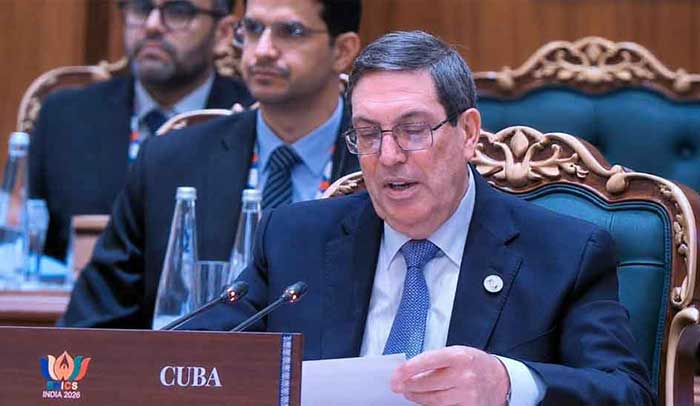
President Miguel Díaz-Canel highlighted today the denunciation made by Foreign Minister Bruno Rodríguez at the BRICS ministerial meeting regarding the tightening of the siege and threats of aggression by the United States against Cuba.
On his profile on the social network X, the President noted that Rodríguez explained during the encounter, held in New Delhi, India, the effects on the Cuban people of the "brutal blockade on fuel supplies."
He pointed out that such actions constitute growing threats to international peace and security and represent a breach of International Law and the universally accepted rules of international trade and freedom of navigation.
During the first day of this meeting, the top representative of Cuban diplomacy rejected in the strongest terms President Donald Trump's Executive Orders against Cuba dated January 29, which imposed an oil blockade, and May 1, which establishes so-called "secondary sanctions."
These latter measures are directed against entities from third countries that operate or have operated with Cuba. Additionally, he cited the supplemental decisions of May 7 by the U.S. Department of the Treasury, which reinforce the blockade against Cuba and its extraterritorial effects to extreme and unprecedented levels.
A #US military aggression against #Cuba will generate a true humanitarian catastrophe, a bloodbath. Both Cuban and US citizens would lose their lives, something which only the politicians who do not send their children and relatives to the war are betting on.
— Bruno Rodríguez P (@BrunoRguezP) May 14, 2026
There isn't the… pic.twitter.com/LGesx6AFVL
Cuba Denounces Threat of Aggression and U.S. Blockade at BRICS
Cuban Foreign Minister Bruno Rodríguez denounced today at the BRICS Meeting of Ministers of Foreign Affairs the threat of direct military aggression and the energy blockade imposed by the United States against his country.
In his speech before the multilateral forum, the head of Cuban Foreign Relations energetically rejected President Donald Trump’s executive orders of January 29 and May 1, as well as the Treasury Department's decisions of May 7, which tighten the economic siege against the island to extreme levels.
Rodríguez explained that the blockade inflicts extraordinary human damage, causing extreme suffering and deprivation for Cuban families. Furthermore, he explained that the energy siege has affected electricity generation, which causes prolonged power outages and difficulties in water pumping, liquefied gas supply, and food distribution.
The Foreign Minister specified that these measures affect transportation, medical services, and the daily life of the Cuban people. He noted that while infant mortality remains low, it has doubled in the recent period, and nearly 100,000 patients, including 12,000 children, are awaiting surgical intervention.
The head of Cuban diplomacy called on the international community to mobilize to prevent a military adventure against Cuba that would cause a humanitarian catastrophe, bloodshed, and the destabilization of the region.
"To produce scarcity, deprivation, and total asphyxiation to provoke a social situation that leads to the overthrow of the Cuban Revolution has always been the true objective of United States hostility," Rodríguez stated.
Despite the adverse context, the Foreign Minister highlighted that the Cuban people have shown unity, determination, and a great capacity for resistance. "In just over a year, with the support of nations like China, Russia, Vietnam, and India, Cuba has achieved sustained progress in terms of energy sovereignty," he emphasized.
The Minister favored the promotion of new cooperation projects to accelerate innovation, as well as the creation of a BRICS repository for science and research at the service of the nations of the Global South.
Rodríguez ratified his country's firm commitment to the defense of international law and the construction of a more just, equitable, and democratic order. He also expressed gratitude for the expressions of support and solidarity from the vast majority of the international community, particularly from the member states and partners of BRICS.
"Count always on our readiness and modest contribution to these legitimate and urgent purposes of the peoples of the Global South," he concluded. (CubaSí)