


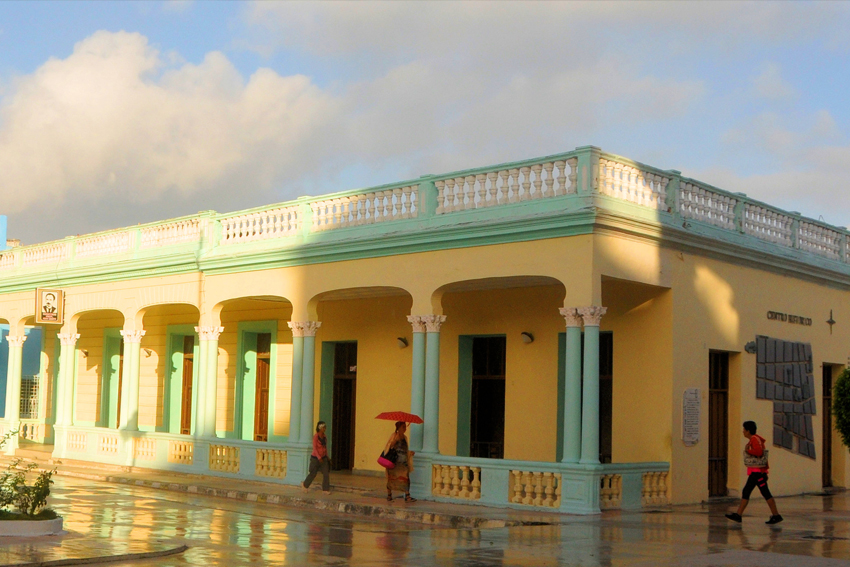
The 1990s were drawing to a close, television screens hadn't yet invaded Cuban homes, and many of us at school enjoyed a special time: the library. There, classics like The Adventures of Tom Sawyer, Old Gold, The Blue Coachman, and others always awaited us, bringing smiles to our faces as we devoured their pages.
We chose what we wanted to read, browsed the shelves, and picked out a book… Glorious days. At home, we didn't have a cell phone; only a few had a Nintendo game. Libraries were packed with visitors, especially on weekends. But times changed, technology gained ground, and today almost all information is available online.
This has happened in most of these institutions. Unless someone is specifically asked to find a book, few people ever set foot in them. Is no one interested in going to these places anymore? Should they adapt to current circumstances to attract audiences?

HAS THE LOVE OF READING BEEN LOST?
The habit of reading, in addition to increasing knowledge, facilitates social interaction, provides fulfillment, and a sense of contentment. Therefore, it is recommended to cultivate it from childhood and promote it throughout all levels of education, with an awareness of the many benefits it brings in diverse aspects, even for managing stress.
We now have tools that allow us to read on digital devices, but it's positive that there isn't so much screen time. However, not everyone sees it that way, and worse, children spend more time on their phones than playing marbles.
To learn about the reading habits of residents of Las Tunas, a survey was conducted via WhatsApp and Telegram. On the first platform, 77% reported reading in their free time, and 74% affirmed that this is a necessary habit. On the second, 60% stated that they read in their free time, and 68% advocated for the importance of this activity. A group that undoubtedly inspires hope.
Meanwhile, 10 readers responded on WhatsApp that reading is boring, and they prefer series and movies. Eight percent of those surveyed on Telegram agree. Through WhatsApp, 58 users opted for digital books. Fifty-two percent of those who responded on Telegram concurred. Given these figures and preferences, libraries, in their original concept, are at a clear disadvantage.
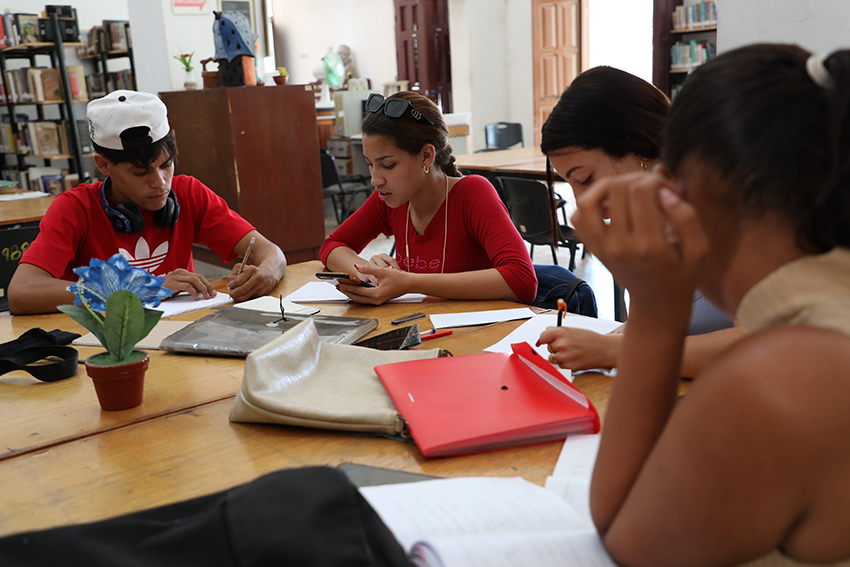
This newspaper also approached students from various grade levels to find out how often they visit these facilities. The opinions are not so different. Ana, a twelfth-grade student, says that “practically, the students only go when these institutions hold a contest. We find all the guidance we need online. A few students from my class go. I go, but not to read, but to study because it's a quiet place. And I barely see two or three students there.”
For Ernesto, reading “is an important habit because of the mental exercise it provides, in addition to its cultural and linguistic contributions.” However, he clarifies that neither he nor his classmates need a library to do it, since “it’s easier to search on the internet.”
Meanwhile, Esteban, a sixth-grade student, states that outside of the designated library hours, very few children visit the library, only some to do homework, and fewer and fewer each time. He admits that at first he went several times because “I liked to read, but not anymore. I think only one person from my class goes; nobody else…”
It’s a practice that is spreading unchecked. We confirmed this when only three internet users stated on WhatsApp that they regularly go to these spaces to borrow a book, while on Telegram, only four percent did so.
For her part, María Magdalena Ruiz Ávila, head of the Information Management Department at the University of Las Tunas, laments how students' desire to visit the library simply for the pleasure of reading has declined.
“Today the library closes at 4:00 pm, but from 2011 to 2015, the lending room was open until 11:00 pm and was quite busy. It's a large room, and many students would wait outside; now, attendance is practically nonexistent.
“Students shouldn't be satisfied with what they learn in the classroom, because there's very little time; they need to explore further. But they only come if they're directed to find a specific book or consult a particular thesis, not to read. Literature books are practically never seen. The other books are only used if there's an extra activity.” “For the last 10 years or so, it’s as if people are only studying on their phones.”
When asked what institutions can do to revitalize their existence, Zoila Nieves Molina Pupo, a librarian with 41 years of service, acknowledges that these centers now face the challenge of new technologies, but they also offer the unique feeling of reading on paper and serve as a meeting place.
“We organize competitions such as Who Reads More Knows More and Read Martí. But students must feel encouraged to participate. We need to hold book presentations, storytelling sessions, and create a vibrant, functional space that cultivates its audience and achieves its objective…
“Teachers must promote reading. There is still much to be done. It’s not about taking children to the Book Fair to see who buys the most, but about ensuring that the books are read and enjoyed,” she asserts.
THE SILENCE OF THE SHELVES
Armando López Carralero, director of the José Martí Provincial Library, reports that there are currently 11 public libraries in Las Tunas (seven municipal libraries, three branches, and the “José Martí” library). At the end of 2025, this network had 21,030 users and 1,244 readers.
“The former is those who go to the library to study, without needing to be registered. The latter are registered and request loans. There are always more users than readers,” he explains. According to data from the Provincial Statistical Yearbook, both numbers have been decreasing considerably for several years.
According to López Carralero, “although this institution currently has three specialized rooms, only one is operational: The Heritage Room. The Navigation Room is also listed, but it remains out of service due to technological deterioration.
“Despite maintenance efforts in recent years, the building's infrastructure is in fair condition. However, the books are in good condition, as restoration and conservation work is systematic. Thanks to this, the books have remained on their shelves according to their classification, and we have a nationally recognized database, created in 2013. We also have a presence on Facebook and X platforms.
“Furthermore, all prisons have mini-libraries, and the collection is updated regularly. Once a month, our specialists conduct a literary workshop that promotes reading and the acquisition of skills in different literary genres. In addition, there are several permanent spaces.”
For her part, Carmen Velázquez Quintana, president of the José Martí Cultural Society (SCJM in Spanish) in Las Tunas and who directed this facility for 21 years, recalls actions taken in the past, examples of best practices.
“In 1980, the National Reading Program was launched, with a strategy to bring reading to different age groups and communities, but people didn't always come to us. That forced us to look for alternatives. That's why the library houses were created here. These were for people who had spaces of this type in their neighborhoods or who enjoyed reading, and we provided them with collections of texts so that they, voluntarily, could involve others."
“This province was a pioneer in this; it operated for nearly 20 years. Then they expanded throughout the country. There were 32 in the province, most of them in the capital city. Unfortunately, that was lost… On the other hand, the ‘José Martí’ library had an outreach area, which fostered initiatives outside the main building.” We had the Baby Libraries, for 3- or 4-year-olds, where we talked to them about books and showed them pictures.”

OF CASES AND THINGS
Analyzing this issue, Carmen notes that—over time—more losses than gains are evident in our region. “The qualifications of library staff have declined, and the staffing levels are very low. The salary and incentives are unattractive. These workers lack adequate training. It's not a matter of locating the book, but of captivating the reader so they visit us and then receive the appropriate attention,” she points out.
She recalls how the art and music section had an extraordinary collection of vinyl records, in addition to slides, artworks, and a specialized bibliography. “Today, practically all libraries in the region have unattractive physical and environmental conditions for visitors.”
“The heritage room here, for example, has leaks, which cause mold, a major enemy. That's terrible; it houses valuable works from previous centuries. Furthermore, we established the country's first tactile lab, which is a computer technology for the blind. But without computers, libraries are nothing now; that's the way to access information we'll never have on paper,” adds Velázquez Quintana.
Carmen is enveloped in nostalgia for those times that placed the institution in an active position within the cultural landscape of Las Tunas. The birth, under her auspices, of the Virtual City space, the Book and Literature Fair here, becoming a pioneer in the country in the digitization of catalogs, and having a computer lab with a loyal clientele are among the glorious days the director experienced.
“The purchase of books is another pressing issue. Libraries shouldn't neglect this topic and should allocate part of their budget to it. “There are also outstanding issues regarding promotion,” says this woman, who has been involved in the profession for 42 years.
AFTER THE RESURRECTION OF THE CHARM

Redeeming the vitality and magic that emanate from these spaces must be a commitment of all of society, beyond just their creators. Authorities, directors, students, teachers, librarians, and others benefit from the results, as their proper functioning contributes to a more cultured country. But this will only be possible if we renew the traditional approach with which these centers have been viewed, building a path to attract the public with more creative and contemporary proposals that foster dialogue between institutional priorities and current cultural practices.
If requesting a book is no longer commonplace, and the usefulness of these spaces as places of study persists in the popular imagination, then we must further develop this aspect and use it as a gateway to greater endeavors.
As a cultural institution, it must not let its guard down in communicating with society. In this regard, Velázquez Quintana recommends studying target audiences before any activity, keeping in mind its inclusive nature, and promoting initiatives across various platforms. “Promoting reading is a science,” she remarks.
One option that could be considered at the local level is partnering with private economic actors, taking literary cafés as a model, given the excellent experiences in provinces like Camagüey. Likewise, “it is necessary to change the image of libraries, focus on staff training, leverage technology to promote reading, and expand the book collection.” These entities are an essential part of the Program for the Preservation of Historical Memory, a priority in Cuba, which must be allocated a budget, and this has not been achieved in our country,” the SCJM director emphasizes.
It is not a matter of underestimating technology, nor the cultural changes it imposes, but rather of understanding this terrain well, and finding opportunities, not obstacles, through the renewal of certain paradigms. From the 26th of July Movement, we urge a governmental, institutional, and social perspective on this issue to rescue “dormant” spaces that are necessary for intellectual development. Let us better defend these temples of wisdom that, in the words of Martí, “invite us to think big.”