


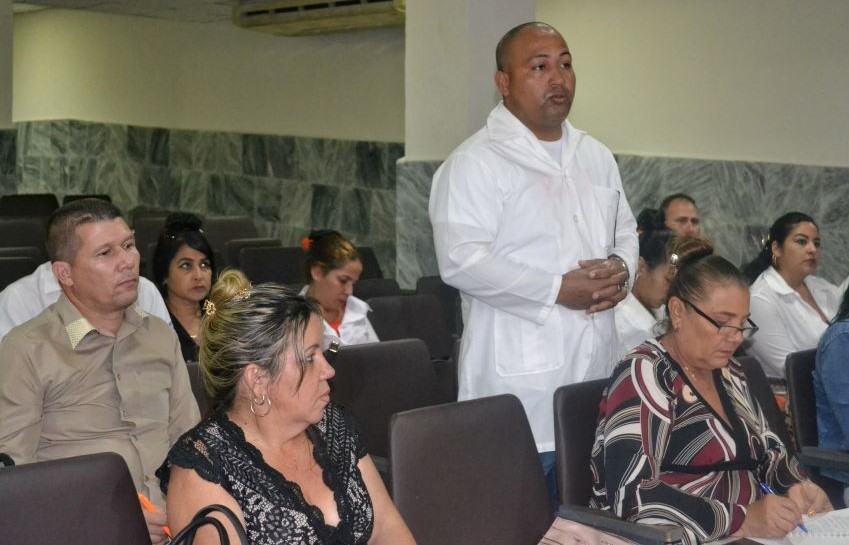
The deterioration of sensitive indicators and deficiencies in administrative management were the focus of exchanges between Osbel Lorenzo Rodríguez, the first secretary of the Cuban Communist Party in Las Tunas, and Yelenis Tornet Menéndez, the governor, with managers and staff from the healthcare sector.
Las Tunas, Cuba.- The meeting not only exposed material shortcomings, but also placed under scrutiny some subjective issues, such as the lack of control, ups and downs in the monitoring of protocols, and the need for a more agile institutional response that would, in turn, enhance the self-sacrificing work of its professionals.
The entities' infrastructure was among the topics evaluated. It was revealed that of 510 clinics, 313 are in good condition, 145 are rated fair, and 59 are poor, with the municipalities of Jesús Menéndez, Manatí, and Jobabo being the most affected.
Delving into the Maternal and Child Program (PAMI, in Spanish), the meeting analyzed the decline in the birth rate. The largest declines were recorded in the municipalities of Las Tunas (-104), Puerto Padre (-85), and Colombia (-40).
Regarding care for pregnant women, it was learned that the 11 maternity homes in the territory face limitations, starting with the number of beds available, due to leaks and a lack of space. Even taking these problems into account, those present considered the current occupancy rate of 84 pregnant women to be low when assessing PAMI's preventive needs.
In relation to the epidemiological situation, the province is in an epidemic zone due to feverish symptoms, although a slight decrease in positivity was reported in the last week.
The workforce to combat this situation is incomplete in all municipalities, and fumigation is not being carried out 100 percent. The municipality of Puerto Padre, declared to be in transmission, exhibits operational deficiencies. In that area, more than 50 percent of the outbreaks are identified in advanced stages.
The issue of fines for health violations sparked a heated debate. With a provincial average of one fine for every 302 homes, territories such as Manatí and Jesús Menéndez report zero warnings of this type, which shows a lack of enforcement and control in the face of the indiscipline that generates outbreaks.
Regarding health transportation, Lorenzo Rodríguez questioned the repair work, citing examples of a lack of monitoring of the quality of the contracted work and delays in the management of components and parts.
The rise in infant mortality since August 2025 completed the thematic core of the meeting. The party leader was emphatic, pointing out that, although there are objective resource problems, there are still shortcomings in how things are done and supervised.
“We must restore the quality of services,” he said, while weighing the value of applying administrative measures when poor work is detected.
The meeting concluded with a call to complete the management structures in the municipalities, to connect more with the grassroots, and to ensure that every resource is used with maximum efficiency and human sensitivity.