

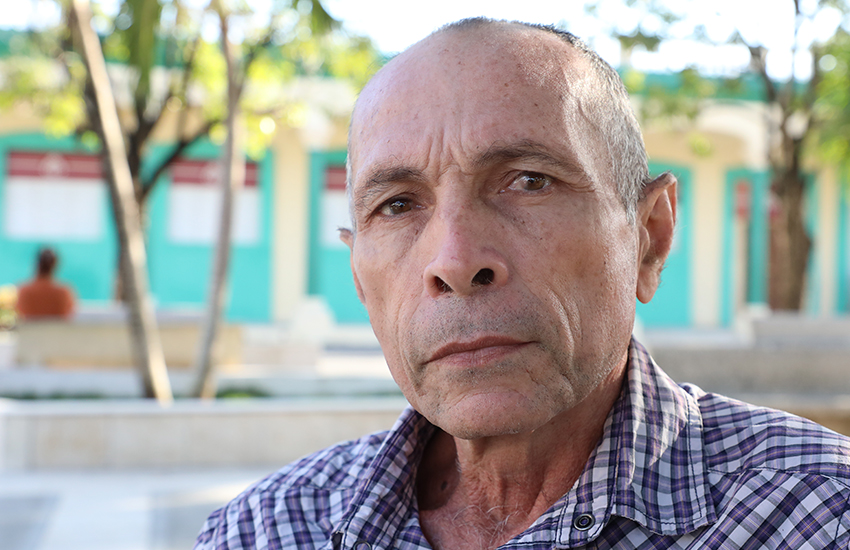
Hyperactive, affable, open to dialogue... that's how I discovered Ridelio Fernández Bodaño, one of those intense days of journalistic work. He has always been passionate about the world of chalk and erasers. He says that this vocation is nothing new in his family, as seven or eight teachers adorn his family tree.
- Ridelio, where does your interest in Pedagogy come from?
On the one hand, from my family heritage. Some relatives were even literacy teachers. My father was a teacher, but he never graduated; he had a certain aptitude for Mathematics. I simply developed this love for teaching.
- How do you remember your studies related to the profession?
I entered the Pepito Tey Pedagogical School in 1978 and graduated in 1982. I was first in my graduating class with a very high grade. I learned a great deal there; I had excellent teachers such as Delio Labrada Torres, Recaredo González, Hilda Robert, Francisco Salcedo…, a very long list. There was also Alfredo Pérez, who was the assistant director of academic affairs. I had the opportunity to observe many classes with him when I was in charge of teaching for the Federation of Middle School Students (FEEM).
One of the moments I remember most fondly was when, in 1981, I participated in a national competition for teaching assistants held in Havana. I presented a Geography lesson. Today, many people associate me with History, but I've always enjoyed that other subject as well.
- What is your ideal class?
The kind of teaching that fosters logical thinking, stimulates reasoning, and leaves a lasting impression on students, not only in terms of content but also in their overall education. Every class has an educational component. Sometimes people think that because it's a Chemistry class, all it needs is to set up an experiment. There are History classes where students get emotional and cry, and the same can happen in Literature or any other subject.
In this sense, I'm a great believer in the power of the teacher's voice. There may be television, computers, and various technologies, but the teacher's voice is essential for learning, because the way something is said enhances its value. Vocal inflections convey moods, values, empathy —a whole range of things— because behind all of this, there's also a psychological component.
It's not just about instruction; it's also about values education. A monotonous class leaves no lasting impression. Sometimes students get bored, or perhaps the class time isn't the most appropriate, and if we don't know how to find the motivation, how to show them the interest in the content, and how to make them feel part of the process, we'll hardly achieve results.
The resources are fundamental. When teaching Cuban History, for example, we might not be able to do a dramatization or show a film, but there's always a chart, and the teacher can illustrate the event so the student can visualize it. We need to revolutionize the classroom so that students feel involved, feel like protagonists, so they can investigate, research, and reach their own conclusions…
- In a way, all subjects complement each other, as they contribute to the final objective. How important it is for teachers to be prepared to interrelate content.
The more they master all the subjects, the more prestige they will have. If you're teaching a Geography class and referring to the characteristics of the Cuban landscape, you should say: "The landscape is V-shaped." That connects it to Spanish, for example. Teachers should be as well-rounded as possible. They can't be brilliant in Mathematics and terrible in Spanish, to give just one example.
- Ridelio, regarding differentiated student attention, we know we live in complex times, and some students come from dysfunctional families or vulnerable neighborhoods. Teachers must be attentive to this…
Teaching is an art. A teacher (at any level) must connect with the student to be their best friend. It's even established that in the first weeks of the school year, teachers contact families and visit their homes. An initial assessment is done so the teacher understands their students' living conditions, surroundings, economic situation… From there, a strategy must be developed to work with these individual needs, encouraging both the bright students and those who unfortunately don't have the same abilities.
For me, parent workshops were very effective. This initiative can be a forum for working with families on behavioral problems, character issues, or educational aspects. I would meet with the parents and outline the new material that would be learned in a given subject. This way, the father feels supported and sees you as a friend.
Similarly, after the midterm exams, we would meet with the parents and give them the test results so each could see how their child had performed. This allowed them to identify areas where the gaps were. There are many ways to connect with families, and this also applies to behavioral issues.
- Do you remember the first class you taught?
Although I graduated in '82, I had been doing my labor practices at the Eduardo Pérez Sánchez boarding school since the previous year. I taught my first class there; it was called "The Seas of Cuba." It was a Geography class, and I remember that I requested to teach it.
- However, although you started with Geography, you have spent most of your career teaching History. What is essential when teaching this subject?
Fidel said that “A people without history is like a tree without roots,” and he was absolutely right. Ignorance of history is a potential danger. One of the many reasons a system can collapse is due to ignorance or distortion of its history. History, especially Cuban History, must be taught dynamically. It cannot be tedious.
- I've heard you've created materials and publications that contribute to better teaching of this subject.
Well, I wrote a compendium of historical dramatizations. It's not the same for a student to read in a book about the Protest of the Thirteen, where not a shot is fired, where there's no military action, as it is for them to see a dramatization of the event so they can recount it. I presented this work at the National Pedagogy Event in 2015. These are events written so that the teacher, using the text as a guide, can stage the dramatization. There are national and local events, 14 in total.
I also wrote a local history booklet, a sort of simple guide for fifth and sixth-grade teachers, so they know what to teach and where to find resources. There's a lesson titled "The Rebellion of the Indigenous and Black People Against Spanish Domination." It discusses the Guamá Rebellion, but that's where the teacher has to ask, "What happened in Las Tunas? Well, in 1533, the Caobilla Rebellion took place in the Jobabo gold mines." Another lesson is titled "The Presence of Women in the Army's War." Mariana Grajales is studied, of course, but Mercedes Varona, Brígida Zaldívar, and others should also be studied.
In addition, I created a set of acrostics, crossword puzzles, and word searches related to local history. These have been distributed to various schools.
- And through your research, you've also delved deeper into events and personalities…
I've conducted several studies. I have repeatedly participated in the Vicente García, Homeland and Honor contest. I have a work called Pancho Estrada, a Man of '68. It is dedicated to the life of Francisco Estrada Céspedes, a combatant from the Céspedes family who was very closely linked to Las Tunas. He was a true role model; he died at 29, very young, on the battlefield. He was very close to Vicente García, whom he adored. I have also created PowerPoint presentations on local history, which include text, images, tables…
- You were recognized as an Illustrious Son of the City of Las Tunas, something very important, but you also have other recognitions.
I have the Frank País Order, First and Second Class; the Distinction for Cuban Education; the Rafael María de Mendive Medal; the Special Award from the Ministry of Education; and others. As for the title of Illustrious Son of the City, I don't consider it a recognition of me personally, but rather of the entire Education sector for its dedication. Many workers, despite the country's economic problems, remain steadfast and contribute to society.
- You work now at the Municipal Directorate of Education in Las Tunas. What is your role there?
I've been with this institution since 2017. I serve as the Political and Ideological Work Advisor to the General Directorate of Education in the municipality of Las Tunas, and I'm also the Cuban Communist Party secretary for that entity.
- I'd like you to tell me in one sentence what teaching means to you.
More than a profession, it's a way for me to feel fulfilled and useful to society.
…
Ridelio is also a member of the Union of Historians of Cuba (UNHIC) and is always pursuing new projects in his quest to disseminate knowledge about history and general culture. Although he now holds other positions within the vital framework that supports pedagogy, he always cherishes his most intense days in the classroom and shares that knowledge with everyone he can. He knows himself to be a worthy heir to a beautiful tradition that forms, to the highest degree, the foundations of a country.