


Las Tunas began the new school year with provincial teaching coverage ranging from 90 to 92 percent. The Provincial Department of Education has identified a shortage of more than 800 teachers across the various levels of education, with the highest concentration in lower secondary education.
This coverage is also uneven across the province. Jesús Menéndez, Puerto Padre, and Las Tunas face the greatest difficulties, while Amancio maintains a more favorable situation. Jobabo, Colombia, and Manatí also report shortages, although conditions there allow for greater stability in educational services.
In the case of the municipality of Las Tunas, the situation is more complex. There, the distribution of teachers requires special attention based on the characteristics of each school and the subjects that must be covered during the school year.
“We currently have an insufficient number of teachers,” acknowledges Magloiris Turruelles López, director of Basic Secondary and Upper Secondary Education in the province.
The greatest impact on lower secondary education introduces another unique challenge. Unlike other levels, students take a wide range of subjects that require teachers with specific training. The absence of a teacher can jeopardize the continuity of a subject within the school schedule and force a revision of the planned organization for the class.
VOICES IN SITU
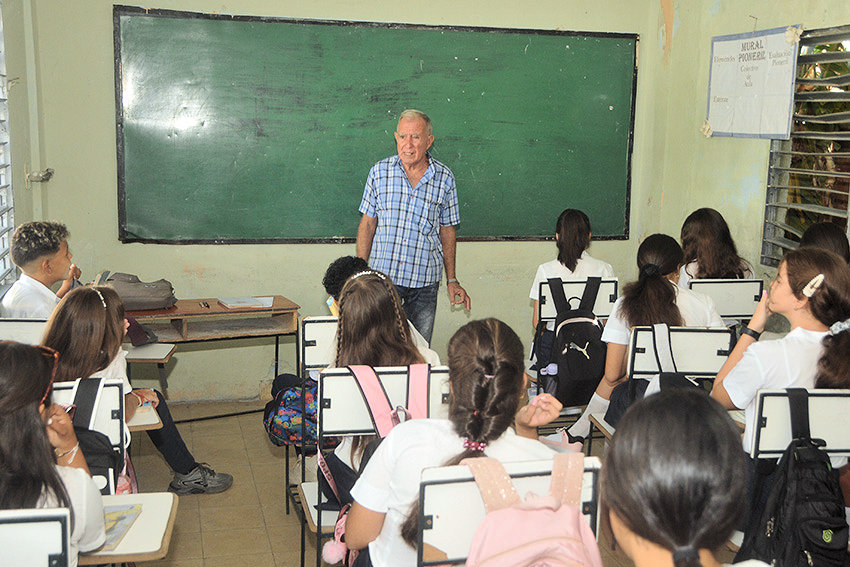
To confirm this assessment, several lower secondary schools in the municipality of Las Tunas were visited: the Carlos Baliño López and Jesús Suárez Gayol lower secondary schools, to name just two examples. Their principals described the teacher coverage situation at each school and the alternatives they are implementing to ensure compliance with the curriculum.
At Carlos Baliño López, the principal, Alexander Torrejón Ramírez, described teacher coverage for the 2026–2027 school year as “quite uneven,” but noted that the school is focused on eliminating any shortcomings that might affect curriculum compliance and progression.
As he explained, the school offers salary incentives in accordance with Resolution 10, which allows employees to receive additional compensation and improves their job performance, as well as their attendance and retention.
In addition to this, there are other initiatives, such as the “Educando por Amor” program, in which college students teach subjects based on their major and area of expertise; the incorporation of personnel from the Revolutionary Armed Forces, who teach seventh and eighth-grade courses; and hourly contracts with teachers from institutions such as GELMA, CITMA, MININT, and others.
“Today, the school is open to collaborating with other educational institutions, demonstrating the improvements being made in the Cuban National Education System,” stated the principal.
“To support instructional coverage, the school recently received all the textbooks required for the ninth-grade curriculum, which are already in the students’ hands. All three grade levels have the necessary textbooks to support teaching activities.
“An additional benefit of this program is the inclusion of fourth-year students from the Rita Longa School of Education, who are supplementing their training in teaching methods, subject-specific methodology, and proficiency in legal documents.”
At Jesús Suárez Gayol Middle School, Principal Itavis Marrero Martínez—who has led the school for five years—painted a different picture. The school has an enrollment of 412 students.
“As for teacher coverage, our school currently has a full faculty with alternative teaching options,” Marrero Martínez stated.
Among these alternatives, she mentioned an hourly contract for teaching Spanish and Literature, which has been in place for several years, and teachers hired under Ministerial Resolution 10 of 2024.
Unlike Carlos Baliño López High School, this institution does not have fourth-year students from Rita Longa School or university student volunteers.
A LONGER-TERM PERSPECTIVE
The teacher shortage in Las Tunas did not arise overnight. It is the result of several factors that ultimately converged in the classrooms. Among them are the economic difficulties the country is facing, the exodus of professionals, and, in particular, the insufficient number of young people entering teaching programs.
“When we’re in a position to encourage students to pursue teaching careers, but they don’t, and on top of that we’re facing an exodus —not just through migration but also from the profession itself— what happens? A huge gap,” explains MagloIris Turruelles López.
The expression is apt, because a teacher who leaves the profession creates an immediate need, while a young person who doesn’t choose to study education creates a future need. When both situations occur simultaneously, the gap widens, and schools must address the present while trying to ensure there will be teachers to fill those classrooms tomorrow.
The province is working on training students from ages prior to university enrollment. Ninth-grade graduates have access to two teacher-training schools where they can train for four years to become intermediate-level teaching technicians. Nearly 200 fourth-year students are already working as teachers and receive more than 6,000 pesos for that work before graduating.
These young people provide a source of teachers for elementary and lower secondary schools. Their entry into the workforce helps alleviate current needs, but it also reveals how much the system depends on ensuring that new generations view the teaching profession as a viable and attractive option.
Las Tunas has 18 pre-university schools and, in collaboration with the University of Las Tunas, carries out vocational training and career guidance programs. Added to this are the teacher-training colleges, where students recruited starting in the 11th grade receive training geared toward the teaching profession.
However, the Department of Education itself acknowledges that enrollment in university teaching programs remains insufficient. “We have to acknowledge it: our young people are not choosing teaching careers, and often their families play a role in this decision by opposing it,” admits Turruelles López.
LOOKING AFTER TEACHERS
This problem also requires us to examine the conditions of those already working in the sector. In recent years, there has been an exodus of teachers and professors—a phenomenon that the administration openly acknowledges. To stem this loss and make better use of available resources, the options for hiring and organizing work have been expanded.
Moonlighting is one such option. A teacher who is available can take on more than one teaching load within their own institution or provide services at another school and receive compensation for that work. The regulations also allow teachers from different levels and institutions to fill needs at other educational institutions.
Flexibility extends to schedules; schools can adapt class times to accommodate the commuting needs of students and teachers. A teacher who lives far away can be scheduled at times that make it easier for them to get to school, while a student with transportation difficulties can join class once they arrive at the school.
In addition to these possibilities, the “Educando por Amor” program brings in college students from various majors to work in schools, even if they are not pursuing a degree in education.
The community thus becomes another resource for the school; knowledgeable parents can contribute to various subjects, just as libraries, museums, and businesses can participate in teaching and vocational training activities. The goal is to expand the sources of knowledge available to students.
The University of Las Tunas has also expanded opportunities for teacher professional development. Education majors can attend classes at university campuses in the municipalities—an option that reduces travel for those living far from the main campus. Graduate education remains accessible as well, with opportunities to pursue master's and doctoral degrees.
DAILY FRAGRANCE
While efforts are underway to address the underlying problem, schools must manage the school year that has already begun. In the municipal seat, due to the current complexity of the situation, the Department of Education reviews school coverage and course offerings weekly to redeploy available resources where they are needed.
The strategy even involves reorganizing the sequence of courses. If one school has a math teacher and another needs to cover that subject, the work can be brought forward at one school, and the teacher can then be transferred when available. The goal is to prevent the absence of a teacher from resulting in the absence of a subject.
“What we are absolutely committed to, at all costs, is ensuring that at no point do we have students who have not received instruction in physics or math,” states Turruelles López.
The province also faces transportation challenges. Las Tunas managed to secure the fuel needed to transport more than 2,000 boarding students at the start of the school year and is working to maintain that service. In rural schools, where difficulties may be greater, efforts are underway to ensure students receive meals.
None of these measures alone solves the shortage of teachers. They are responses designed to keep a system functioning that simultaneously needs to regain its ability to train and retain teachers.
“There is only one way to train teachers, and that is to make our students want to become teachers,” he stated.
The province can reorganize its schedules, hire new teachers, transfer teachers between schools, bring in student teachers, and seek support from the community.
But these measures only buy time. The solution that will determine how long the problem lasts lies in ensuring that this time is sufficient to train those who will fill the classrooms tomorrow.