


- As part of his personal efforts to lead various tasks, the Commander in Chief always paid special attention to the sugar harvest, visiting production processes and agro-industrial companies.
The first of his visits to the current province of Las Tunas was on June 7, 1965, when he visited the Antonio Guiteras sugar mill in Puerto Padre and sewed the sack that completed the six million tons produced in that harvest in the country. This Saturday marks six decades since that event.
The process was preceded by the fact that on March 28, 1965, the mill set the production record achieved in 1952, producing 13,520 sacks of sugar in 24 hours. Five days later, in the same time, it produced 14,040 sacks of 115 kilograms. It was the largest amount packaged to date since its founding, an event that brought smiles of joy to the sweaty faces of the workers and a sense of satisfaction to the people who excitedly greeted the feat.
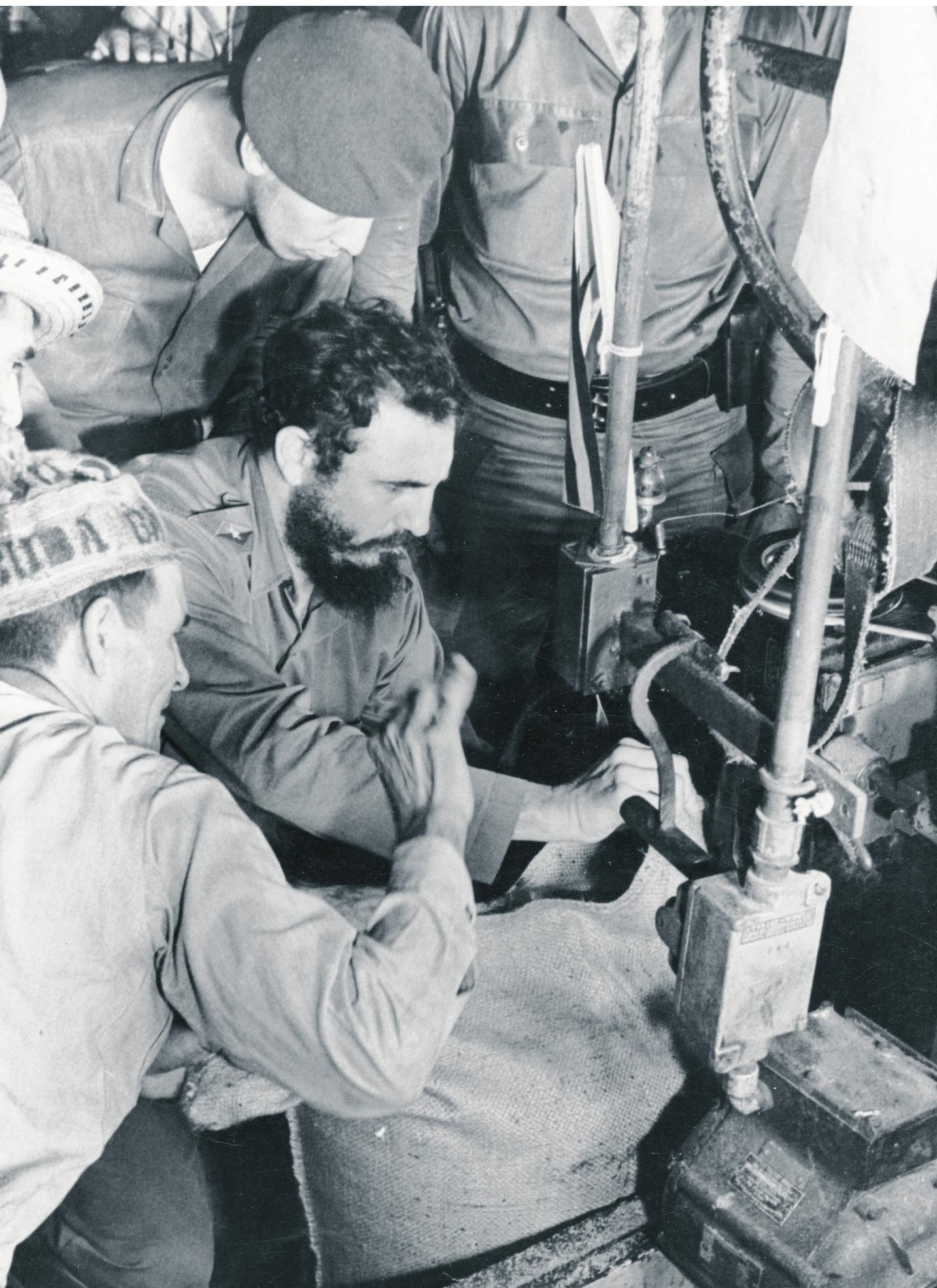
The millionth sack was sewn this time by Commander Armando Acosta Cordero and donated by the collective to the heroic people of Vietnam, as a show of solidarity with this homeland that was selflessly fighting for its freedom.
The country was immersed in the implementation of the sugar production plan, and the motivation for doing so was reflected in Fidel's words at the commemoration of World Proletariat Day that year in Revolution Square, when he announced the expected goals. "During the week of Girón, 103,000 tons more were produced than last year, and this fact decisively contributed to reaching and surpassing the goal of five million by May Day." The commitment was to produce six million by July 10.
On June 7, at the Las Tunas sugar mill, Fidel cooked the 52,173,816th sack, which represented the total number packaged nationwide up to the previous day and marked the arrival of six million metric tons of sugar that morning.
At 6:45 p.m., the sacks were still moving along the conveyor belts to the griddle on the railroad line. The workers impatiently awaited the Leader's arrival and talked constantly about the six million.
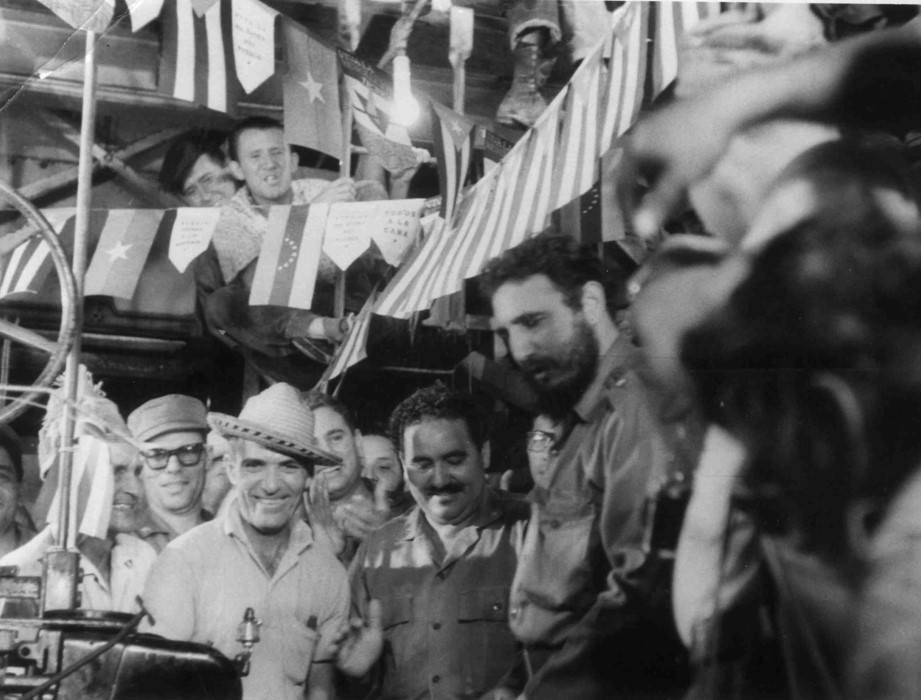
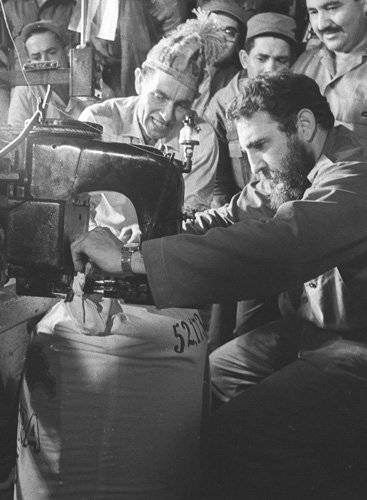
Suddenly, shouts of "Fidel's here, Fidel, Fidel... Long live the harvest! We've reached six million tons..." were heard. These were the voices of the sugar mill staff, standing out among the noise of the heavy machines grinding the sugarcane. They saw the Commander in Chief arrive, who had suddenly entered and placed himself next to the entourage accompanying him under the funnel. From there, he quickly moved to the seat of the sewing machine and began to learn how the sacks were sewn. The worker Israel Peña explained it to him, and the legendary fighter proceeded to experiment with two sacks before sealing the sixth millionth. They were the numbers 52,173,913 and 52,173,915, representing the number of sacks of sugar packaged up to that day across the island.
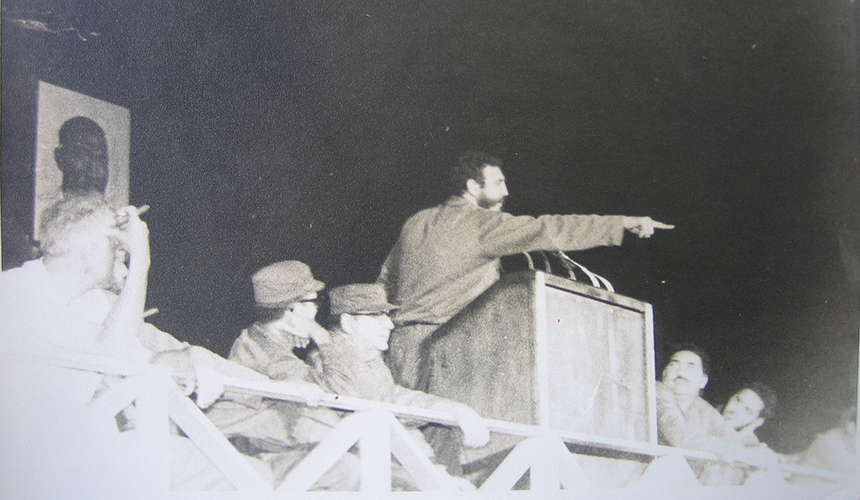
Knowing the correct procedure, and amidst a shower of applause and shouts of greeting, he began sewing the aforementioned sack in front of those gathered. Amidst the applause, everyone followed the rhythm of the ceremony. A microphone had been placed on a sugar plate carried by the workers. The ceremony was taking place in the batey, but Fidel, realizing that some of them could not attend because they were working, climbed onto the plate to address such a large audience.
Accompanying him were Commanders Armando Acosta Cordero, Raúl Curbelo Morales, Eddy Suñol Ricardo, Dermidio Escalona Alonso, Captain Antonio Núñez Jiménez, as well as Jorge Risquet Valdés-Saldaña, Julián Rizo Álvarez, and Antonio Borrego, among others.
Speaking to those present, and amid the joy of the success achieved, he expressed: "When we reach 10 million tons, the excitement will be even greater, since this harvest has been an unprecedented increase; we have no doubt that we will get there."
He was convinced that the "Guiteras" would break his record. With simple words, sometimes typical of rural men, Fidel continued the speech, invited those present to participate in the event, congratulated them, and concluded with the slogan: "Homeland or Death! We Will Win!"
Thousands of workers from the Puerto Padre sugar mill and the "Jesús Menéndez" sugar mill, along with people from Puerto Padre, Las Tunas, and other towns along the northeastern coast, had gathered since early hours on the platform erected in the sugar mill's batey.
Joining him in the delegation were Lázaro Peña González, secretary general of the CTC, and Pedro Ross Leal, first secretary of the Party in the Tunas-Puerto Padre region, as well as the millionaire machete-wielding workers and Heroes of Labor, Graciliano Rondán and Reynaldo Castro Yebra. Present at the meeting were all the machete-wielding workers who had cut more than 100,000 arrobas of sugarcane during the conflict.
Speaking at the event, the guerrilla commander stated: "Many times we have gathered for multiple reasons; many times the people have gathered for different reasons, under different circumstances, in this long revolutionary battle, but rarely as today with a more justified reason for joy and optimism: on the occasion of this success of our workers, to celebrate a triumph achieved with the effort and sweat of our people."
He announced that Cuba was now above the established goal, having produced 6,025,000 tons, 1,000,600 tons more than the previous harvest, without being affected by the consequences of Hurricane Flora. He emphasized that this figure had been achieved despite all the imperialist threats and multiple attempts to sabotage the economy.
"This victory demonstrates that under socialism, nothing is impossible," he stated, adding that it was only now that we were beginning, that from now on, the imperialists would see what an advanced nation was. He reaffirmed that work would be done to produce 10 million tons by 1970 and announced that work was already well underway to expand the sugar mills, with greater milling capacity. At the same time, he analyzed the economic significance that producing 10 million tons would bring to the country in various national sectors.
In his speech, he analyzed sugar production and the country's current circumstances, and outlined the international situation. He called for a dynamic approach to repairs at the sugar mills, preparations to maximize the efficiency of the facilities, and the maintenance of new crops and plantations.
In his speech, he acknowledged the contribution of the machete-wielding workers who had cut more than 100,000 arrobas, including Papi Ramírez, from this northeastern region. "Those everyday heroes, tireless, quiet, modest workers," he emphasized.
Almost at the end, he referred to the calculation made for meeting the six million arrobas. There were different ideas, but everyone was overflowing with enthusiasm. A personal bet was made between him and the Minister of the Sugar Industry. "Don't think it was one of those prohibited bets," Fidel specified. And they bet the clock. Antonio Borrego said it was 2:00 pm, and the man in olive green said it was 11:00 am.
The event occurred at 12:6:06, and the Commander won the bet by 29 minutes and 48 seconds, thus winning the watch. "But," Fidel said, "I don't want to go back to the custom of having two watches (like in the Sierra Maestra), because I don't need them." Considering what to do with the object, he said the fairest course was to give it to a frontline worker. Names began to be mentioned from the audience, and he decided to give it to Graciliano Rondán.
After this exchange, he outlined his views on the work to be done to increase sugar production, the fulfillment of plans, and the work of the collectives, Party members, cadres, and leaders.
His wide-ranging speech concluded with words of foresight: "When we speak of our triumphs, when we proclaim our triumphs, when we look with hope to tomorrow, we look not only for ourselves, but we look also for others; we not only wish this for ourselves, but we wish this for all other peoples, just like us. When privilege, injustice, exploitation, and abuse are eradicated from all peoples, as they were eradicated from our country, all peoples just like us will march forward, and all peoples will have the right to aspire, just as we dream and aspire to a better tomorrow for ourselves and for all other peoples, just like us."