



Special TV appearance of the Minister President of the Central Bank of Cuba.
As reported by the Government of the Republic, the Central Bank of Cuba has worked to create the conditions for gradual transformations in the foreign exchange market, based on principles of gradualness and temporality.
The Cuban economy currently operates with multiple exchange rates for foreign currency, which generates distortions, incentivizes informal markets, and complicates the banking and fiscal traceability of economic activity.
This exchange transformation seeks to restore the convertibility of the Cuban peso, strengthen monetary institutions, and advance in an orderly manner toward exchange rate and monetary convergence.
 A functional foreign exchange market requires a minimum set of conditions, including macroeconomic stability, the operational capacity of the banking system, and a regulatory framework adjusted to current conditions.
The combination of severe external restrictions, an abrupt decline in foreign currency income, the contraction of its supply in the official exchange market, as well as accumulated imbalances, determines the start of the exchange transformation with a gradual and responsible approach.
The strategy, focused on recovering the purchasing power of the national currency, is to concentrate and guide the foreign exchange market by connecting different economic actors —state and non-state— in the production, export, and commercialization of goods and services at competitive prices.
An immediate unification of the exchange rate, without a transition period, could cause a sharp devaluation, with inflationary effects greater than current ones and a deepening of the loss of purchasing power of the national currency against foreign currencies.
International experience shows that in economies with accumulated exchange imbalances, transitional schemes with multiple segments allow for the gradual correction of distortions without severe macroeconomic shocks.
Considering the elements presented, it has been decided to enact, on December 18, 2025, the measures that guarantee the transformation of the foreign exchange market. In this first stage, its structure has been conceived in three exchange segments: two fixed exchange rates—already existing—a Segment I operating at 1 to 24, a Segment II operating at 1 to 120, and a third segment with a floating exchange rate that will be published daily by the Central Bank of Cuba in its capacity as the country's monetary authority.
The decision to recognize a third segment is based on the objective existence of differences between official exchange rates and the real value that reflects the scarcity of foreign currency.
The first two market segments will be maintained in such a way that no abrupt devaluations of the exchange rates and, therefore, of the value of the national currency occur, which allows protecting the population in basic and sensitive operations, preserving stability and predictability in prices of essential goods and services.
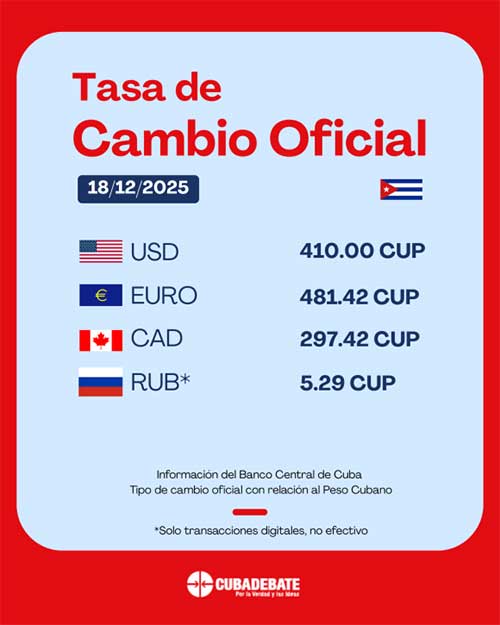 |
| The new measures related to the foreign exchange market come into effect on December 18. |
The third segment, based on a daily floating rate, will facilitate exporters and other suppliers of foreign currency to sell at a competitive price, determined by supply and demand. The aim is to incentivize the entry of foreign currency into the exchange market, which will constitute a source for its operations and reduce the pressures and irregularities of the informal market.
The transformation of the exchange market is integrated into a set of financial, commercial, tax, and other measures, which comprise several simultaneous fronts with the objective of improving the efficiency of the economy in general.
Among the measures to be implemented, the stabilization and progressive strengthening of the so-called MLC accounts stand out, contrary to what some have falsely speculated or claimed. The objective is clear: to strengthen the purchasing power of the MLC and its use value.
As part of this projection, the operability of the bank accounts of non-state management forms will be guaranteed, allowing them to execute transactions in foreign currency both domestically and in foreign trade operations.
I want to conclude by insisting that the purpose is not to substitute one distortion for another, but to gradually close the monetary gaps that affect the economy and families.
The legal provisions that will implement the transformations of the exchange market will be published in the Official Gazette and will take effect this Thursday, December 18, 2025. Henceforth, the Central Bank of Cuba will publish the daily exchange rates on its website.
Exchange transformations are not an end in themselves, but a tool to order the economy and strengthen the financial system. It is a gradual, responsible, and transparent process, in accordance with the specific conditions of Cuba.
In the coming days, we will continue to provide information about these decisions and the processes and mechanisms that will govern them. (CubaSí)